Gift of the Persistently Possible

Just how does one step into the next story? In the liberal arts sense, we do it with thoughtfulness. Thoughtfulness embodied and expressed by people in the careful way they think and in how they care about other people and places.

It’s hard to believe it has been more than a year since my friend, colleague, and sustainability guru Jim Farrell died.  In his honor and for others, I take this opportunity to post some words I shared at the on-campus memorial service.  We all continue to do great work, inspired by those who came before us and who lived and worked with us!

From 25 Sep 2013 – Memorial Service…

I’d like to make an offering, some brief thoughts about Jim, a teacher, mentor, colleague, friend, writer, author and lover of all nature, especially human-nature. This is not the human nature we typically think about when those words are uttered, but the connectivity between human cultures and the rest of Creation. Jim frequently reminded us that we are nature, we are gifts – to nature and to each other, and we are engaged in the continuing, evolving human-nature enterprise as stewards of God’s Creation.

I recall the first time the Sustainability Task Force read, in full draft form, the principles we had been talking about, principles that came to life in words Jim penned to paper. Here is an excerpt about energy. “Environmentally speaking, a college campus is a place for converting natural energy to human thoughtfulness. It’s a place where people employ natural resources to refine and transmit the intellectual and artistic resources we call culture. Like all other colleges and universities, St. Olaf College is an organic machine, where nature’s energy is shaped by nature’s human energy, and vice versa. We think of a campus as a place, a location, a space – and it is. But more importantly, it’s a relationship, where human designs intersect with nature’s designs in food and water, heat and electricity, cars and computers, lawns and gardens and natural lands. A campus is one way of making love to nature – or of making war on it. It’s a way of caring for the Creation. A campus is, like it or not, an ecological design.” All of us were astounded by the conversational character of the writing, the relationship centered core of the story, and the imagery it conjured. It provided the group and campus with fuel to keep doing good work, no matter the obstacles.

Friend and colleague, Jim Farrell.

This pursuit of good work is framed by what I call ‘embracing the cycles’ or the ‘gift of the persistently possible,’ a gift Jim consistently doled out. Rather than lament about a particular situation or become mired in despair and anger, the Daniel Quinn novel Ishmael and the words story and opportunity soon would pop up in discussions with Jim. The narrator says, “They failed because you can’t just stop being in a story, you have to have another story to be in.” A given story might come to a close, yet another takes its place. The challenge is to rise up and recognize the new opportunity, the opportunity to use your gifts and talents to work with others who feel as passionately as you do to unfold the next story. This is jumping from the downcycle into the upcycle which can, at times, feel like you are actually in the spin cycle! Jim consistently encouraged all to step into their next story and to do so with gusto, whether it was students attempting to start an on-campus organic farm, a department trying to develop a revised curriculum, or a friend struggling to make sense of a life-changing event.

Just how does one step into the next story? In the liberal arts sense, we do it with thoughtfulness. Thoughtfulness embodied and expressed by people in the careful way they think and in how they care about other people and places. This kind of thinking and doing is hard work and certainly has its upcycles and downcycles. In parallel we do this as a spiritual journey or leap of faith. Our stories are deeply interconnected – making a tangled web of beauty reflective of God at work in the world. As the earth spins on its axis, meandering through space and time, may we have the courage to embrace our upcycles and downcycles to spin through life and see the gifts of the possible, in each other, in St. Olaf and in Creation. Thanks Jim, for encouraging all to see and practice a different kind of human-nature.
Musings on Green…

During the last two weeks we have enjoyed the Melbourne area during a break, journeyed to Canberra to see Parliament, discussed how environment plays into the political process and we now find ourselves in Sydney. The break allowed us to muse on various “Green” ideas, topics or just free form thoughts. As we reflect back on our first six weeks in country we ask, “Did we need to journey half-way around the world to appreciate how we are inextricably part of nature and to fully appreciate its wonder, diversity and beauty?”

From EnvSci Australia – 17 Mar 2012

During the last two weeks we have enjoyed the Melbourne area during a break, journeyed to Canberra to see Parliament, discussed how environment plays into the political process and we now find ourselves in Sydney.  The break allowed us to muse on various “Green” ideas, topics or just free form thoughts.

As we reflect back on our first six weeks in country we ask, “Did we need to journey half-way around the world to appreciate how we are inextricably part of nature and to fully appreciate its wonder, diversity and beauty?”

Yes.  How can we not see a place where over 50% of the plants and animals are endemic – found no where else on the globe?  Along the southern coast of Victoria, the endemism of marine life is estimated at over 90%.  You can’t find that characteristic of life near home.  The country is dry – usually.  The second La Nina year in a row is bringing

Cafes, including Affogato, along Hardware Lane, Melbourne

mild temperature and lots of rainfall to the SE region, which translated means moving from drought into flash flooding.  Australia is perched in a unique climatic zone, so it is highly sensitive to small changes in global climatic cycles.

No.  Our travel makes an impact.  Certainly the 9500+ miles traveled from Minneapolis to Melbourne left a big carbon footprint, as does our coach travel around the country.  Taking lunches, with all their packaging, also leaves behind a substantive energy and materials footprint.  What can we do to change some of this and minimize our impacts?  Last spring one of my EnvSt seniors did an audit of the program for her senior project.  Certainly, one can apply offsets to our air travel or even do work in and around campus to mitigate this.  We have pushed for more reusable containers and seek out eating establishments that have strong relationships to small, local farms.  One of our favorites in Melbourne was the Affogato Cafe, located on Hardware Lane.  The husband-wife team that operates this place were friendly, welcoming and big fans of the United States, especially New York, San Francisco and Memphis.  Yes, they loved the music scene in Tennessee and the eclectic mix playing in the cafe was a delight to experience each day.  The food was simple and delicious.

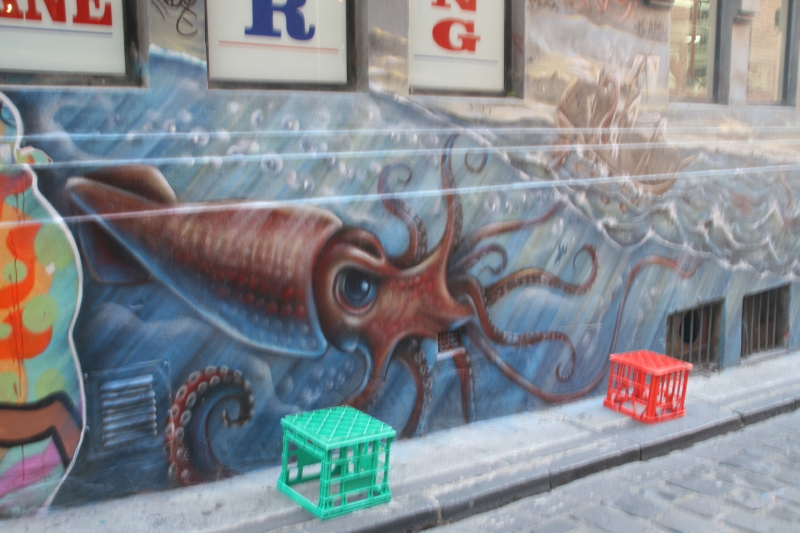
Another prompt to being green was not too far from our QUEST accommodation on Flinders Lane.  Here you could walk about 30 meters to a few alleys filled with what I will call social, public art.  Graffiti artist alter the visual landscape daily – putting layers of spray paint on top of previous work.  This ever changing scene provides social commentary, highlights cultural differences, and expresses profound personal perspectives.  The spray paint is not very green, but the response of other artists, citizens and tourist make it worth the look.

Graffiti art along alley near Flinders Lane, Melbourne, VIC.
Graffiti art celebrates cultural influences and people.
The alley squid with painters crates in Melbourne, VIC


It would be difficult not to end a few green musings with policy.  In Australia the federal government does not have environment or environmental issues written specifically into its constitution.  These responsibilities primarily rest with each state government.  What the Commonwealth does have are constitutional provisions for addressing foreign affairs, trade and international financing as specified by the external affairs section of the constitution (Section 51).  Throughout the last 50 years the Commonwealth has been advancing environmental protection largely through being part of international treaties and multi-national environmental declarations.  This was reviewed on a number of occasions by the High Court and subsequent common law gave the federal government more authority in this area.  Our visit to the Commonwealth’s Parliament House was excellent.  We were fortunate to see “question time” in the Parliamentary system (click link for a comparison with the USA).  The images below show the provisional parliament house (white buildings in foreground) and the current parliament house (background with large flag spire and grassed roof).  Inside the colors and materials reflect the Australian palette.  In particular, the color of the House of Representatives is a grayish blue-green; the leaf color many acaias and eucalypts in Australia.  For example, check out the leaf color of Eucalypts globulus (Blue gum) when it is young.

Looking at both the old and current Parliament House from the War Memorial in Canberra, ACT.
A view from the public gallery into the House of Representatives. Note the “front bench” areas for the government and for the opposition.