Faculty and Staff
Introduction
Many members of St. Olaf became intertwined with the Lutheran World Service to Refugees (LWF-SR). Professors and staff members from St. Olaf went to contribute to the work being done by the LWF-SR in Europe.
Another group within the St. Olaf community connected to this story are the Displaced Persons themselves. Thanks to the assistance of the LWF-SR, many were able to come to the United States and join the St. Olaf Community.
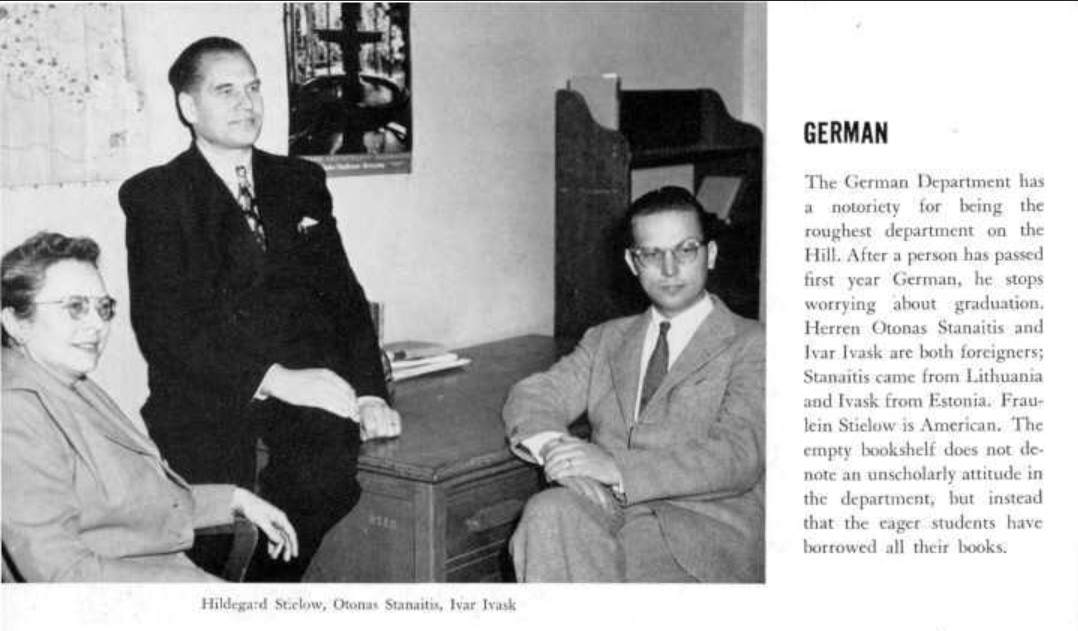
Faculty
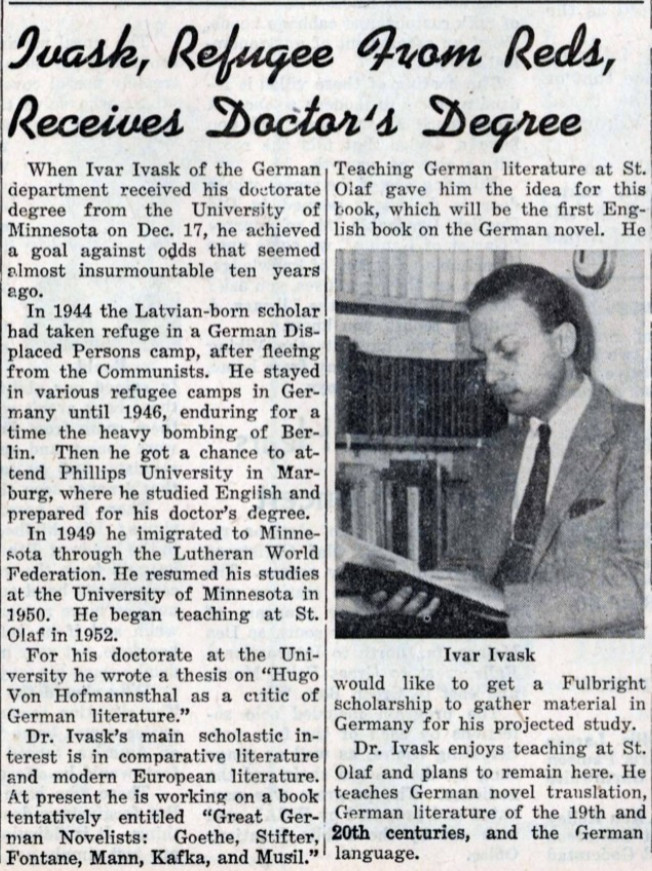
Ivar Ivask
Ivar Ivask was born on December 22nd, 1927, to Friedrich and Ilze Ivask. Growing up, he spent time going between the capital of Latvia, Riga, and a small town in Estonia called Rongu. Ivar Ivask and his family also fled in 1944, eventually ending up in Germany. Ivar was skilled in languages, gaining a degree in German literature, while also being fluent in Estonian, Latvian, and English. He was a student at the University of Marburg while living as a displaced person. After immigrating to America Ivar gained a PHD in German Literature from the University of Minnesota. Ivar Ivask worked as a professor at St. Olaf College from 1952 to 1967. During his life he became an accomplished poet, writing in German, English, and Estonian.1
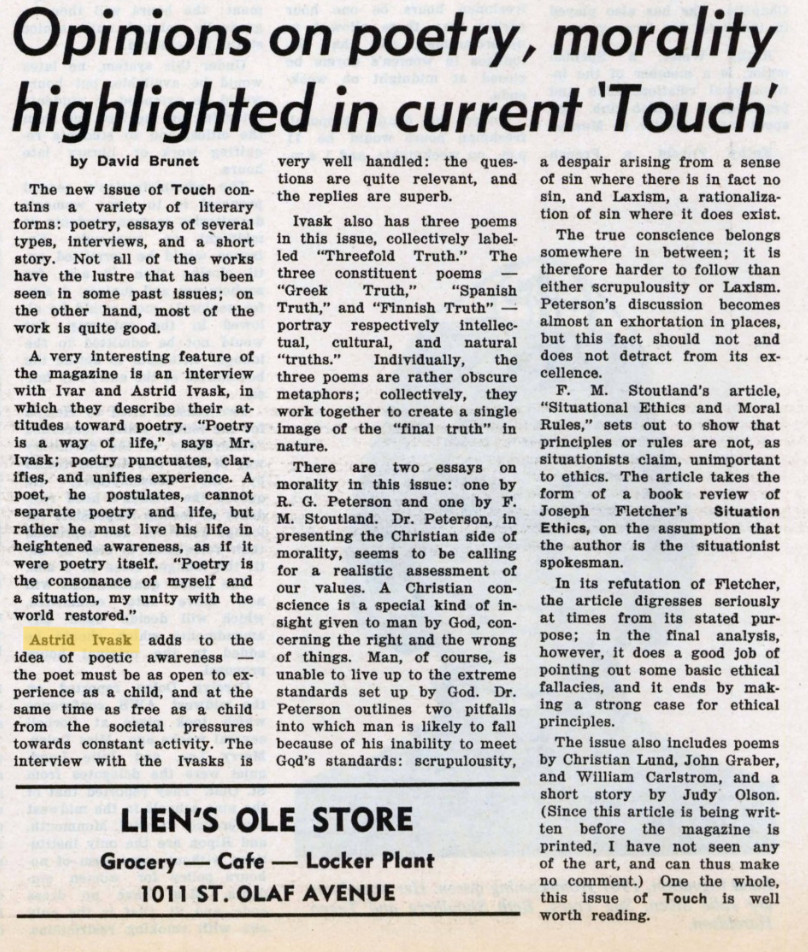
Astrid Ivask
Astrid: Astrid Ivask (nee Hartmanis) was born to Martins and Marija Hartmanis on August 7th 1926 in Riga. Martins Hartmanis was an army general for the Latvian Army, leading him to being deported by the Soviets as a potential threat in 1940. Four years later, Astrid, her mother, and her brother flee the oncoming Soviet army, with the shadow of their fathers deportation and death prompting such action. Astrid was skilled in languages, speaking Latvian, German, and Russian in addition to obtaining a masters in romance languages from Marburg University in 1949. In the same year, she married her husband Ivar Ivask and immigrated to America. Once in America she became an professor at St. Olaf College, working in the Russian language department. Astrid was a skilled poet, writing in English and Latvian, as well as translating poems into other languages.2
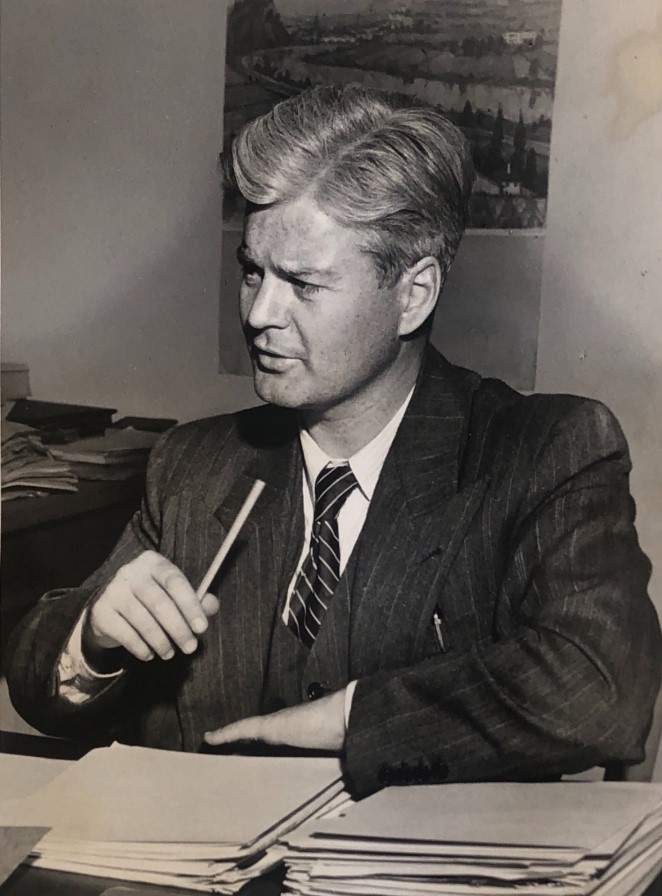
Howard & Edna Hong
Howard Hong was born in Wolford, North Dakota, grew up in Willmar, Minnesota. After finishing high school in Willmar, he attended St. Olaf College, graduating with the class of 1934. Edna Hatlestad grew up on a farm in Taylor County, Wisconsin, and studied at St. Olaf College. Edna and Howard met when Howard came back to St. Olaf to give a talk about student newspapers. While there he read the latest edition of the Manitou Messenger and noticed a column written by Edna. Howard Hong was recommended by the Evangelical Lutheran Church leadership to lead the fulfillment of the LWF’s aim of caring for the spiritual and material needs of Displaced Persons, and specifically Lutheran, non-German refugees who could not safely return to their home countries. As Senior Field Representative in Germany for the LWF Service to Refugees division, he was responsible for a wide variety of director functions, including supply orders ranging from powdered eggs to catechisms, channeling resettlement assurances between the ELC and the IRO, and communicating with the LWF headquarters in Geneva about operations. Based mainly in Munich-Pasing, Hong traveled throughout the American and British Occupied Zones to check on LWF activities in the DP camps and Lutheran Study Centers. The two-volume report and photographic section that he compiled are the most valuable primary sources documenting that work.3
Kaarel Kirde
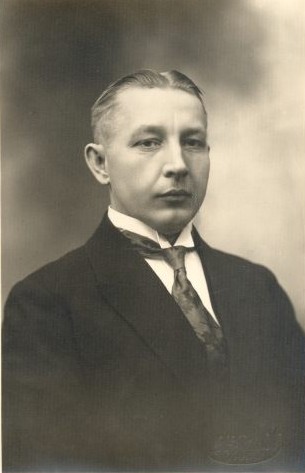
Kaarel August Kirde was born as Kaarel August Frisch on November 13, 1892 in a rural town in Estonia.4 He graduated from Tartu University in 1918 with “a degree in physics and mathematics.”5 He fought in the War of Independence when Estonia wanted to break away from the Russian Empire. At first, he was in an engineering battalion, but then he “was transferred to the Marine Observatory as a hydrometeorologist-observer.”6 He continued studying meteorology, and after the war, he finished his PhD. In 1923, he became a professor at the University of Tartu and would eventually be “the first Estonian professor of geophysics” after becoming “a Full Professor” in 1933.7 In 1935, Kaarel changed his original German-sounding surname to a more Estonian one.8 No sources have verified why he changed his name. One article claims that he “wished to once again bear an Estonian name.” It could have been that Kirde felt more Estonian than German, given that he fought in the War of Independence for Estonia. However, this speculation has yet to be verified. He married his wife, Alma, and they fled to Germany from the Soviets in 1944 after the Second Soviet Occupation.9 Kaarel continued to work at various institutions (Danzig Technical University, Göttingen Estonian Gymnasium as a teacher, and the Baltic University as a professor). He moved to the United States in 1950 and worked at the Detroit Automobile Plant until he became a St. Olaf physics professor in 1952.10 He died in Northfield on May 25, 1953, at 60 years old.11 He was initially buried in Göttingen, Germany. However, in 1998, he and his wife’s ashes “were brought to Estonia… and buried in their home garden at Hurda 4 in Tartu.”12
Otonas Stanaitis
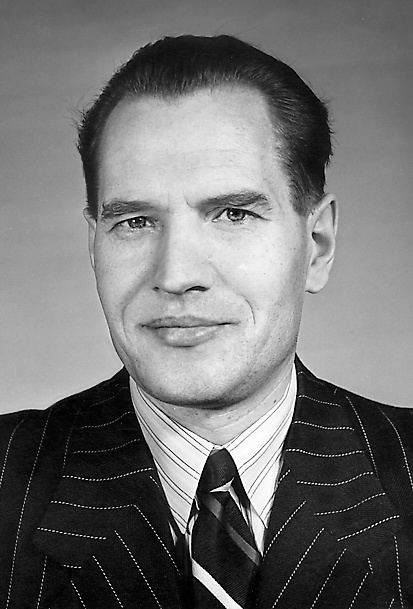
Otonas Edmundas Stanaitis was born May 28, 1905 in the village of Gaisriai in the county of Marijampolė, Lithuania. Stanaitis graduated from the University of Kaunas in 1930 and then received a scholarship to pursue his PhD in mathematics at the University of Würzburg in Germany. After completing his PhD, Stanaitis returned to Lithuania where he taught at various universities until the Soviet reoccupation of Lithuania in 1944. Indeed it was not until August 1949, roughly 4 years after arriving at the DP camp that Stanaitis and his family immigrated to Northfield, Minnesota. The Stanaitis family’s immigration was assured by St. Olaf College, where Otonas Stanaitis was awarded a position in the mathematics department.11
Gertrude Sovik
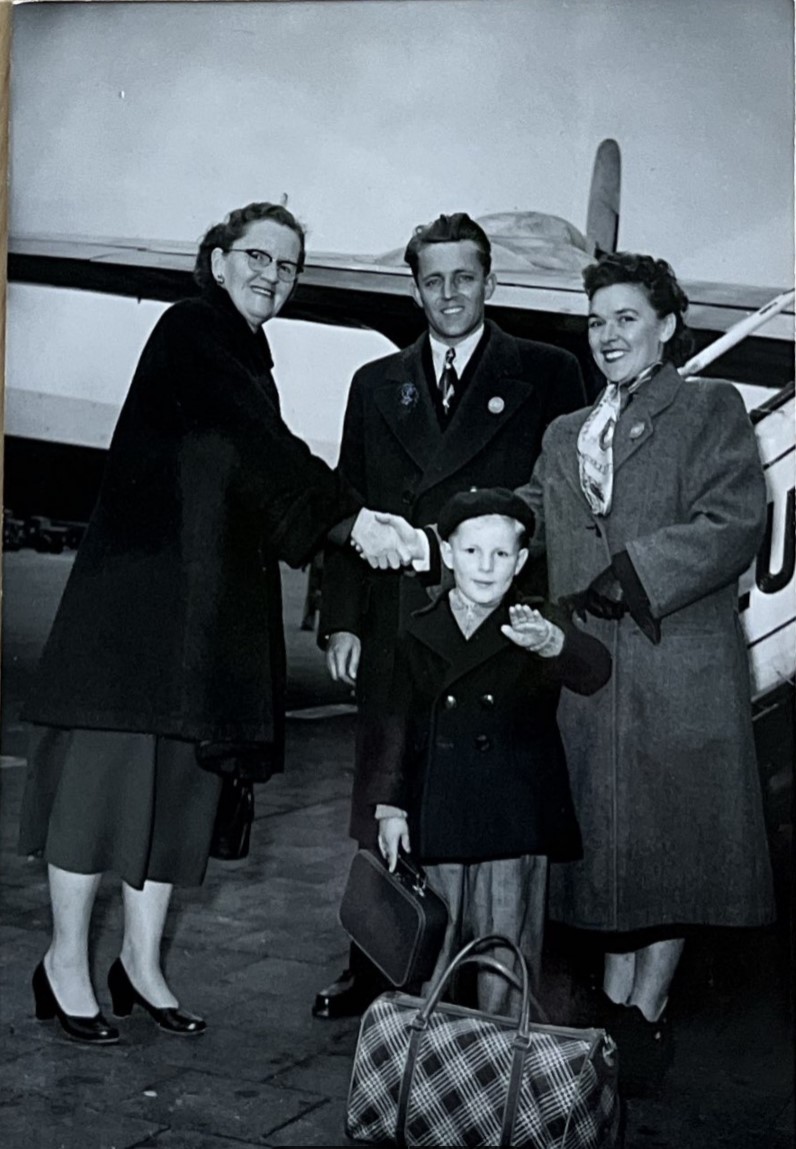
Gertrude Sovik was born October 21, 1907 in China. Her American missionary parents travelled with her through China, Russian, and the United States by the time Gertrude was five years old. She attended St. Olaf College, graduating in 1931. Afterwards she worked at Concordia College and St. Olaf 4 years. Next she went on to live for a period of time in China. Sadly her time in China was ended abruptly, with her becoming a refugee herself evacuating from Hong Kong. In 1950, she joined the Lutheran World Federation Service to Refugees, leading the assistance to DPs in Austria in a role similar to Howard Hong’s in Germany. She carried out this work for seven years, focusing on assisting the resettlement of ‘hard core cases.’ After her time working with the LWF-SR, she joined St. Olaf as a faculty member in the German Department. more about Gertrude Sovik’s life can be found in L. Deane Lagerquist’s article entitled “My Trip Around the World: Gertrude Sovik’s Missionary Life,” along with the article linked below.12
Olaf Millert
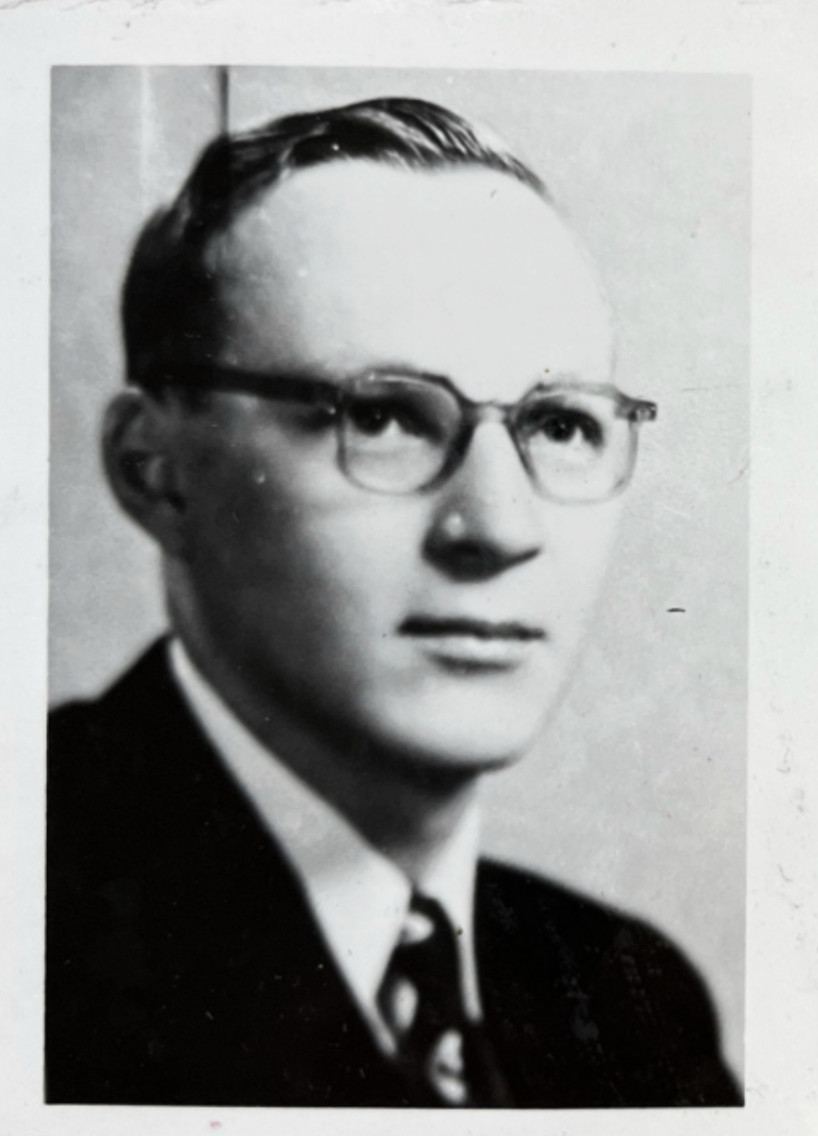
Olaf Millert was born on September 6, 1924, in Tallinn, Estonia. In 1944, with the Soviet army advancing across Estonia, Olaf and his parents left Estonia and fled to Germany. They remained there for several years as refugees in Displaced Persons camps. In 1949, Millert received sponsorship through the Lutheran World Federation to study in the United States. He attended Augustana College in Sioux Falls, South Dakota, receiving his Bachelor of Arts in 1950 and receiving his Masters Degree from the University of South Dakota. Millert completed graduate studies at the University of Minnesota before receiving his Doctorate from Harvard University. At St. Olaf, Professor Millert was impactful and well-loved. Millert founded the St. Olaf Psychology Department in 1960, and in 1969 Millert was promoted to a full-time professor. He taught personality and social psychology until his retirement in 1995. Millert has three endowments at St. Olaf, the G. Allport award which goes to two psychology students, Juta R. Millert Memorial Speaker Series in Psychology which supports an annual lecture, and the Olaf and Juta Millert Endowment, intended for Estonian students to study at St. Olaf, but has also helped support students from neighboring countries.13
Staff
Arnold Nelson
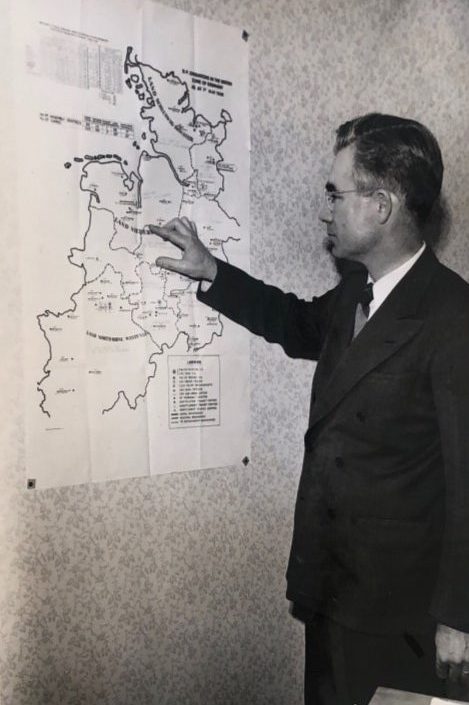
Arnold Nelson graduated from St. Olaf College in 1931. After he finished his theological studies he returned to be a pastor at the local St. John’s Lutheran Church. At the time St. John's served as both the college church as well as a community church for Northfield. Beginning in 1949 he worked with the Lutheran World Federation Service to Refugees (LWF-SR), supervising the resettlement process for the displaced people, specifically in the British zone. After this, Arnold Nelson continued to work at St, John’s Lutheran Church, helping his congregation (both locals and newly arrived displaced peoples).14
Sources
- Text created in "Astrid & Ivar Ivask" by Sydney Hugdahl.
- Text originally created in "Astrid & Ivar Ivask" by Sydney Hugdahl.
- Text created by Anneke Shiller (CURI 2023), edited by Sydney Hugdahl (CURI 2026).
- “Kaarel Kirde,” Geni.com, Last Updated February 27, 2025, https://www.geni.com/people/Kaarel-Kirde/6000000016024380083.
- Tartu University Observatory, Department of Atmospheric Physics
Chronicle, https://scorpion.to.ee/atm/k_kirde.html - Tartu University Observatory, Department of Atmospheric Physics
Chronicle. - Tartu University Observatory, Department of Atmospheric Physics
Chronicle; Cornelia Lüdecke et al., “Alfred Wegener and His Influence on Meteorology at the University of Dorpat (Tartu),” Meteorologische Zeitschrift 9, no. 3 (2000): 181–82, https://doi.org/10.1127/metz/9/2000/175. - Cornelia Lüdecke et al., “Alfred Wegener and His Influence on Meteorology at the University of Dorpat (Tartu),” 181–82.
- Cornelia Lüdecke et al., “Alfred Wegener and His Influence on Meteorology at the University of Dorpat (Tartu),” 181–82.
- Tartu University Observatory, Department of Atmospheric Physics
Chronicle. - Geni, “Kaarel Kirde.”
- Tartu University Observatory, Department of Atmospheric Physics
Chronicle. - Text originally created in "Otonas Stanaitis" by Sophia Hayes.
- Lagerquist, L. D., “My Trip Around the World: Gertrude Sovik’s Missionary Life,” Journal of the Lutheran Historical Conference, (2018): 40-41.
- Text created in "Olaf Millert" by Ella Nielsen.
- Text made by Anneke Shiller (CURI 2023), edited by Sydney Hugdahl.
Images
- (Heading) “St. Olaf Student Body,” September 25, 1956, St. Olaf College Panorama Photographs, Series 1: Digital, St. Olaf Archives, Northfield, Minnesota. Used with permission of the St. Olaf Archives.
- German Department Faculty Photo. St. Olaf College, The Viking Yearbook, Northfield, (1953): 23. Used with permission of the St. Olaf Archives.
- “Juask Refugee from Red, Receives, Doctor’s Degree,” The Manitou Messenger (1916-2020), 1954. Used with permission from the St. Olaf Archives.
- D. Brunet, "Opinions on Poetry, morality highlighted in current 'Touch'," The Manitou Messenger (1916-2020), 1967. Used with permission from the St. Olaf Archives.
- Image of Howard Hong, Senior Field Representation of the Lutheran World Federation in Germany. Lutheran World Federation Service to Refugees 1947-1949 Photographic Section, used with permission of the Lutheran World Federation and Evangelical Lutheran Church in America.
- Kaarel Kirde 1931, University of Tartu Library, Heinrich Riedel (1870-1932), Wikimedia Commons, https://commons.wikimedia.org/wiki/File:Kaarel_Kirde_1931.jpg.
- November 1959: St. Olaf and Carleton Professors with Carleton’s First Computer, 1959, Collection 3: Photographic Prints, Series 5 1959/60, Computing, Carleton College Archives, https://archive.carleton.edu/Detail/collections/9385. Used with permission.
- Two women (left is Gertrude Sovik) shaking hands with young boy and man next to them, Lutheran World Federation Archive, Geneva, Switzerland. Used with permission.
- Olaf Millert, gelatin silver print, Folder "Millert, Dr. Olaf", Northfield Historical Center, Northfield, MN.
- Arnold Nelson pointing at map, Lutheran World Federation Service to Refugees 1947-1949 Photographic Section, used with permission of the Lutheran World Federation and Evangelical Lutheran Church in America.