The Baltic States under Occupation
The experiences of Baltic Lutherans through the 1940s was shaped by multiple foreign occupations; cultural suppression and and political cooption; war and atrocities; voluntary and forced displacement; and, ultimately, resettlement or repatriation. This overview summarize the factors that drove this population to flee, or not, and the entanglements with oppressive regimes - the Soviet Union, Nazi Germany, and the USSR once again - that impacted displaced Baltic Lutherans, the so-called "Churches in Exile."
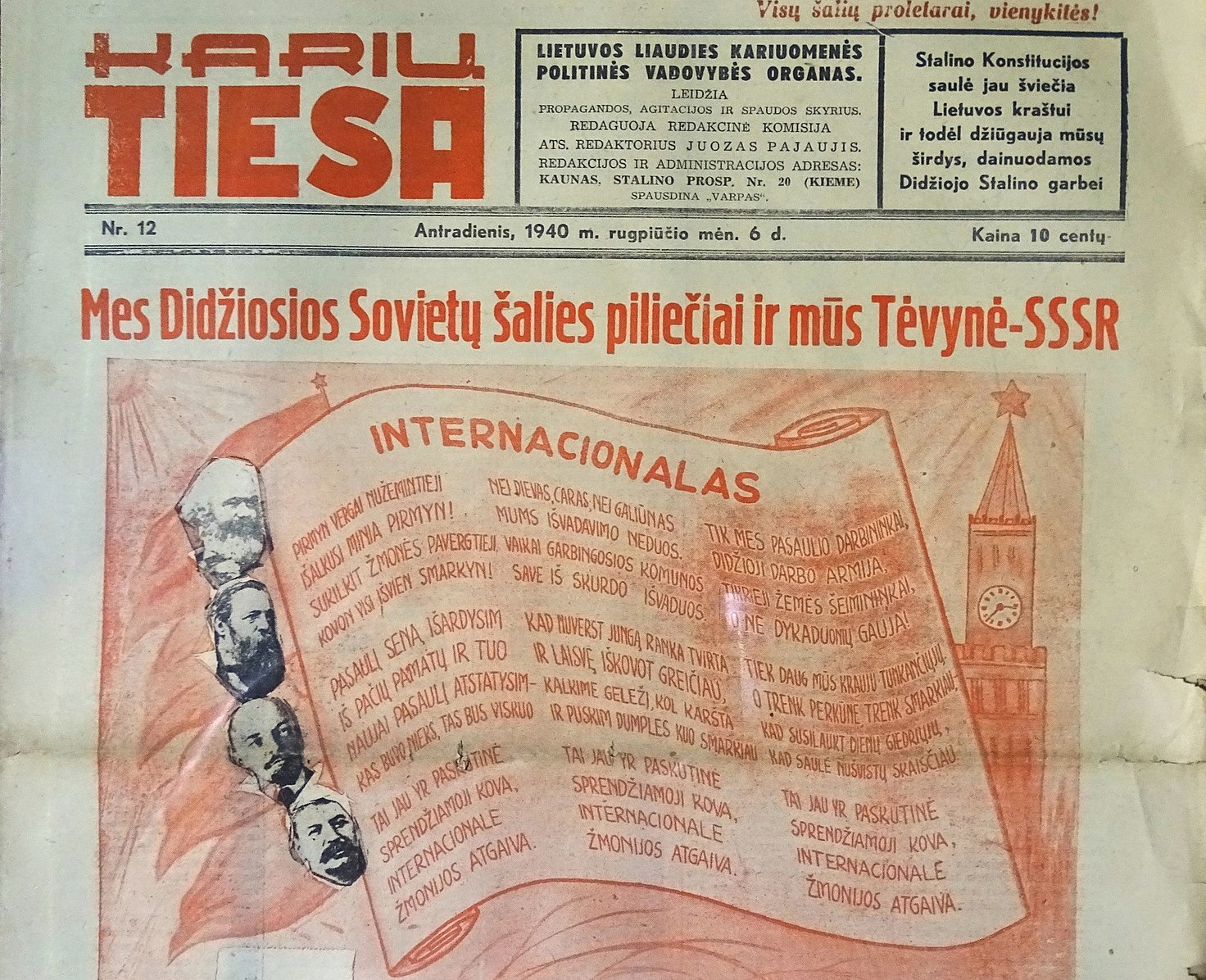
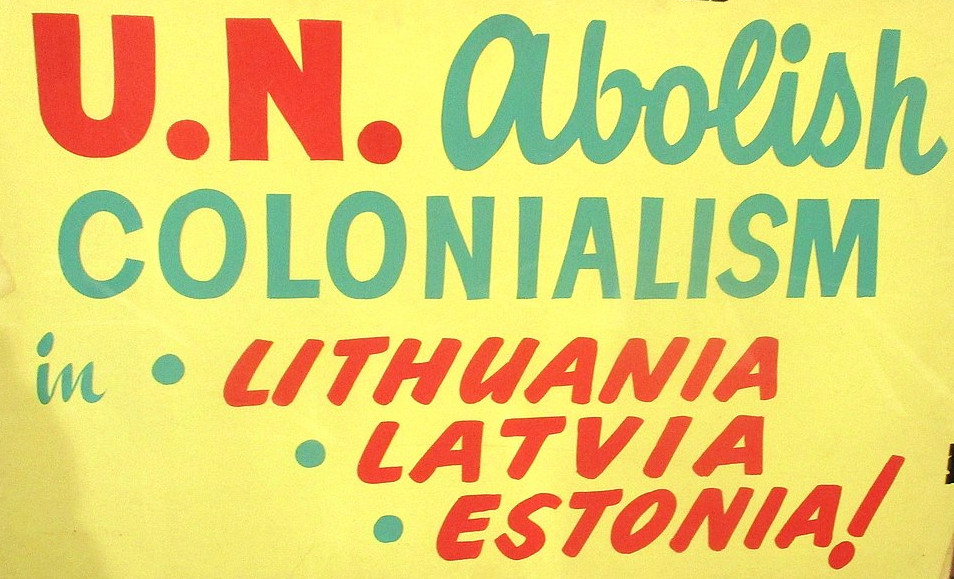
The total number of those deported, murdered, or missing during the Year of Terror (1940-41) under Soviet occupation is 34,250 Latvians, 39,000 Lithuanians, and 61,000 Estonians.2
Independence Lost
Estonia
The first Soviet occupation of Estonia occurred between 1940 and 1941. Following the Bolshevik motto “religion is the opium of the people,'' the Soviet Union banned religion in public areas (schools, broadcasting, and periodicals) as well as private settings (singing sacred music, devotional literature, and theological studies). At the same time, anti-religious propaganda was implemented throughout the country's schools and radio stations. Finally, taxes that paid the congregation were banned with clergy members being categorized as non-workers and capitalists.
During both occupations, the NKVD-Soviet secret police were notoriously known for interrogating and arresting clergy members at night. They threatened them and their families for information and encouraged criminalizing fellow members of the congregation. In one year alone, two Evangelical Lutheran pastors were murdered, seventeen were arrested and deported to the Soviet Union, six were drafted into the Red Army, twenty-seven members of the parish were murdered, and a number of leading church members were arrested and deported to Siberia.
In the second Soviet occupation (1944 to 1948), these conditions only worsened. More and more pastors were deported to concentration camps in the Soviet Union, while those that remained were not able to observe church holidays or obtain suitable rations.1
Latvia
Tensions between Latvia and the Soviet Union erupted on June 17, 1940, when the USSR launched a formal invasion into the country.2 Latvia was unable to suppress the Soviet’s advancing army, and became an occupied state quickly. The quest to ‘Sovietize’ Latvia was immediately apparent.3 During 1941, during the "Year of Terror," theology schools were banned, religious leaders were hunted down, arrested, or disappeared, and anti-religious propaganda was extreme. But it was not just the religious leaders experiencing this terror. More generally, Latvians remember the deportations, arrests, and killings of June 1941 as a genocide aimed at wiping out the Latvian nation, while the Soviets claimed to be relocating Latvians to prevent a bourgeois uprising.4
These acts of terror were halted with the advance of the Nazi’s into the Baltics. On June 26, 1941 the Germans advanced, resulting in Latvia being occupied twice in the span of just one year.5 Despite the return to certain rights, such as religion, the Latvian people still struggled under their occupiers. In the month of February, 1943, 30,000 Latvians were conscripted to go work for the Nazis in labor camps.6 Then, news reached Latvia that the Soviet Army was advancing towards their borders in the summer of 1944.7 Many families fled, preferring life in exile over the possible deportation and death of their families in Soviet labor camps. These fears soon proved to be well-founded, during the 1945-1946 year, 60,000 Latvians were deported.8
Lithuania
Lithuania was invaded and became occupied by the Soviet Union on June 15th, 1940.9 Following this take over, the Soviet government sought to make sweeping changes to the government structure, work, and religious life.10 Through the deportation of over 5,000 people in 1940 to work camps in Siberia, they were able to replace many Lithuanian political leaders with their own.11 This wave of deportations started in the middle of the night of July 11. Whole families disappeared, and many died due to the conditions of the work camps. Among those deported were social elites, industrial owners, and members of the clergy.12 This act, along with the forced sovietization of the occupied state, led many to fear the Soviets and welcomed anyone who could intervene.13 On June 22, 1941, Germany successfully invaded and occupied Lithuania. Thus, in the span of two years, Lithuania went from an independent country to being occupied by two competing forces.14
With the Nazi occupation came a reprieve from religious and cultural oppression enforced by the Soviets. But this freedom was short-lived. Soon, Nazi Germany began to integrate the Lithuanian people into their pool of conscripted workers, whether they wanted to come and work or not. Despite promises of Lithuanian independence, the Nazi leaders in Lithuania continued to suppress nationalist movements and forced citizens to either work in labor camps for them, or be drafted into fighting.15 Despite the German occupiers’ efforts, high levels of military desertion and labor shortage continued.16 When news of the USSR’s advance in 1944, many Lithuanians fled to Germany in hopes of keeping their families alive.17 On August 1, 1944, the Soviet Union recaptured Lithuania.18 Immediately, they continued their plans from before, resulting in around 100,000 additional Lithuanians deported to Siberia during 1945-46.19
Life Under Occupation
German Invasion
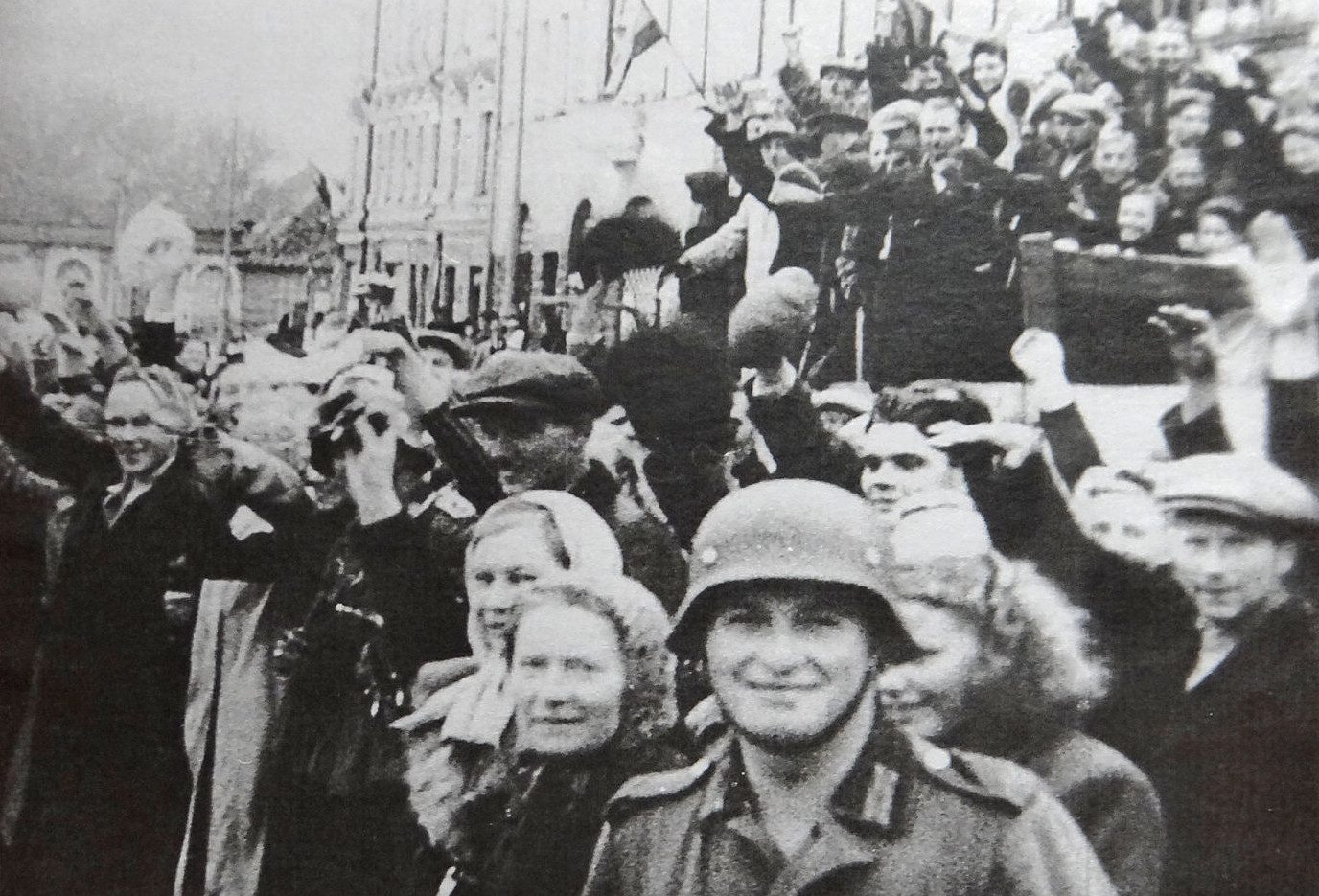
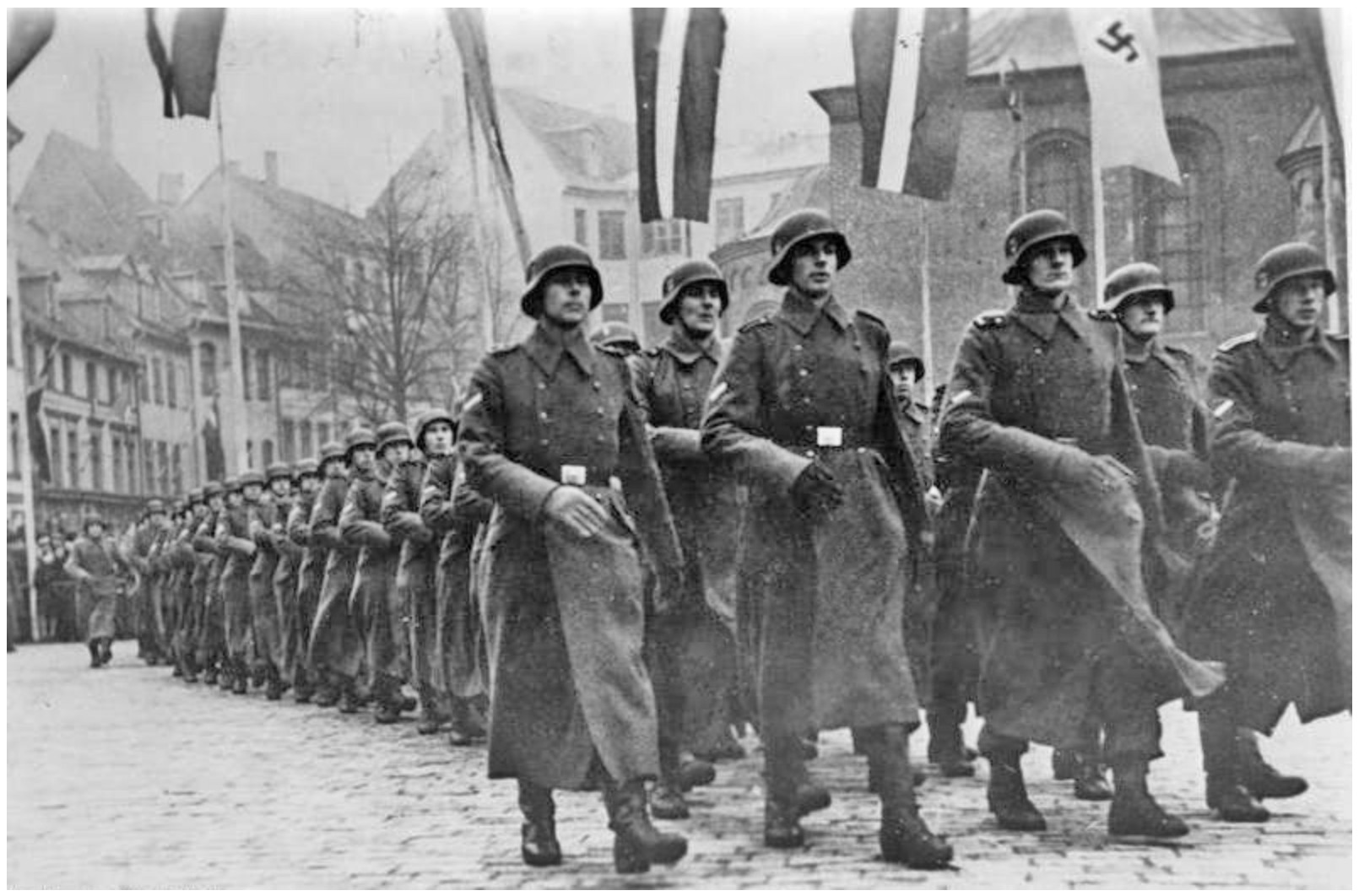
The 1941 German occupation of the Baltic states is sometimes referred to as a “liberation.” For some Baltics, this feeling rang true, and this sentiment is reflected in scholarship on that history. When German forces entered Latvia, they were greeted by cheering crowds of Latvians (see photo, right). Relief was felt for many, as they felt they were being “liberated” from a year of totalitarian Soviet rule.20 Yet liberation did not mean freedom for all. The Germans used the brutality and intensity of Soviet rule over the Baltic states (1940) to their advantage; to receive the Germans as liberators from the Soviets laid the groundwork for the kinds of collaboration that existed between Germany and those under its occupation of the Baltics.21 The Baltics were eventually incorporated under a German civilian administration called Reich Commissariat Ostland. Under this administration, many Baltic citizens joined Waffen SS or auxiliary police units. Reasons for joining varied, but many’s participation was undergirded by a sense of patriotism, hope for an independent state, and anit-communist sentiment.22 Meanwhile, the Jewish peoples of the Baltics became subject to the same persecution and policies of extermination carried out by Germany in Eastern Europe. In Latvia alone, which had the second largest Jewish population of the three Baltic nations, historians estimate that by the end of 1941, the Germans, with varying levels of assistance from other Latvians, murdered at least 69,750 of the country’s estimated population of 80,000 Jewish people.23
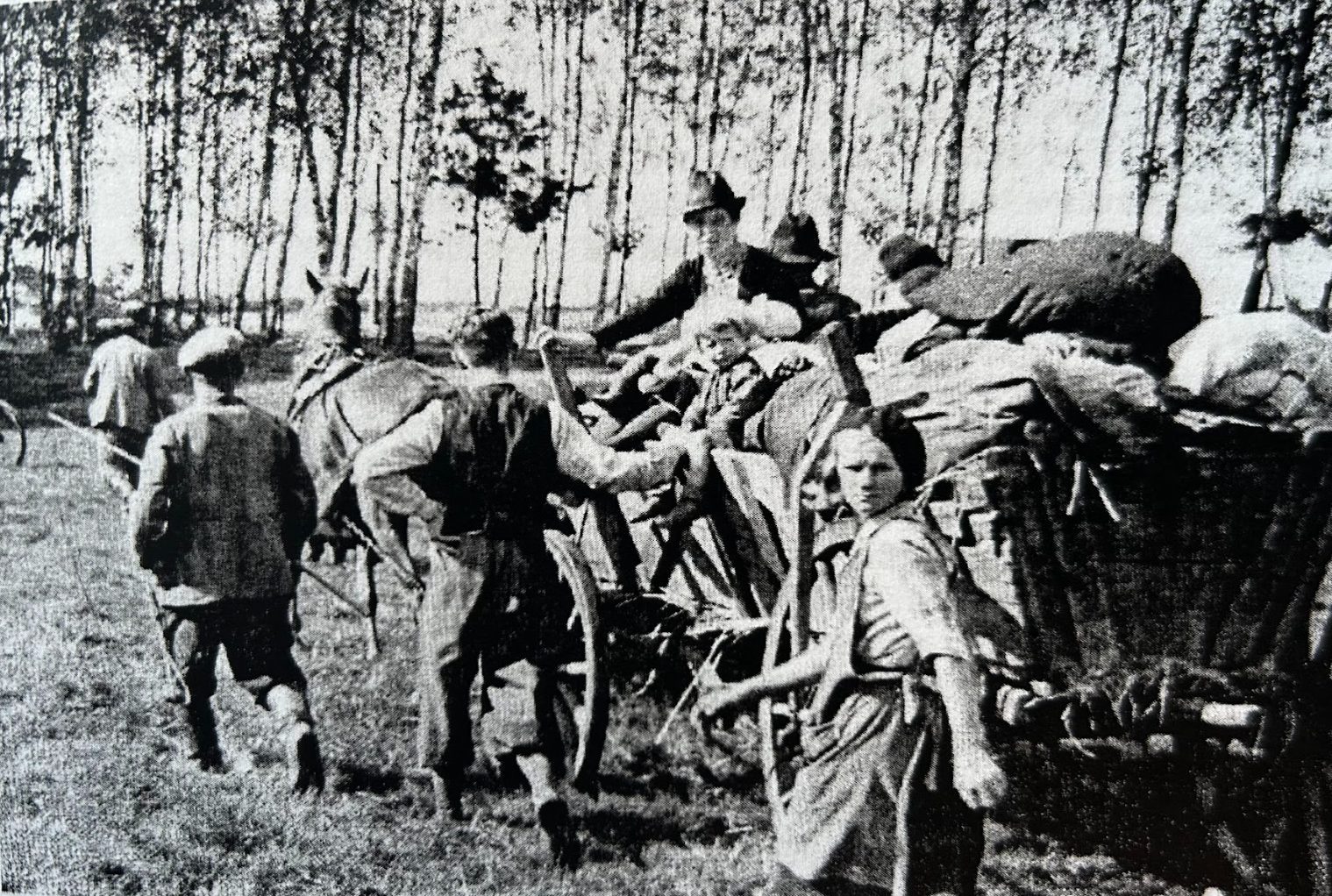
As the war returned in 1944, Latvian refugees began gathering in Riga, Latvia but feared the return and spread of maltreatment under Soviet occupation. The Germans, despite considering providing aid, did nothing to provide much needed food and shelter. In the end, while tens of thousands of Latvian soldiers, some inside SS units, stayed to fight for Latvia's independence, hundreds of thousands of refugees chose to flee west. Seeking shelter from the war and bringing what they could, they traveled down roads crowded by military convoys.24
SS Entanglements
There existed Estonian, Latvian, and Ukrainian auxiliary units within the Waffen SS commanded by Nazi Germany. Baltic connection to these units and Nazi German sentiments is tenuous. Modern evidence suggests there was a positive movement of Estonians and Latvians to enlist as local police, concentration camp guards, and anti-partisan troops. The Balts were likely motivated to enlist as retaliation against Soviet oppression or for their assumptions that Jewish people supported the Soviets and communism. These began as volunteer units, but as the need for men grew, the Nazis began conscription. In the end, the Waffen SS killed thousands of Jewish people and participated in the suppression of Jewish ghetto uprisings. The murder of millions of Jews would not have been possible without the assistance of Baltic auxiliary units.25
However, after World War II, the international tribunal of Nuremberg determined that Balts were forcibly drafted in obvious disregard of international laws, and it was therefore deemed unjust to classify former members of Latvian Legion as collaborators with the Nazi regime and bar their immigration into the US. As a result, the U.S. State Department deemed many Baltic persons as eligible for immigration, despite their SS entanglements.26 In consequence, only known war criminals were subject to full, fair scrutiny.
While American Lutherans at the time wanted to save the Balts from Soviet oppression and, like much of the US post-WWII, prioritized anti-communist over anti-Nazi sentiments, this was not a perfect system of scrutiny and soon created tensions with Jewish organizations and within modern understandings of Baltic history.27
Volksdeutsche/Ethnic Germans
Volksdeutsche or Ethnic Germans included those with German heritage yet were residing outside of Germany such as in Poland and Eastern European countries (ie. Baltics, Romania, and Ukraine).
However, this definition is not so simple when looking at the history of WWII. As Doris L. Bergen contends, Volksdeutsche was a term created with the purpose of motivating Nazi movement into Eastern Europe, creating a rise of anti-Semetism and Nazism in ethnic Germans, and expanding ranks of SS units. For instance, Nazis often made ethnic Germans beneficiaries of land taken from Jewish people. Yet they also made ethnic German-ness a loose definition which often relied on a display of Nazi sentiments.28 Through intermarrying, speaking different languages, or merely not following Nazi sentiments, not all ethnic Germans followed this definition of “German-ness,” which made them vulnerable to being sent to concentration camps or having their children taken and sent to a “more German” family.29
Even before the fall of WWII, around May of 1945, expulsions of ethnic Germans from their countries to Germany and Austria began. Yet, this was not the beginning of ethnic German flight with around 3 to 4 million fleeing the Red Army starting in 1944.30 Before the Potsdam Conference and Agreement, the first ethnic German expulsions and flights often were ad hoc, disorganized, and violent in nature.31 After the Potsdam Agreement stated that their expulsion was “to be effected in an orderly and humane manner,” these expulsions became more organized, yet still resulted in loss of possessions, harassment, and poor travel conditions.32 It is estimated that about 12 million entered Germany between 1945 and 1947.33 In the end, most of the expulsions and flights ended in 1949, leaving many ethnic Germans to settle into Germany or depart for areas like the U.S..34
Sources
- Lutheran World Federation, Lutheran World Federation Service to Refugees in Germany 1947-1949. Materials for Report, ed. Howard V. Hong, vol. 1, 1949.
- R. J. Misiunas, R. Taagepera, and G. von Rauch, The Baltic States, Years of Dependence, 1940-1980, University of California Press, 1984, 19.
- Misiunas et al., The Baltic States, 44.
- Valdis O. Lumans, Latvia in World War II, 1st ed, World War II--the Global, Human, and Ethical Dimension (New York: Fordham University Press, 2006), 134, 138 http://catdir.loc.gov/catdir/toc/ecip0610/2006007965.html.
- Misiunas et al., The Baltic States, 44.
- Misiunas et al., The Baltic States, 53.
- Misiunas et al., The Baltic States, 68.
- Misiunas et al., The Baltic States, 70.
- Misiunas et al., The Baltic States, 19.
- Misiunas et al., The Baltic States, 24.
- Misiunas et al., The Baltic States, 24, 39.
- Misiunas et al., The Baltic States, 24, 39.
- D. Hristenko, “Wartime Decisions Lead to Peacetime Problems: Leadership of the Lutheran Churches in Baltic States, 1944–1949.” Cel̦ś (Riga), no. 74 (December 2023): 48.
- Misiunas et al., The Baltic States, 44.
- Misiunas et al., The Baltic States, 63.
- Misiunas et al., The Baltic States, 63.
- D. Nasaw, The Last Million: Europe’s Displaced Persons from World War to Cold War, Penguin Press, 2020, 52.
- Misiunas et al., The Baltic States, 68.
- Misiunas et al., The Baltic States, 70.
- Valdis O. Lumans, Latvia in World War II.
- Valters Nollendorfs et al., “The Three Occupations of Latvia, 1940–1991: Soviet and Nazi Take-Overs and Their Consequences,” Museum of the Occupation of Latvia, 2005, 26.
- Valters Nollendorfs et al., “The Three Occupations of Latvia," 26. Latvia was also occupied from 1945-1991. Because of this, national consciousness concerning Soviet occupation is largely negative.
- Arūnas Bubnys, Matthew Kott, and Ülle Kraft, “The Baltic States: Auxiliaries and Waffen-SS Soldiers from Estonia, Latvia, and Lithuania,” in The Waffen-SS: A European History, ed. Jochen Böhler and Robert Gerwarth (Oxford University Press, 2016), https://doi.org/10.1093/acprof:oso/9780198790556.003.0005. For a more complete exploration of the complex issue of the participation of Baltic citizens in Waffen-SS and police auxiliary units, see Bubnys, Kott, and Kraft.
- Timothy Snyder, Bloodlands: Europe Between Hitler and Stalin (New York: Basic Books, 2010), 193.
- United States Holocaust Memorial Museum, “Latvia,” Holocaust Encyclopedia, n.d., https://encyclopedia.ushmm.org/content/en/article/jewish-population-of-europe-in-1933-population-data-by-country.
- David Nasaw, The Last Million: Europe’s Displaced Persons from World War to Cold War, Penguin Press, 2020, 135.
- Nasaw, The Last Million, 128.
- Bergen, Doris L. “The Nazi Concept of ‘Volksdeutsche’ and the Exacerbation of Anti-Semitism in Eastern Europe, 1939-45.” Journal of Contemporary History 29, no. 4 (1994): 569-82. http://www.jstor.org/stable/260679.
- Bergen, Doris L. “The Nazi Concept of ‘Volksdeutsche'", 572.
- Ulrich Merten, Forgotten Voices: The Expulsion of the Germans from Eastern Europe after World War II (New Brunswick, N.J: Transaction Publishers, 2012), 7-20.
- Ulrich Merten, Forgotten Voices.
- Ulrich Merten, Forgotten Voices, 10.
- Mark Wyman, DPs: Europe’s Displaced Persons, 1945-1951 (Ithaca, N.Y.: Cornell University Press, 2014), 20.
- Merten, Forgotten Voices, 20.
Images
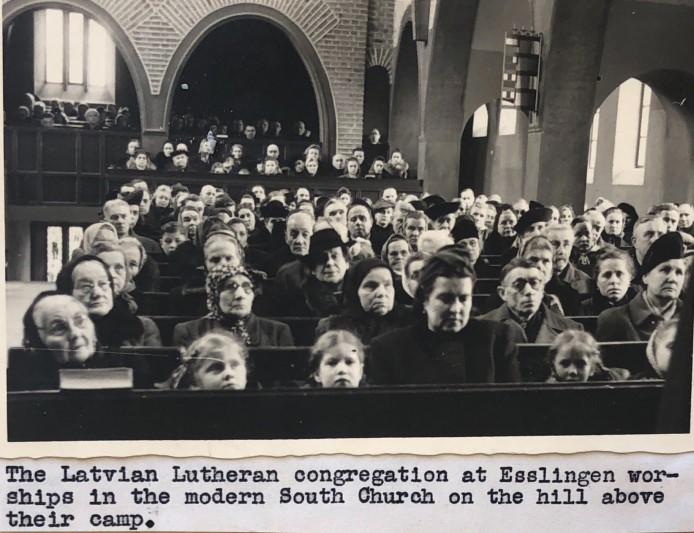
- Congregation sitting in pews, Lutheran World Federation Service to Refugees 1947-1949 Photographic Section, used with permission of the Lutheran World Federation and Evangelical Lutheran Church in America.
- News flier regarding the Soviet occupation of Lithuania, likely propaganda, Jones, Adam. “File:Propaganda News Item on Soviet Takeover of Lithuania - Wikimedia.” Wikimedia Commons license, November 17, 2017.
- Protest sign from a Baltic person in exile, calling on the U.N. to abolish Soviet colonialism in Lithuania, Latvia and Estonia. From the exhibition "Nyet, nyet, Soviet! Political protests and demonstrations outside Latvia 1945-1991" at the Latvian Railway History Museum, Contributors to Wikimedia Projects. “File:Nyet, Nyet, Soviet.Jpg - Wikimedia Commons.” Wikimedia Commons license, May 22, 2022.
- A crowd welcomes the Germans, expecting liberation from the Soviet Occupation. August 28th 1941, Tallinn, Estonia, Contributors to Wikimedia Projects. “File:Lentrée de Larmée Allemande En Estonie En 1941.” Wikimedia Commons, February 17, 2023.
- “The Latvian SS Volunteer Legion on parade celebrating the 25th anniversary of National Latvia Day” November 1943, Contributors to Wikimedia Projects “Category:Waffen-SS.” Wikimedia Commons license, June 26, 2023.
- “How most rural residents fled their homes ahead of the battlefront", from: Ventis Plume, John Plume, and Vaira Vīke-Freiberga, Insula, Island of Hope: A Latvian Memoir, Revised and enlarged edition. Bookstand Publishing, 2013.
_(2).jpg)
.jpg)
.jpg)
