Arrival and Adjustment: Northfield
Once Displaced Persons (DPs) made it out of the camps and across the Atlantic to the United States, they faced the various challenges of integrating into their new communities. Adjusting to life as an immigrant in the United States required DPs to balance the pressure to assimilate with the desire to retain their original culture and identity.
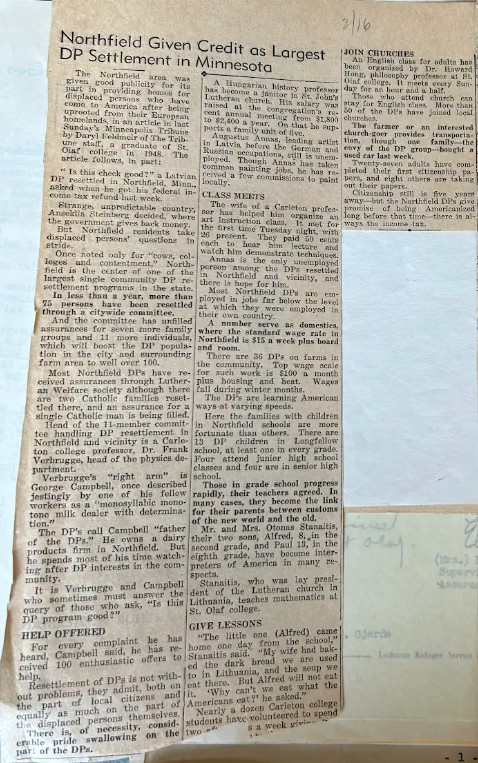
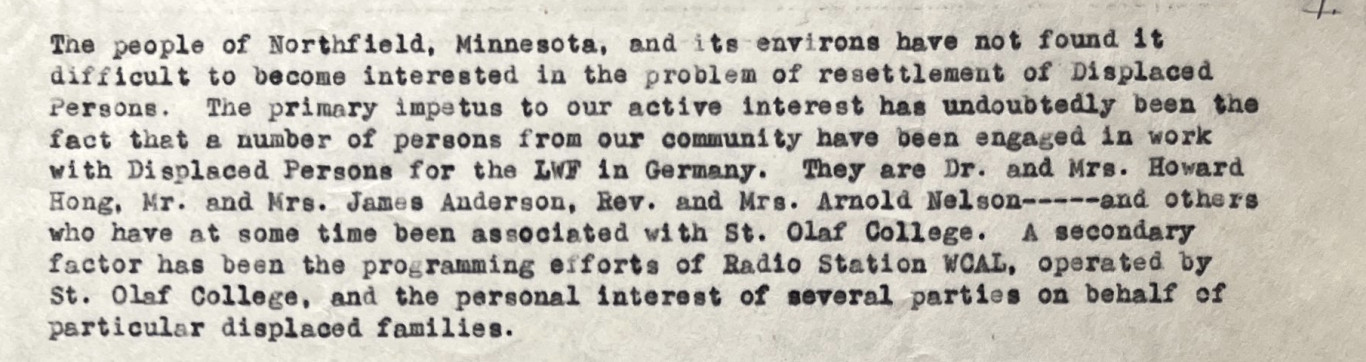
From 1948 to 1955, more than 250 people were resettled in the Northfield area alone, a significant commitment for a town of its size.1 This page examines the resettlement process in Northfield and how different members of the community experienced or participated in it.
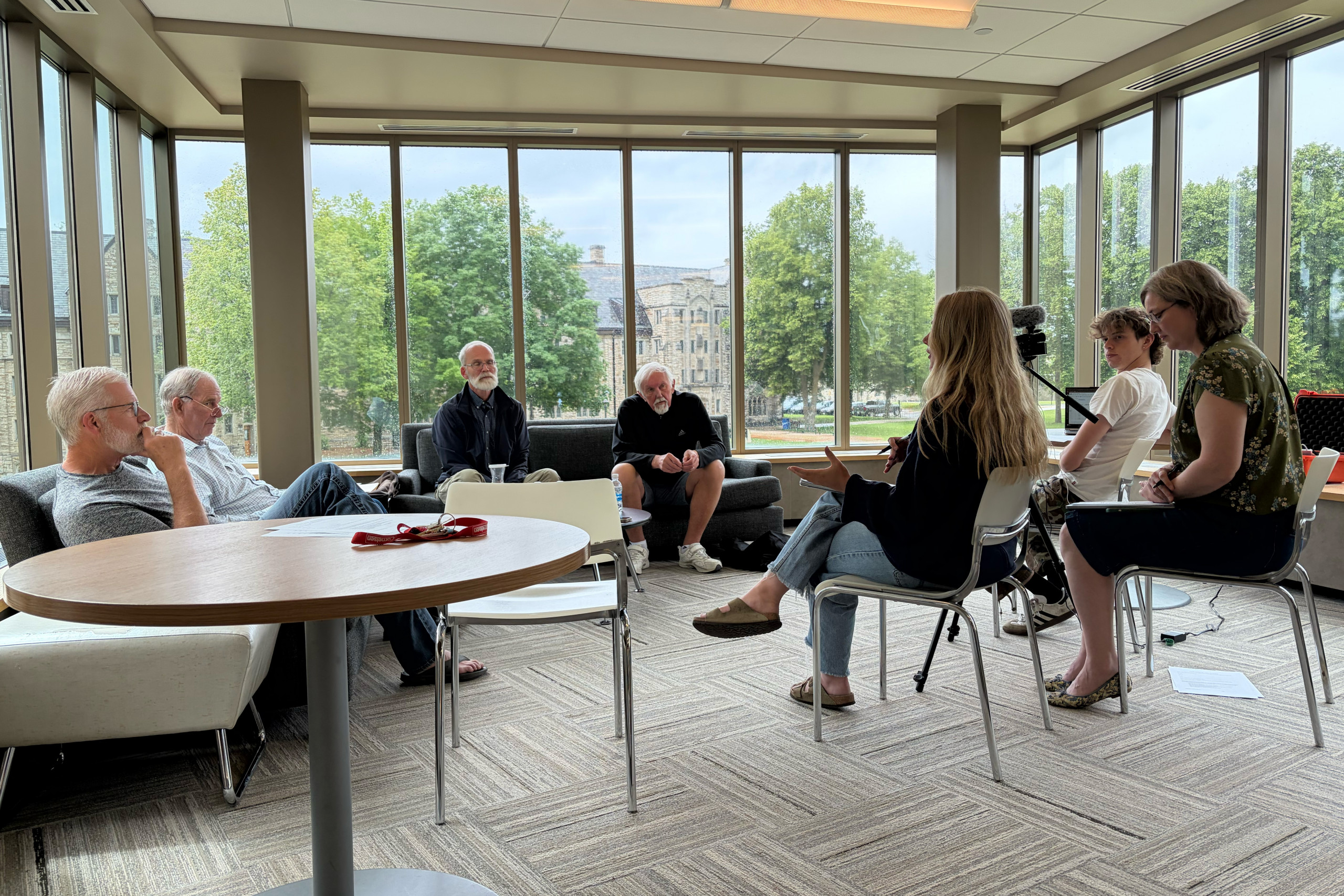
Special thanks for this page is owed to the Koester family, especially Mr. Rene Koester and Dr. Craig Koester, and Mr. Vilnis Giga for agreeing to share their families’ stories and experiences of resettlement with us in an oral history interview. Their memories and insights were invaluable to this project and we are deeply grateful for their participation.
"My most important goal was to blend in…in the United States, you can come from anywhere, live here, and become and be considered an American. That's the goal that I had as a kid, even though I'm not sure I thought of it in the way that I describe it now."
Challenges & Needs
Language & Culture
Resettlement posed several material, cultural, and social challenges for both Displaced Persons (DPs) and the local residents of Northfield. The most immediate of these for the newly arrived DP families were basic living concerns such as housing and furniture, employment, insurance, and the language barrier. Housing accommodations and employment were secured by the assurances prior to arrival, but Displaced Persons still had to adjust to the new setting and learn to do the work they were provided.2 This required communication, but many DPs had little to no knowledge of English when they first arrived in Minnesota and had to learn it with help from various local institutions and individuals.3
Beyond adapting to new conditions and a new language out of necessity, DPs experienced a social pressure to integrate into the Northfield community and assimilate culturally. Mr. Vilnis Giga explained that even as a child he felt an urgency to learn English as fast as possible and “become an American”. As newcomers to the area, DPs found it hard to retain a shared cultural identity. Despite coming to Northfield under similar circumstances, DP groups of different nationalities did not necessarily feel strong ties to one another. This, along with the geographical dispersion of resettled families in and around Northfield, made it somewhat difficult for families to continue to cultivate a shared national identity on a day-to-day basis. Mr. Giga explained that the only people with whom he could regularly speak Latvian were his immediate family. The nearest strong Latvian community for them was in the Twin Cities, which had a Latvian Lutheran Church. The Giga family made the trip to this church “countless times” after their resettlement in Minnesota.4
Politics & Economy
By most accounts, the residents of Northfield were quite welcoming and got along well with the resettled families. There were however a few underlying economic and political concerns that affected the social dynamics in Northfield during this period.
Economic concerns were a major part of decision-making at many stages of the resettlement process. The assurance documents that brought the Displaced Persons to the United States required the sponsor to ensure that the resettled family would be able to sustain themselves by working, and that the employment they were given would not force an American citizen out of their job.5 The need or want of labor, especially by farmers, played a role in the decision to sponsor DPs.6 While compassion for the plight of these refugees was certainly a motivator, DPs were expected to uphold their end of the bargain by contributing to the community that they were resettled in.
Not every Northfielder saw the program as an economic boon. Despite the promise that no American workers would be displaced, the influx of new workers into the small town prompted one Northfield organization in 1950 to write a letter to George Campbell, the head of the Northfield Resettlement Committee, expressing concerns that Northfield was oversaturated with DP families, which they felt was upsetting the town’s labor market. They asked the Committee to cease bringing new DPs to Northfield.7
A defining element of political discourse during this time in the United States was an intense suspicion of communism. This suspicion was present in the public perception of DPs and the resettlement program, and was a barrier that DPs had to overcome during the sponsorship process and during the resettlement and integration period.8 Lutheran World Federation promotional and informational materials frequently featured sections telling readers and potential sponsors that DPs were anti-communist, emphasizing their persecution at the hands of the Soviet Union, and assuring audiences that all DPs had been thoroughly vetted to ensure that they were “independent and democratic”.9
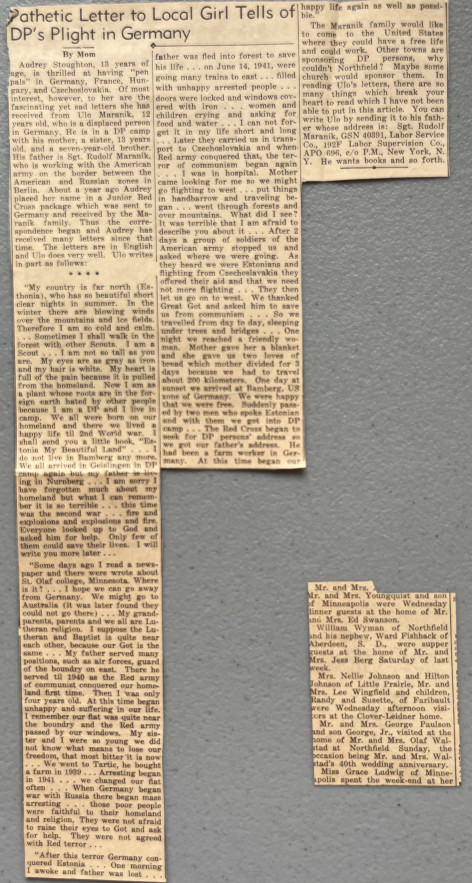
Newspaper publications around the country continued to run stories about the experiences of the DPs under Soviet rule. A local newspaper, for instance, published a story about a displaced woman in Northfield who reprimanded a couple of local boys who had “laughingly observed that communism did not sound so bad” followed by a dramatic account of her family’s harrowing flight from their home in Estonia.10
Support & Services
Sponsors
Meeting the needs of these new neighbors was a communal effort. Sponsors were the main hosts for the displaced families, and were responsible for employing them, finding them housing, and furnishing their accommodations.11
Mr. Giga’s father had been a farmer back in Latvia, and was employed by Ralph Koester on his farm just outside Northfield, where he learned to operate tractors and other farm machinery that had been unavailable back home. Mr. Rene Koester recalled his parents scrounging up old family furniture as well as furniture donated by neighbors to fill the vacant farmhouse on their land that the Giga family stayed in.12
People chose to become sponsors for a variety of reasons. The promise of cheap labor was a significant motivator, but Lutheran identity and Christian compassion and humanitarianism were also important factors that were emphasized through the church-led outreach.13 In the case of the Koester family, Walter felt compelled to sponsor families after travelling to Germany in 1948 and experiencing the conditions firsthand.14
Churches and Religous Organizations
The challenges of integration faced by the DPs and the people of Northfield had to be resolved by attempting to bridge the cultural and social divide between the newcomers and the locals, beyond simply matching sponsors to DPs and securing assurances.
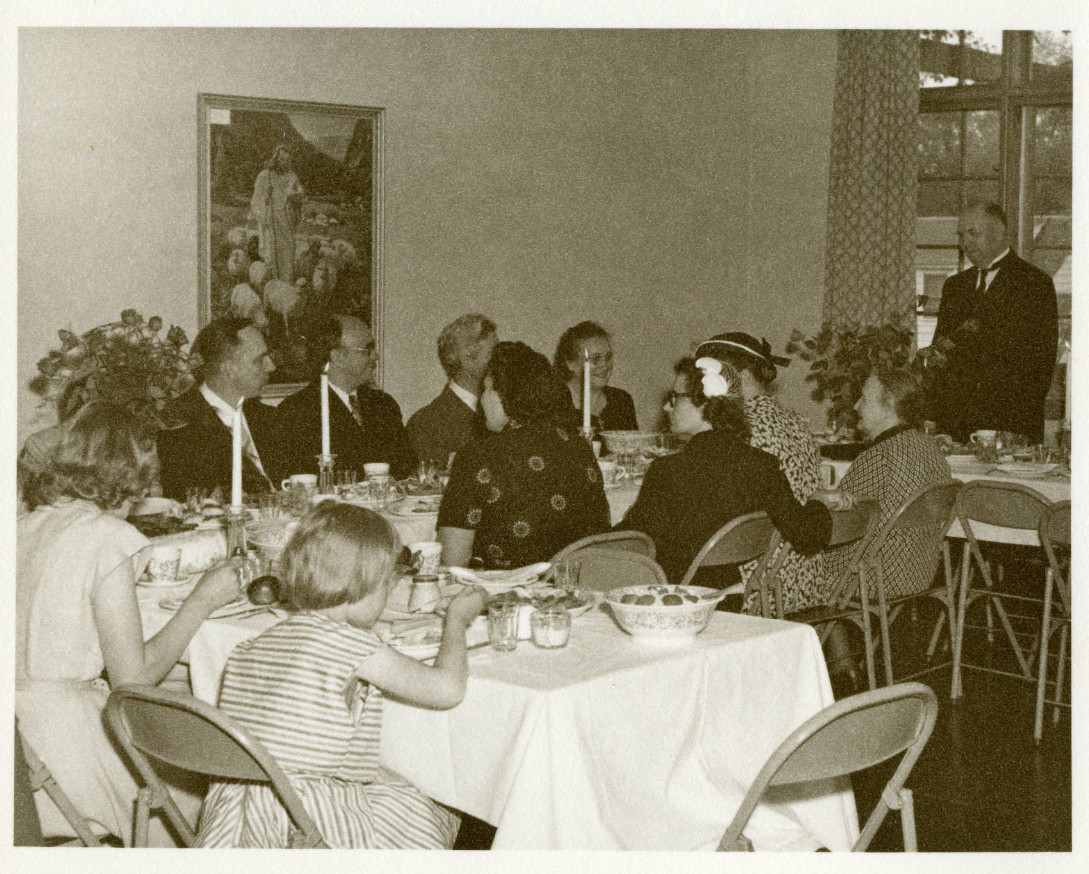
Local churches, especially St. John’s Lutheran Church, continued to offer various means of support for DPs after helping them secure sponsors and transportation to Northfield. They held supplementary English classes to help families integrate into the community.15 Well-connected members of the church, especially Pastor Biorn, often helped organize assistance for families struggling with specific things like loan repayment or familial conflicts.16; 17 St. John’s also offered cultural and communal support, holding church services in Latvian and Estonian and providing meals for DPs.18; 19
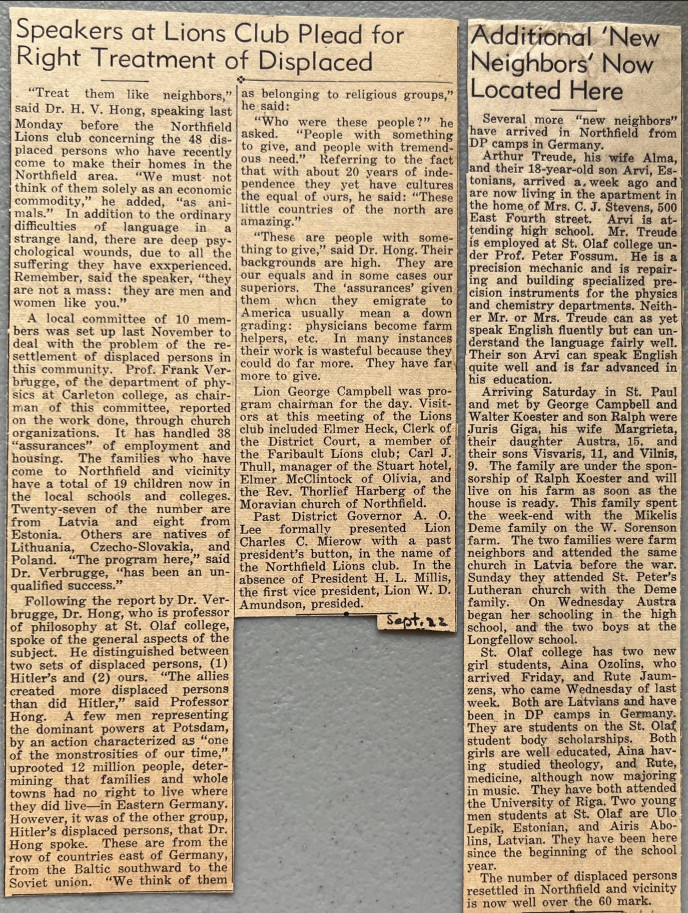
Members of St. John’s devoted their efforts to helping the Northfield community adjust and be welcoming to the DPs. Dr. Hong, who himself adopted two DP children, spoke at the Northfield Lions Club encouraging Northfielders to see the humanity of the DPs in their community and “not think of them solely as an economic commodity”. 20
Other nearby churches and religious organizations also gave support, often with organizing help from St. John's, which set up a series of 'Lutheran Welfare Workshops' to tell DP stories and attract new sponsorships.21 DPs living on farms outside town such as the Giga family received help from rural churches such as Valley Grove Lutheran, which supplied food and clothing for the Gigas.22
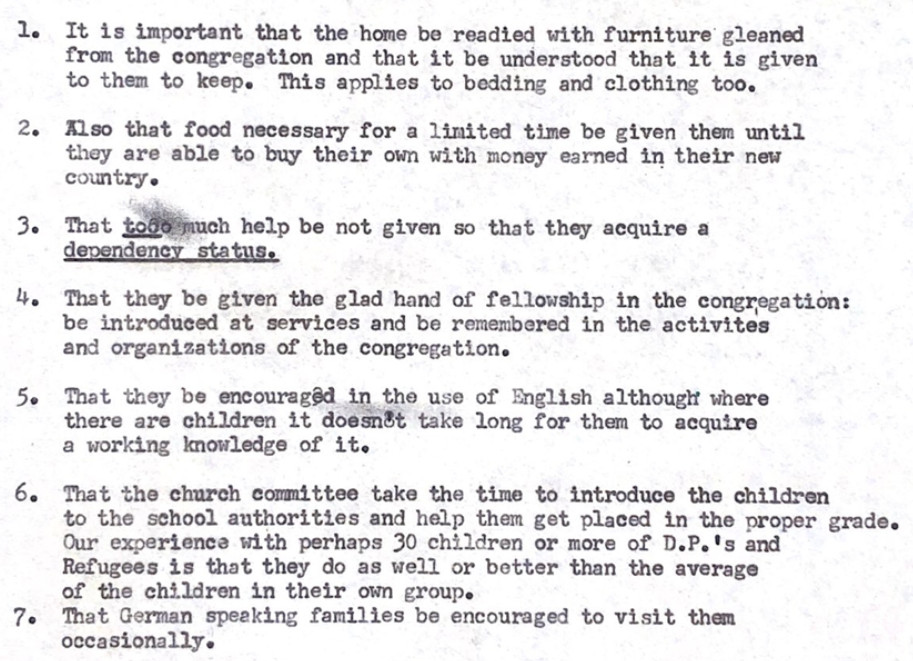
St. John’s Lutheran Church & Northfield Local Committee for Resettlement of Displaced Persons
In January of 1946, St. John’s congregation appointed a committee to work on the Lutheran war relief, in cooperation with the Lutheran World Action and Lutheran World Relief. A Reverend was selected from St. John’s congregation as a “representative on the mission field”.23
The Committee for the Resettlement of Displaced Persons here consisted of: Dr. Frank Verbrugge, George Campbell, Mrs. C. B. Helgen, Mrs. Olaf Christiansen, Albert Quie, and Mrs. P. E. Fossum. Pastor Boral Biorn also contributed substantially to it.24
The Committee and St. John's did outreach in Northfield to recruit sponsors, and provided assurance forms like the one you see on the right, which has been highlighted and annotated (see key) to showcase important parts of the process. Members of the Committee helped sponsors complete the forms and sent them to the Lutheran Resettlement Service of Minnesota for processing.
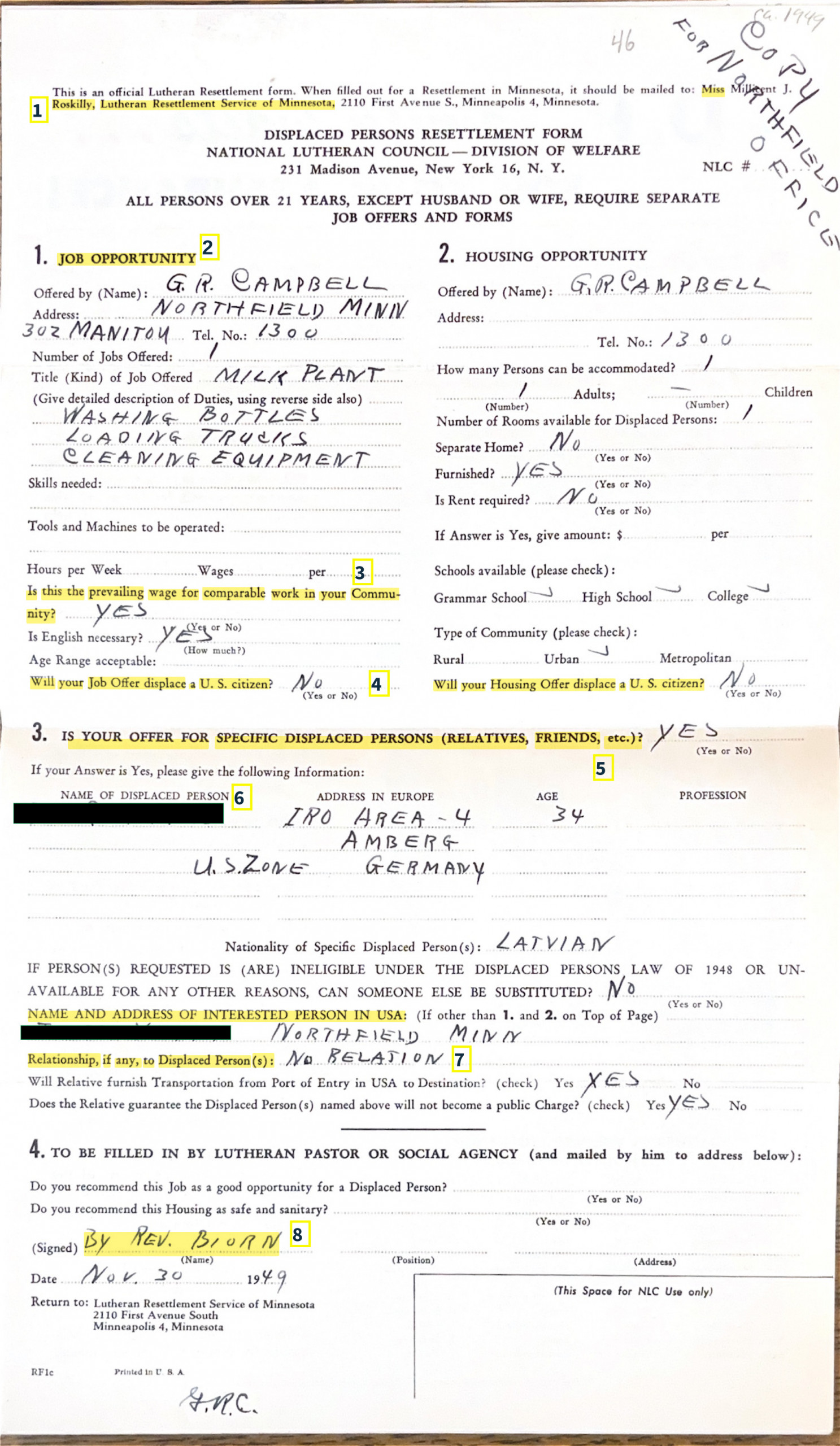
1: Millicent Roskilly played a large role in bringing DPs to Northfield. Members of the Resettlement Committee frequently corresponded with her to find suitable candidates for resettlement
2: DP families could only be resettled if they could support themselves financially
3: Sponsors had to ensure that the resettled people would be paid fairly
4: The community had to be able to accommodate the resettled DPs without pushing out other residents
5: Assurances could be completed for a specific DP or family, or as a general request which would be matched to a candidate
6: This assurance was completed for a single male, but assurances were often made to entire families. Usually, the employment offer would go to the husband/father in the family
7: Previously resettled people often brought over friends or relatives
8: Local church leaders, like Pastor Biorn of St. John's, certified the assurances
Moving On
The jobs and homes provided by sponsors met DPs’ needs for a time, but after the one year period of their assurance was up, most chose to seek new opportunities. The LWF resettlement program had matched them with sponsors primarily based on the needs of the host instead of the skills or experience of the DPs. This often meant basic jobs such as farm help or custodial work. Once families had settled and adjusted to life in the United States, many sought more lucrative careers in other cities. Juris Giga for example moved his family to Owatonna to work with the Owatonna Tool Company.25
Cultural identity also influenced families’ decision to move away from Northfield. Many Latvians moved to Wisconsin, which had had a significant Latvian community in the northern part of the state since the early 20th Century. This drew many Latvians to Wisconsin in the 1940s and 50s, many of whom settled and established communities in Milwaukee.26
Sources
- “Partial List of Displaced Persons Settled Around Northfield Minn 1947-1955”, November 10, 1964, George R. Campbell, Displaced Persons Records, Scrapbook, Northfield Historical Center Archive, Northfield, Minnesota.
- “Displaced Persons Resettlement Form”, 1949, National Lutheran Council – Division of Welfare, DP Resettlement Employment Forms 1950-1951, Box 3, St. John’s Lutheran Church Archives, Northfield, Minnesota.
- Various newspaper clippings describing English instruction, Fram Fram #4, Box 2, St. John’s Lutheran Church Archives, Northfield, Minnesota.
- Vilnis Giga, Latvian Displaced Person resettled in Northfield, interviewed by Ned Whipple, Ella Nielsen, and Dr. Amanda Randall, June 17, 2026.
- “Resettlement Form”, National Lutheran Council.
- Craig Koester, Grandson of DP sponsor Walter Koester, interviewed by Ned Whipple, Ella Nielsen, and Dr. Amanda Randall, June 17, 2026.
- E. Hong, “St. John’s Great Decade of Sharing, 1947-1957”, in The Book of a Century 1869-1969, E. Hong, (1969), 108.
- “Report to House Denies D.P. Act Lets Reds Enter”, Newspaper clipping, January 21, 1950, Robert J. Donovan, New York Herald Tribune, Box 3, St. John’s Lutheran Church Archives, Northfield, Minnesota.
- “Resettlement Form”, National Lutheran Council
- “‘Kathe Becomes One of Us’, Says Local Teacher in Telling of DP’s Here”, Newspaper clipping, undated, author unknown, Box 3, St. John’s Lutheran Church Archives, Northfield, Minnesota.
- “Resettlement Form”, National Lutheran Council
- Rene Koester, Grandson of DP sponsor Walter Koester, interviewed by Ned Whipple, Ella Nielsen, and Dr. Amanda Randall, June 17, 2026.
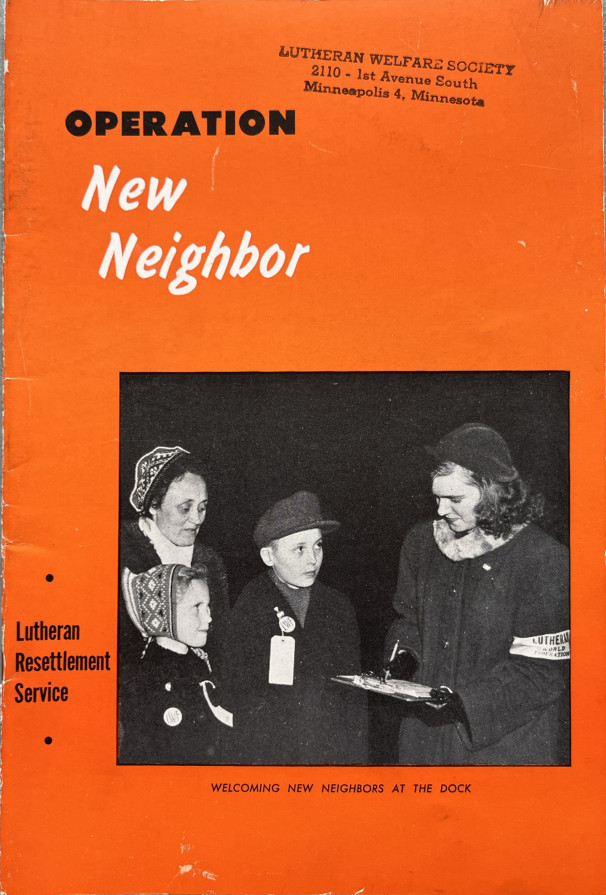
- “Operation New Neighbor”, Lutheran Resettlement Service booklet, 1949, National Lutheran Council, Box 3, St. John’s Lutheran Church Archives, Northfield, Minnesota, 14-19.
- C. Koester, interview
- “English Class”, Notebook, undated, Howard Hong, Hong Kierkegaard Library Archives, St. Olaf College, Northfield, Minnesota.
- Letter to Pastor Boral Biorn asking him to talk with a DP family about a loan, November 24, 1964, Mildreth N. Meyer, Box 1, St. John’s Lutheran Church Archives, Northfield, Minnesota.
- Letter to Rice County Welfare Board recommending working with Pastor Boral Biorn to help a DP girl having conflict with her parents, September 22, 1958, Sara D. Nordlie, Binder 2, Box 1, St. John’s Lutheran Church Archives, Northfield, Minnesota.
- Various documents and letters regarding preparation for and invitations to Estonian and Latvian church services at St. John’s, 1950, various authors, Personal Record Papers for the Displaced Persons Who Were Guaranteed Through St. John’s Congregation 1949-1955, Book 1, Album 1, Box 1, St. John’s Lutheran Church Archives, Northfield, Minnesota.
- St. John’s Lutheran Church, Photograph of displaced persons eating at St. John's Lutheran Church, c. 1950.
- “Speakers at Lions Club Plead for Right Treatment of the Displaced”, Newspaper clipping, undated, author unknown, Box 3, St. John’s Lutheran Church Archives, Northfield, Minnesota.
- “Resettlement Form”, National Lutheran Council
- V. Giga, interview.
- E. Hong, Book of a Century
- E. Hong, Book of a Century
- V. Giga, interview.
- Juris Veidemanis, “Latvian Settlers in Wisconsin: A Comparative View,” The Wisconsin Magazine of History 45 (Summer 1962), 254.
Images
- “Northfield Given Credit as Largest DP Settlement in Minnesota”, scan of original clipping, Northfield News, undated. Used with permission of Northfield News.
- Bryan, Rene, and Craig Koester, Vilnis Giga, interview with Ned Whipple, Ella Nielsen, Dr. Amanda Randall, photo by Olivia Schmidt, June 17, 2026.
- “Operation New Neighbor” booklet cover, scan of original, National Lutheran Council, 1949. Used with permission of St. John's Lutheran Church.
- “Pathetic Letter to Local Girl Tells of DP’s Plight in Germany” newspaper clipping, scan of original, Northfield News, undated. Used with permission of Northfield News.
- Photo of DPs sharing a meal at St. John’s, St. John’s Lutheran Church, c. 1950. Used with permission of St. John's Lutheran Church.
- Part of a letter from Pastor Boral Biorn, scan of original, St. John’s Lutheran Church. Used with permission of St. John's Lutheran Church..
- “Speakers at Lions Club Plead for Right Treatment of Displaced” and “Additional ‘New Neighbors’ Now Located Here” newspaper clippings, scans of originals, Northfield News, undated. Used with permission of Northfield News.
- “Displaced Persons Resettlement Form”, scan of original, National Lutheran Council - Division of Welfare, 1949. Used with permission of St. John's Lutheran Church.