
Variation in Storytelling and Translation of “Kobutori”
by Tiana Pay '29
The Folktale "Kobutori"
Synopsis: “Kobutori” (瘤取り, taking the lump), also known as “Kobutori jīsan” (こぶ取り爺さん, lump-taken old man), is a well known folktale in Japan. Generally, the story tells of two old men, both with a lump (also translated as a tumor, wen, or cyst) on their faces. One old man goes to the mountain to cut wood, but is forced to take shelter due to heavy rain. Once the rain lets up, he witnesses supernatural beings throwing a boisterous gathering. These being are depicted as either tengu (天狗)—powerful deities or supernatural beings that have red faces, long noses, and wings to fly—or oni (鬼)—troublemaking supernatural creatures that have red, green, or blue skin, with horns, sharp and elongated teeth, claws, wild hair, and iron clubs. Spurred on by the lively atmosphere and his love of dancing, the old man comes out of hiding to dance for them. He dances so well that they take the lump off his face to encourage him to come back. Once he returns home, he tells the story of what happened, whereby the second old man attempts to do the same as the first to have his lump removed. However, he cannot dance as well as the first, and the creatures, offended by his lack of skill and wanting never to see him again, put the lump they removed from the first old man onto the second, leaving him with two.
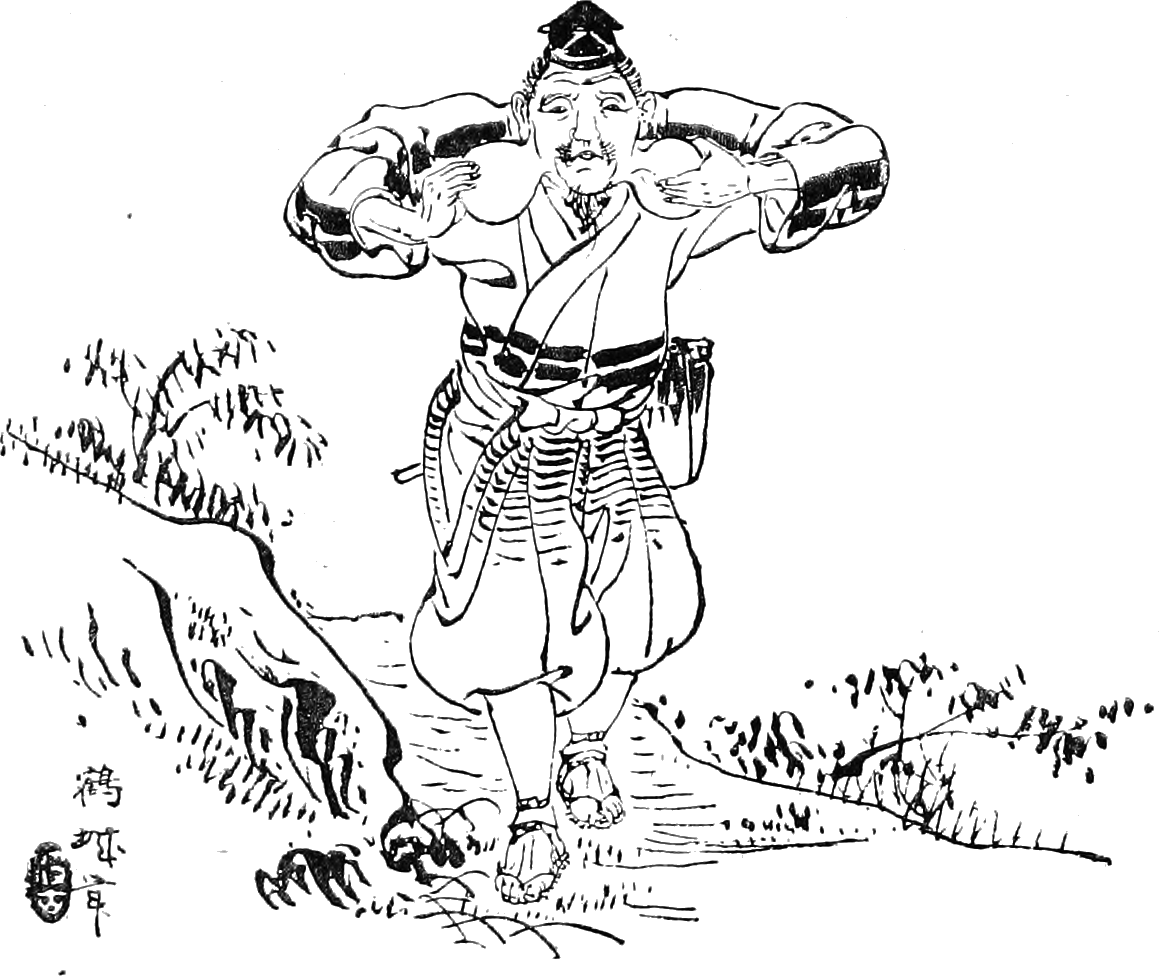
Fujiyama Kakuzō, [Kobutori], 1903. Illustration printed in Yei Theodora Ozaki, Japanese Fairy Book (London; Bombay; Sydney New York: Constable and Company Limited; E. P. Dutton and Company, 1903), 281.
Reverend James Curtis Hepburn used “Kobutori” as the basis forThe Old Man and the Devils, his contribution to Hasegawa Takejirō’s (長谷川武次郎, 1853-1938) Japanese fairy tale series. Hepburn first came to Japan in 1859 as one of the first medical Presbyterian missionaries. While in Japan, he learned Japanese through reading novels and stories in colloquial Japanese. This assisted his curation of the first Japanese-English dictionary, in addition to translating the Bible. He also developed a standardized system for romanizing Japanese called the Hepburn system that is still used today. He was also one of the first to translate “Kobutori” into English, and through his collaboration with Hasegawa, reached wide audiences with it.
Hepburn references the Ujishūi monogatari (宇治拾遺物語) for his translation, but many versions of the story exist within Japan. Through translations such as Hepburn’s, these stories have also spread outside of Japan and captured the interest of the Western world.
This essay proceeds in two parts to analyze these varying approaches to telling the story of “Kobutori.” I first address various renditions inside Japan. Then, I explore the various ways these stories have been translated into English in an investigation of the evolving significance of folktales.
Variants of “Kobutori” in Japan
“Kobutori” was first recorded in writing in the thirteenth century in the Ujishūi monogatari. However, there are many regional variations and contemporary literary adaptations that offer interesting insights into the malleability of the narrative and contemporary role of folktales.
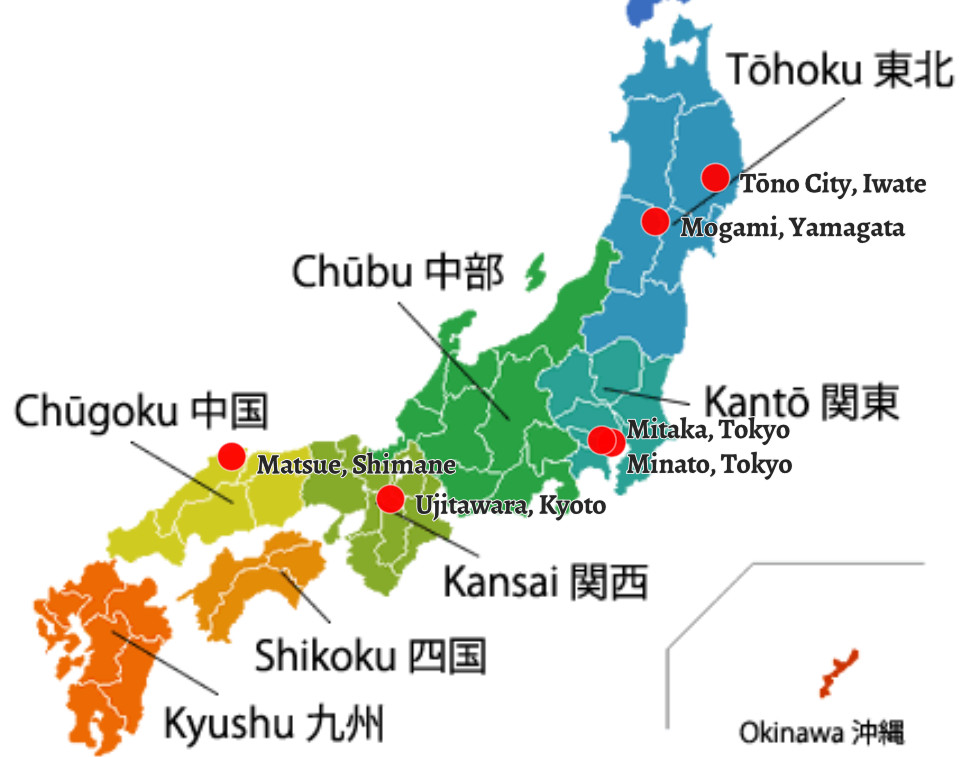
I examine six different renditions of the folktale found in Japan: one found in the classical text of the Ujishūi monogatari, two recorded by folklorists Yanagita Kunio (柳田国男, 1875-1962) and Seki Keigo (関敬吾, 1899-1990), and three written by professional writers—Iwaya Sazanami (巌谷小波, 1870-1933), Dazai Osamu (太宰治, 1909-1948), and Brittany Partin (dates unknown).
| Title | Author | Publication Date | Location |
| Oni ni kobu torareruru koto (鬼に瘤取られるる事) | Unknown | c. 1212-1221 | Ujitawara, Kyoto (京都府宇治田原町) |
| Kobutori (瘤取り) | Iwaya Sazanami (巌谷小波) | 1895 | Minato, Tokyo (東京都港区) |
| Kobutori (瘤取り) | Dazai Osamu (太宰治) | 1945 | Mitaka, Tokyo (東京都三鷹市) |
| Kobutori jīsan (瘤取爺) | Yanagita Kunio (柳田国男) | 1948 | Mogami, Yamagata (山形県最上町) |
| Kobutatsu (瘤たつ) | Seki Keigo (関敬吾) | 1956-1957 | Tsuchibuchi, Iwate (岩手県遠野市) |
| The Dancing Old Man with a Lump on His Cheek | Brittany Partin | 2013 | Matsue, Shimane (島根県松江市) |
Being the oldest recorded version of the tale, the Ujishūi monogatari offers a foundation upon which to compare other renditions of the story. Yanagita and Seki’s versions offer insight into regional variations, as well as Japan’s newfound academic interest in the value of folktales through the field of folklore studies. Finally, writers such as Iwaya, Dazai, and Partin demonstrate how contemporary considerations and circumstances impact their retellings, highlighting the versatility and adaptability of folktales for modern audiences.
Regional Rariants
These renditions of the folktale originated from four different regions in Japan: Chūkoku (中国), Kansai (関西), Kantō (関東) and Tōhoku (東北). Versions of "Kobutori" written by professional writers generally come from Tokyo (part of the Kantō region), while the versions the folklorists collected are from two prefectures in the Tōhoku region. I included a variation of the folktale recorded by a foreigner to Japan as well. Despite her work being a translation, and therefore outside of its original Japanese context, it still captures the essence of the region’s retelling of the folktale. While there are not many significant disparities resulting from regional differences in these selected works, there are some details worth noting.
First, the retelling Seki recorded in Iwate prefecture and Partin recorded in Shimane prefecture opt to include tengu instead of oni. This is a relatively common disparity that manifests among variants of the folktale.
There are few behavioral differences between the two creatures in the tale, making this detail easily interchangeable. However, the versions that use tengu usually include less of them than there are oni in versions where oni are used. For instance, in Seki’s rendition, there are only five or six tengu, and in Partin’s, there are only three. Conversely, there is usually a large group of oni, with some retellings, such as that found in the Ujishūi monogatari, describing there to be around a hundred of them. Another difference that can manifest with the use of tengu instead of oni is the setting of the tale. In Seki’s variant, the tale is set in a shrine that the two old men go to to pray for their wens to be gone. Interestingly, in this version the old men face the supernatural creatures together, whereas typically, they encounter them in succession. One outlier to this comparison between oni and tengu is Yanagita’s variation of the tale. Instead of oni or tengu, the creatures are bakemono (化物), a general term encompassing most monsters in Japanese folklore.
We also see regional differences in the reason the second old man has the lump placed on his face. In Partin’s retelling, the lump is gifted to the second old man as a reward for dancing so well, despite him seeking out the tengu to remove it for him. This contrasts with most variations—typically, the creatures return the lump to him so they never have to see his awful dancing again, or, as in Yanagita’s version, as retribution for being too afraid to dance at all. In a similar vein, in Seki’s variantion, the lump is removed as a gift to the first old man for dancing so well, rather than as a promise for his return, and then placed on the second as a punishment for dancing so poorly. Seki’s version displays another particularly intriguing difference: the lumps are not located on the old men’s cheeks, but rather on their forehead and nose. This detail is especially uncommon, as most renditions agree that the first old man has a lump on his right cheek, while the second old man has a lump on his left cheek.
Many more interesting findings can be made by comparing regional variations of this folktale—indeed, other regional versions display even greater disparities than found in those I selected. However, I would like to shift to focus on the differences in the retelling of the folktale by professional writers. While most regional versions are oral traditions and circulate among a limited community, professional writers seek to capture and impact a national audience.
Contemporary Audience Adaptations
Iwaya Sazanami wrote his popular adaptation of “Kobutori” in 1895. It gained significant international renown at the time, and was frequently translated into English. Fifty years later in 1945, Dazai Osamu wrote his own retelling of the tale. Both display significant alterations that highlight the writers’ beliefs and Japan’s contemporary circumstances.
Iwaya Sazanami is widely regarded as Japan’s father of children’s literature. Much of his writing for children was influenced by Western fairy tales; he studied German and valued Western fairy tales’ structures, morals, and ability to influence youth.1Aafke van Ewijk, “Premodern Warriors as Spirited Young Citizens: Iwaya Sazanami and the Semiosphere of Meiji Youth Literature,” Japan Forum 35, no. 3 (2023): 354-355, https://doi.org/10.1080/09555803.2021.2008471. As a Meiji era writer, his works reflect the nationalistic and imperialistic ideologies that gained precedence in Japan as it tried to redefine itself as a modern nation-state. However, he emphasizes adventurous, imaginative, and spirited dispositions over moral and nationalistic lessons in his writing. He saw these characteristics as necessary for Japanese youth to mature into men like those in the West and allow Japan to achieve the same level of international success.2van Ewijk, 355.
Iwaya’s retelling of “Kobutori” follows the same plotline as the Ujishūi monogatari, but he makes major alterations to fit it into his ideal model of a children’s story. He emphasizes that the “good” old man was rewarded while the “wicked and disagreeable” one was punished, demonstrating didactic intent. Moreover, he highlights the adventurousness and courageousness of the old men who were willing to dance in front of oni despite the danger. Typically, the second old man is depicted to be so frightened that he cannot dance well, but Iwaya instead depicts him as having the same bravery as the first old man, only lacking the dancing skills to have his lump removed. This highlights Iwaya’s view that appropriating folktales to offer “indirect teachings” is a valuable way to impart Meiji values on children and guide the development of their characters.3van Ewijk, 355-356. This also demonstrates the influence of Western fairy tale traditions and Meiji ideals on his writing. Thus, his retelling is longer, more detailed, and more accessible to children readers than other renditions of the tale.
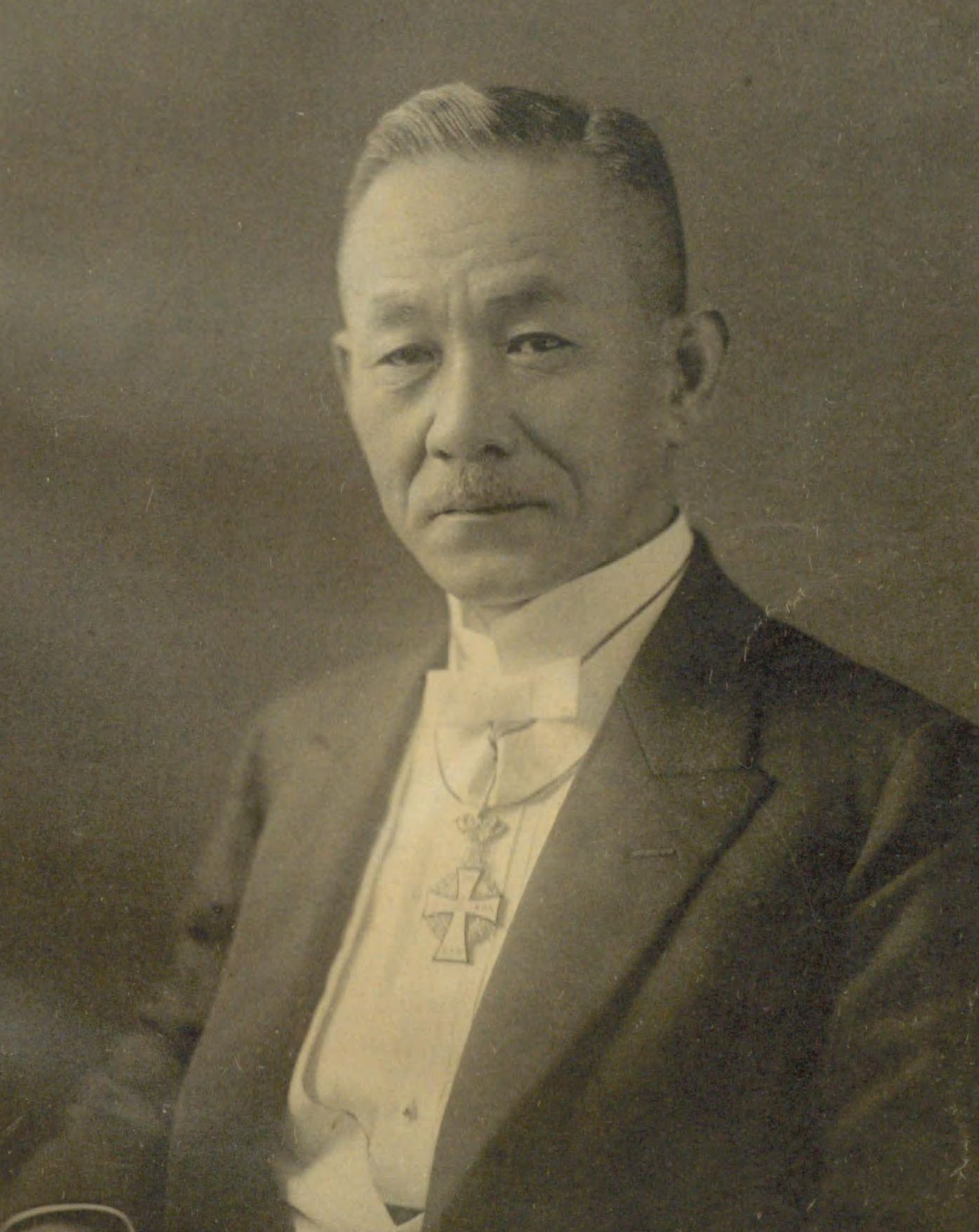
Sazanami Iwaya, 1928-1930. Portaits of Modern Japanese Historical Figues, National Diet Library, Japan.
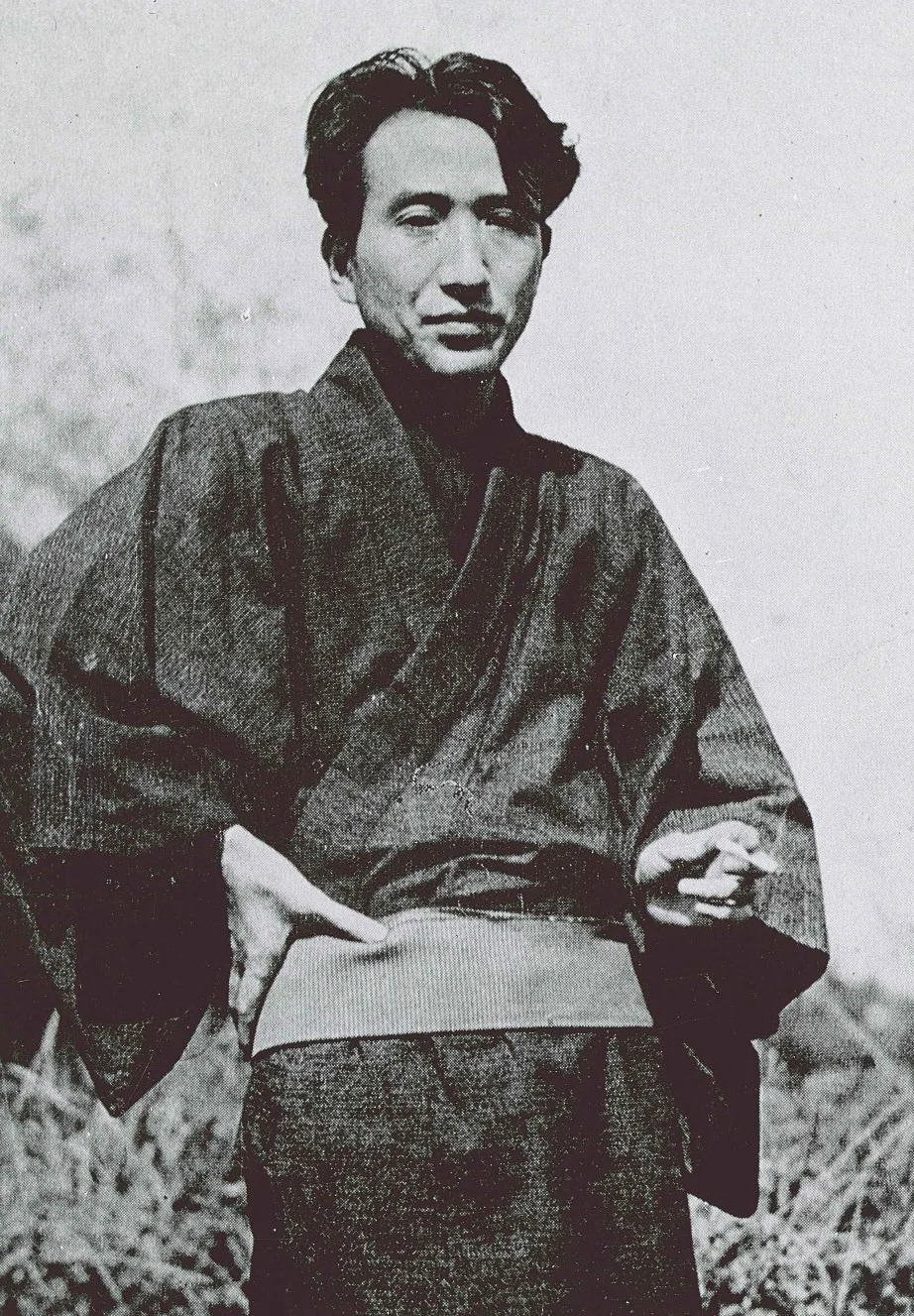
Yoshiaki Watanabe, Osamu Dazai in Mitaka, Tokyo, 1944. Wikimedia Commons.
Dazai Osamu is well known for his works published in post-war Japan, which capture the despair felt by many Japanese after the war.4Reiko Nemoto, “Research Starters | Osamu Dazai: Japanese novelist and short-story writer,” EBSCO, accessed July 29, 2026, https://www.ebsco.com/research-starters/history/osamu-dazai. His writing is characterized by illustrations of suffering and the less appealing features of human nature as beautiful, insertions of characters reminiscent of himself and his experiences, and use of self-deprecating humor.5Nemoto. All of these qualities can be found in his retelling of “Kobutori.” First, he does not write for a child audience. Although the narrator in the story is a father reading the tale to his child, the actual writing itself is not simple and easy to understand. Moreover, Dazai vastly alters the plot—the narrator tells his own version of the tale, being about an old man with a drinking problem, while in a shelter during an air raid.
In the tale, the old man, while still having his lump removed on the basis of his good dancing skills, did not want to have it removed. In fact, he thought of it fondly as it warded off his loneliness. While the Ujishūi monogatari similarly describes the old man asking for anything but his lump to be taken, he does not act remorseful after the event, while in Dazai’s version, the old man is depicted to have conflicting thoughts about it. Furthermore, the second old man was successful and respectable, not bad, disliking his lump for being a hindrance to him and his worth. He sought out the oni to get his lump removed, but scared them off with his rather unique dancing. Through this, Dazai emphasizes that despite the second old man not necessarily doing anything wrong, he was punished, showcasing the unfairness of reality in comparison to what stories tell us to expect should happen. He ends the tale with, “Try drawing a moral from this story and you’re in real trouble. So why did I bother telling the tale? If the anxious reader presses me on this question, I’d have to answer that there’s always something both tragic and comical in people’s very nature. It’s a problem at the very core of our lives, and that’s really all I can say,”6Osamu Dazai, Crackling Mountain and Other Stories, trans. James O’Brien, with Internet Archive (Rutland, Vt. : C.E. Tuttle Co., 1989), http://archive.org/details/cracklingmountai0000daza. questioning conventional stories’ inconsistency with real life.
Moreover, Dazai emphasizes the old men’s families, not just their experiences with their lumps, placing the tale closer to the readers in relatability and emotional connection. There are many asides throughout the tale as well—the narrator chides himself for not being more educated in folktales or not knowing what a true oni looks like for lack of personal encounters with them—which highlight Dazai’s distinctive storytelling style that employs a highly active and involved narrator. Overall, Dazai’s retelling emphasizes everything that he found salient at the time, such as the ongoing World War II, unpolished depictions of human experiences, and the reality of life not reflecting one’s virtue. Out of all of the retellings I analyzed, Dazai’s stands out for its literary genius and expression, completely flouting expectations of the original folktale, as well as typical writing conventions in general.
Through investigating the retellings of “Kobutori” in Japan, the extent of variation in Japan’s folklore tradition becomes apparent. Each rendition of the tale—adapted to fit regional oral traditions, to influence children to exemplify nationalistic values, or to question human nature in a time of suffering and uncertainty—reflects the identity of the storyteller and the influence of the state of contemporary Japan. These numerous adjustments and appropriations of folktales to suit various needs is testimony to the continued significance of the folktale tradition in Japanese society.
Translations of “Kobutori”
“Kobutori” also has many English translations. These, too, reflect the individual tastes and motivations of the translator, and demonstrate significant variation through time.
I examine eight different translations of the folktale: three translations of the Ujishūi monogatari’s rendition—by John Carey Hall (1864-1926), James Curtis Hepburn (1815-1911), and Royall Tyler (1936-)—and five translations of later renditions of the tale—Yei Theodora Ozaki’s (1870-1932) translation of Iwaya, James O’Brien’s (dates unknown) translation of Dazai, Robert J. Adams’ (dates unknown) translation of Seki, Fanny Hagin Mayer’s (1899-1990) translation of Yanagita, and Brittany Partin’s written translation of oral tradition.
| Japanese Title | Author | Publication Date | English Title | Translator | Translation Date |
| Oni ni kobu torareruru koto (鬼に瘤取られるる事) | Unknown | c. 1212-1221 | The Story of the Man with the Wen | John Carey Hall | 1875 |
| Oni ni kobu torareruru koto (鬼に瘤取られるる事) | Unknown | c. 1212-1221 | The Old Man and the Devils | James Curtis Hepburn | 1886 |
| Oni ni kobu torareruru koto (鬼に瘤取られるる事) | Unknown | c. 1212-1221 | Lump Off, Lump On | Royall Tyler | 1987 |
| Kobutori (瘤取り) | Iwaya Sazanami (巌谷小波) | 1895 | How an Old Man Lost His Wen | Yei Theodora Ozaki | 1903 |
| Kobutori (瘤取り) | Dazai Osamu (太宰治) | 1945 | Taking the Wen Away | James O'Brien | 1989 |
| Kobutori jīsan (瘤取爺) | Yanagita Kunio (柳田国男) | 1948 | The Old Man Who Got a Tumor | Fanny Hagin Mayer | 1985 |
| Kobutatsu (瘤たつ) | Seki Keigo (関敬吾) | 1956-1957 | The Old Men Who Had Wens | Robert J. Adams | 1963 |
| n/a | n/a | n/a | The Dancing Old Man with a Lump on His Cheek | Brittany Partin | 2013 |
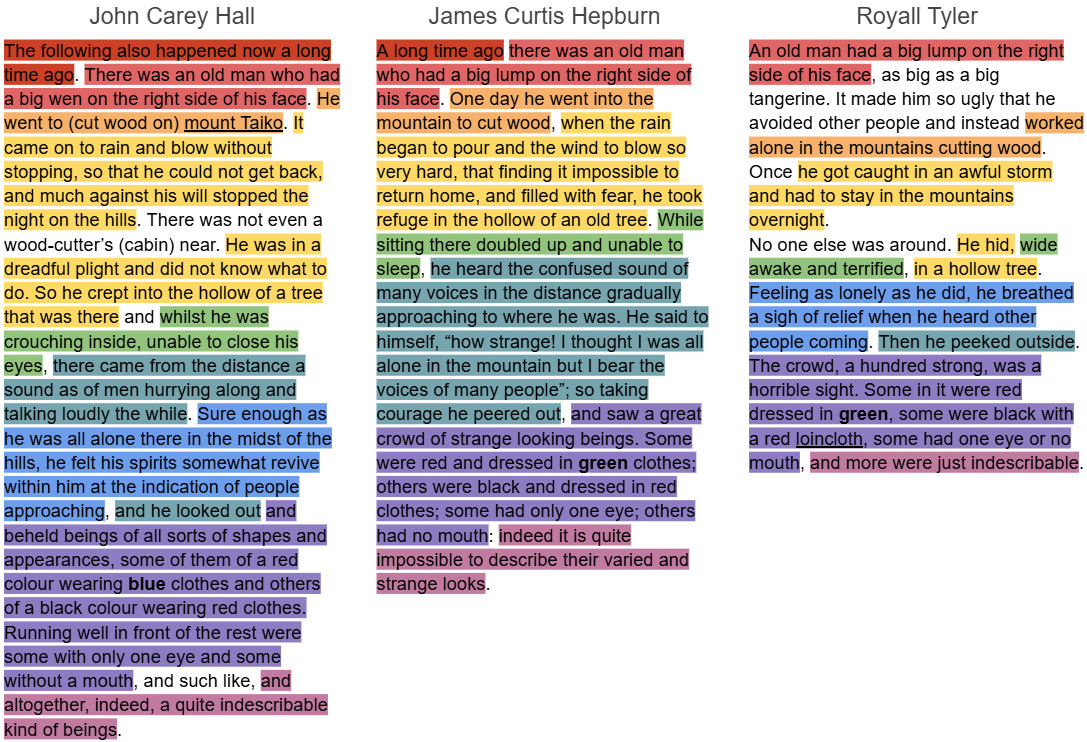
Hall, Hepburn, and Tyler all translated the same text, but for different audiences and at different points in time. Hall and Hepburn’s translations are one of the earliest English versions of the tale, while Tyler offers a more contemporary translation. This comparison shines light onto what factors induce variability in translation, and how individual translators approach a translation.
The five translations based on later Japanese adaptations of “Kobutori” also provide more perspective on the ever-evolving nature of this folktale. Ozaki’s translation of Iwaya’s work offers an alternate lens through which to view “Kobutori” and its role in children’s literature with her similar, but differing, audience. O’Brien’s emphasis on literature and its comparative value enhance the quality and reliability of his translation, which in turn highlights the significance of Dazai’s work for contemplation in the West. Adams’ strong devotion to maintaining the original Japanese feel of the text marked his translation as noteworthy, while Mayer offers her distinguished folklorist perspective to her translation of Yanagita’s work. Finally, Partin translates freely from oral tradition, offering another angle to explore translations of folktales from.
Translations of Ujishūi monogatari’s “Kobutori”
First, I’ll examine the three translations of “Kobutori” as found in the Ujishūi monogatari, translated in 1875, 1886, and 1987. They were translated—respectively—by John Carey Hall, a consular and legal worker in Japan,7J. E. Hoare, “John Carey Hall (1864–1926): A Career in Japan and the Japan Consular Service,” in Britain & Japan Biographical Portraits Vol X, ed. Hugh Cortazzi, Britain & Japan: Biographical Portraits (Amsterdam University Press, 2016), https://doi.org/10.1017/9781898823469.023. James Curtis Hepburn, a medical missionary, and Royall Tyler, a professor of Japanese language and literature at the University of Oslo with a Ph.D. in Japanese literature.
Hall translates the text almost exactly as written in the Ujishūi monogatari, even writing “saké” instead of translating it to “wine” like both Tyler and Hepburn do. The only notable discrepancies arise from the influence Victorian England’s fairy tale tradition had on his translation: he translates “oni” to “elves,” and ends with “Moral. People ought not to feel envious,”8C. W. Goodwin, “On Some Japanese Legends,” Transactions of the Asiatic Society of Japan, vol. 3, part 2, (Vaduz: Kraus Reprint Limited 1875), 54-57, https://babel.hathitrust.org/cgi/pt?id=uc1.31175002426693&seq=684 which is not included in the original text. He additionally excludes the comparison of the old man’s lump to a mandarin orange, though it is not clear why. Hall’s literal translation was a result of his intended audience—instead of translating the tale for the general public to enjoy, like Hepburn and Tyler, he instead translated it for his friend Charles Wycliffe Goodwin’s essay for the Asiatic Society of Japan. In other words, his translation is intended to assist with scholarly pursuits rather than entertain children or a general audience, accounting for the extent to which he translates the text literally.
That being said, Tyler’s translation is also relatively faithful. The title he creates for the tale, “Lump On, Lump Off,” is the first indication of the changes he does make, however. Besides Hepburn, who chooses to uniquely title his work The Old Man and the Devils, this creativity with the title is not seen in the other translations. This alteration reflects Tyler’s emphasis on creating a tale that is understandable and enjoyable not just to Western readers, but to a modern audience. To accomplish this, he excludes some of the details included in the original text that he sees as tedious and deductive to the retelling. He leaves out the beginning of the original tale, which starts “This also happened a long time ago,” providing the tale with a more active, forward moving pacing, and translates “sake” to “wine” and “oni” to “monster” to appeal to Western audiences. Outside of this, he does not make any sizable addition or alterations that distract from the original text, only enhancing its digestibility and accessibility to readers. This intention is also made clear through the introduction to his collection of translated Japanese tales, where he explains Japanese culture, customs, and imagery. He thus saw his translation as educational, allowing the reader to experience Japanese culture and become more acquainted with it.
When compared to these two examples, Hepburn’s translation published by Hasegawa is the least faithful to the original text. While he also simplifies the text to make it more straightforward and accessible, he takes it a step further than Tyler does, cutting more details and misrepresenting parts of the text. For example, his translation of “oni’ to “devil” and framing them to be adverse to light adapts the story to a Western, Christian perspective in a way that neither Hall nor Tyler attempt. He additionally adds dialogue where there originally is none, or excludes dialogue and major details of the tale, such as the oni chief being entertained by his underlings. He also misrepresents the lump, as instead of depicting the conclusion that the lump is lucky to be based on the oni’s assumptions, his writing presents this to be a fact of Japanese culture. Furthermore, he depicts the old man as not minding giving away his lump, when the original text maintains that he specifically asked for them to take anything but his lump. Overall, as Hepburn was writing for a general and not academic audience, he, like Hall, adapts the tale to better fit their expectations. However, unlike Hall, he takes a lot more liberty in his translation to subtly adapt it to his worldview and suit his purposes of proselytizing.
Translation of Later Adaptations of “Kobutori”
Beyond translations of the Ujishūi monogatari’s “Kobutori,” there are also translations of Yanagita and Seki’s folktale collections, as well as Iwaya and Dazai’s literary adaptations of the tale.
Yei Theodora Ozaki, a writer of Japanese and English heritage, was one of the first to translate Iwaya’s retelling of the tale to English, completing her translation in 1903. She does not translate the work literally, and notes in her preface, “In telling these stories in English I have followed my fancy in adding such touches of local colour or description as they seemed to need or as pleased me, and in one or two instances I have gathered in an incident from another version.”9Yei Theodora Ozaki, The Japanese Fairy Book, [1st edition]. (C. E. Tuttle Co., 1970), xi-xii. Her lax approach to translation stems from her view of herself as a storyteller in her own right writing for a Western, child audience, similar to Lafcadio Hearn and his translations of Japanese folktales. This intended Western audience explains her translation of “oni” to “demon” and “sake” to “wine.” Furthermore, the influence Victorian fairy tales had on her writing is easily discernible in its tone, and especially through her dialogue. Overall, her translation of Iwaya’s work resembles Hasegawa’s translators’ translations, especially those of Kate James, Basil Hall Chamberlain, and Lafcadio Hearn.10Tiana Pay, “Translation in Japanese Fairy Tale Series: Hasegawa's English Translators,” Hasegawa's Whimsical World, 2026, https://pages.stolaf.edu/crepepaperbooks/essay-translation/.
Robert J. Adams translated Seki’s collection of folktales in 1963. As his translation is intended for academic purposes, namely to expand the study of Japanese folktales to Western scholars, his translation is very literal and faithful to the original. As such, he keeps the original Japanese when an English equivalent does not exist. He thus keeps the terms “tengu” and “shaku” followed by explanations of what these are (shaku being a Japanese measurement similar to a foot). Interestingly, he describes tengu to be "mischievous ogres.”11Keigo Seki, Folktales of Japan, trans. Robert J. Adams, Folktales of the World (University of Chicago Press, 1963), 127. Oni is also commonly translated to “ogre,” despite these two Japanese creatures being vastly different, and the potential for them to be translated the same way in English demonstrates the difficulty in accurately translating Japanese folktales into English. Adams keeps many onomatopoeic elements in Japanese, such as the songs the tengu and old men sing, adding an explanation of the nature of the onomatopoeic element for the latter (being imitation of instruments). This is not seen in other translations despite the high frequency of onomatopoeic language in Japanese. Overall, Adams' translation is very literal, managing to maintain the essence of the original text while also writing the tale in a compelling way.
Fanny Hagin Mayer, an American translator, educator, and Japanese folklorist, translated Yanagita’s collection of folktales in 1985. Her translation, also meant to serve as a reference for students of folklore studies, is literally and faithfully translated from Yanagita’s text. However, she translates “bakemono” to “ghosts,” which while not necessarily incorrect, is not, in this context, the most accurate translation. Bakemono is a general term, so the translation to “monster” may be better suited here. Otherwise, she maintains the original text’s very direct and concise style, only adding quotations to a section of the text that could be interpreted as being directly said by the bakemono, though is not indicated as such in the original. Overall, Mayer’s translation may be the most literal and faithful out of all the selected translations.
James O’Brien, a professor of Japanese literature at the University of Wisconsin-Madison, translated Dazai’s adaptation of “Kobutori” in 1989. His translation, while relatively faithful to the original in style, does display changes intended to improve the readability for English readers. O’Brien preserves Dazai’s exclusion of quotations around what would typically be considered a direct quote in English to maintain his style, but includes his own distinctive storytelling tone that is more sure and eloquent than Dazai’s long-winded and musing narrator. Nevertheless, O’Brien’s translation stands out from the others for the fact that he does not attempt to write for a children's audience or an academic one. Rather, he writes for the general populace, carefully translating the work to highlight its genius while minimizing the obvious signs of translation. As such, his translation uses more complex vocabulary and phrasing than seen in the other faithful translations. This may also be due to Dazai’s work being the most literarily advanced as compared to the other versions of “Kobutori,” naturally applying itself to a more sophisticated translation. O’Brien additionally uses footnotes to explain the many cultural references Dazai makes, streamlining his translation. However, while he keeps “sake” as is, he translates “oni” to “demon,” accepting it as a culturally similar enough equivalent. Overall, O'Brien's translation is the most similar to what is typically thought of as a translation—a literary work in its own right that allows the average reader to enjoy foreign works without knowledge of source language or culture.
Literal Translation of Dazai
That is to say that is just how I feel it was like, but it's not like I have a reference or anything. Originally, this Kobutori tale, appears to have come from the Ujishūi monogatari, but in this air-raid shelter, it's impossible to examine this original text or that one. Not limited to this Kobutori story, even in the story of Urashima-san which I plan to try telling next, first of all that fact was fastidiously recorded in the Nihon shoki, and also in the Manyō there is a chōka about Urashima, besides that, even turning to such things as the Tango fūdoki or the Honchō shinsenden, something similar seems to be passed down in them, and again, just in recent times there is Ōgai’s play, and didn’t Shōyō also make this story into a music dance drama, in any case, from noh plays, kabuki, all the way to geisha’s parlor dance, this Urashima-san’s appearance is innumerable.
といふやうな気がするだけの事で、別に典拠があるわけではない。もともと、この瘤取りの話は、宇治拾遺物語から発してゐるものらしいが、防空壕の中で、あれこれ原典を詮議する事は不可能である。この瘤取りの話に限らず、次に展開して見ようと思ふ浦島さんの話でも、まづ日本書紀にその事実がちやんと記載せられてゐるし、また万葉にも浦島を詠じた長歌があり、そのほか、丹後風土記やら本朝神仙伝などといふものに依つても、それらしいものが伝へられてゐるやうだし、また、つい最近に於いては鴎外の戯曲があるし、逍遥などもこの物語を舞曲にした事は無かつたかしら、とにかく、能楽、歌舞伎、芸者の手踊りに到るまで、この浦島さんの登場はおびただしい。
O'Brien's Translation (footnotes included)
That's how I remember it, but there's no way to check here in this air-raid shelter. Worse yet, I can't confirm whether this story was first told in The Tales of Uji (2), as seems to be the case. I’m a bit hazy about where the other stories got started, too—Urashima, for instance, which I plan to tell next. I am aware that the true story of Urashima is duly recorded in the Chronicle of Japan (3) and that there’s even a ballad on him in The Collection of Ten Thousand Leaves (4). And let’s see, now—besides that, there’s a similar tale in the Tango Gazetteer (5) and one in the Biographies of the Taoist Immortals (6) as well. Coming down to recent times, didn’t Ōgai (7) write a play about Urashima? And didn’t Shōyō (8) set the story to music for dancing? In any event, Urashima puts in countless appearances on the stage, whether in Noh, Kabuki, or geisha dancing.
2. The Tales of Uji is an anonymous collection of 197 tales, most likely compiled between 1180 and 1220. The range of works is from simple folktales to stories of religion and the supernatural.
3. The Chronicles of Japan or the Nihon Shoki, to give the work its well-known Japanese title, is the first officially sponsored account of the mythic origins and early history of Japan. The chronicle runs from the Age of the Gods to the reign of the Empress Jitō (686-97).
4. The Collection of Ten Thousand Leaves (Man'yōshū) is the first anthology of Japanese poetry, containing approximately 4,500 works in three distinct forms. The tale of how Urashima passed three years in an underwater realm only to return to his village and find everything changed and himself presently transformed into an old man is detailed in a chōka, or "long poem," in Book Three of the anthology.
5. A fudoki, or "gazetteer," was a compilation of reports in the eighth century on various natural features of a given region in Japan. The Tango Gazetteer survives only in fragmentary form.
6. The Biographies of the Taoist Immortals is a collection of marvelous tales compiled at the end of the eleventh century by Ōe no Masafusa (1041-1111).
7. Ōgai Mori (1862-1922) was one of Japan's greatest men of letters during the latter part of the Meiji period (1868-1912). He also pursued a career in the army medical corps, ultimately rising to the position of surgeon general.
8. Shōyō Tsubouchi (1859-1935) is best remembered as the first Japanese translator of Shakespeare's plays and as an advocate of reform of the novel and drama in Japan.
Brittany Partin, a blog writer and JET program member, wrote a retelling of “Kobutori” in 2013 that is also technically a translation. However, as she translated the tale from an oral version, it is difficult to gauge how faithfully she did so. As she sees herself as a writer, Hearn becomes a good comparison for her storytelling. Partin, like Hearn, has a very distinct storytelling style that hints at the translation not being faithfully recorded like folklorists Yanagita and Seki did for their collection of oral stories. Rather, she adapts the tale to fit her style, designating her as an author in her own right, rather than just a translator. Nevertheless, it is clear that she, like Hearn, sought to express the tale in an entertaining manner for Western audiences, resulting in her rendition completely avoiding the slightly awkward and stiff prose found in many of the other translations. She even explains what tengu are incredibly naturally in her text, writing, “One day, while out chopping wood in the forest, he came across a trio of tengu, that is, crow-like goblins that fly, control the weather with their special fans, and have egos almost as big as their noses are long.”12Brittany Partin, “‘The Dancing Old Man with a Lump on His Cheek,’” San’in Monogatari, October 12, 2013, https://saninstory.wordpress.com/2013/10/12/the-dancing-old-man-with-a-welt-on-his-cheek/. Her version of the tale is thus very accessible to Western audiences while allowing her creative freedom in her prose, though is not necessarily accurate to the original Japanese version.
As a whole, several noticeable patterns emerged from analyzing these translations. First, with the exception of scholarly translations, translations of “Kobutori” started off as much more volatile, with translators altering the text as they saw fit and making sizable changes to it. Later, while there was still emphasis on adapting the tale to become more comprehensible to Western audiences, the translators also began pulling the audience closer to Japan through explanations of Japanese culture and thought. This is accompanied by less arbitrary alterations of the original text, with an added emphasis on conveying the style of the original.
Overall, it becomes clear how salient the translator is in the translation process. Regardless of the original source material, the will of the translators themselves plays a substantial role in their work, with variations in religious beliefs, intended audiences, and writer autonomy vastly impacting the final translation. These decisions, such as how to translate “oni” or “sake,” while subtle, heavily influence how the reader interacts with and interprets this Japanese folktale. While none of the translators are necessarily wrong in their approach, noticing and gaining awareness of their decisions is essential to recognizing that a translated text may not accurately represent the original text in full, no matter how literal or faithful it is.
Throughout these translations, there is an underlying, driving force in the form of interest in Japanese culture. While this may seem obvious, it is fascinating to contemplate that, over the span of 150 years, Japan has continued to capture the interest of the West. Today, this interest in Japan is no less strong than it was in Europe during the rise of Japonisme, and may be even more intense now with the internet’s dissemination of Japanese culture. There has been a change in the telling of Japanese folktales abroad, however. While originally published in English with children in mind, this consideration has grown less salient throughout the years. Indeed, many of the compilations of Japanese folktales seen in English today do not consider a child audience at all, but an adult audience curious about Japanese culture. While English translations of Japanese folktales for children have not disappeared, translations of these folktales have evolved to take on a new role. Much like Hasegawa’s Japanese fairy tale series’s original purpose—to help teach English—Japanese folktales are now being used as a tool for Japanese language learners to enhance their studies. As these tales are written for Japanese children, they are well suited for beginning language learners to study with and absorb the culture naturally. As such, many English translations of the tale are now published alongside their original Japanese form. While modern interest in Japan and the Japanese language is largely sparked by Japanese popular culture, it is intriguing to see folktales, vestiges of traditional Japanese culture, afforded just as much interest.
I hope that, after reading this, you will consider each of Hasegawa’s fairy tales in a new light. While his translators’ collaboration and general interest in Japanese culture sparked their creation, and continues to motivate new translations to this day, the translated stories themselves have not remained static. They possess their own living quality to them, evolving to fit the contemporary needs of the populace. As a result, folktales continue to occupy a position of importance in our lives in spite of their ancient origins.
Works Cited
- 1Aafke van Ewijk, “Premodern Warriors as Spirited Young Citizens: Iwaya Sazanami and the Semiosphere of Meiji Youth Literature,” Japan Forum 35, no. 3 (2023): 354-355, https://doi.org/10.1080/09555803.2021.2008471. ↩︎
- 2van Ewijk, 355. ↩︎
- 3van Ewijk, 355-356. ↩︎
- 4Reiko Nemoto, “Research Starters | Osamu Dazai: Japanese novelist and short-story writer,” EBSCO, accessed July 29, 2026, https://www.ebsco.com/research-starters/history/osamu-dazai. ↩︎
- 5Nemoto. ↩︎
- 6Osamu Dazai, Crackling Mountain and Other Stories, trans. James O’Brien, with Internet Archive (Rutland, Vt. : C.E. Tuttle Co., 1989), http://archive.org/details/cracklingmountai0000daza. ↩︎
- 7J. E. Hoare, “John Carey Hall (1864–1926): A Career in Japan and the Japan Consular Service,” in Britain & Japan Biographical Portraits Vol X, ed. Hugh Cortazzi, Britain & Japan: Biographical Portraits (Amsterdam University Press, 2016), https://doi.org/10.1017/9781898823469.023. ↩︎
- 8C. W. Goodwin, “On Some Japanese Legends,” Transactions of the Asiatic Society of Japan, vol. 3, part 2, (Vaduz: Kraus Reprint Limited 1875), 54-57, https://babel.hathitrust.org/cgi/pt?id=uc1.31175002426693&seq=684 ↩︎
- 9Yei Theodora Ozaki, The Japanese Fairy Book, [1st edition]. (C. E. Tuttle Co., 1970), xi-xii. ↩︎
- 10Tiana Pay, “Translation in Japanese Fairy Tale Series: Hasegawa's English Translators,” Hasegawa's Whimsical World, 2026, https://pages.stolaf.edu/crepepaperbooks/essay-translation/. ↩︎
- 11Keigo Seki, Folktales of Japan, trans. Robert J. Adams, Folktales of the World (University of Chicago Press, 1963), 127. ↩︎
- 12Brittany Partin, “‘The Dancing Old Man with a Lump on His Cheek,’” San’in Monogatari, October 12, 2013, https://saninstory.wordpress.com/2013/10/12/the-dancing-old-man-with-a-welt-on-his-cheek/. ↩︎