
Essay: Reconstructing Hasegawa's Network
by Christina M. Spiker
No Japanese crepe-paper book was created in isolation. Behind every volume lies a complex web of artists, translators, printers, publishers, educators, missionaries, booksellers, diplomats, and countless others whose collaborations brought Japanese stories, art, and culture to readers around the world.
Although historians have carefully documented many of these individuals, they are often studied in isolation—as translators, artists, publishers, or missionaries. Yet the production of crepe-paper books was fundamentally collaborative. Each publication emerged from a web of personal, professional, commercial, and institutional relationships that extended across Japan, Europe, and North America. By reconstructing these connections, we can move beyond individual biographies to better understand the international publishing ecosystem that made these books possible.
Why Build a Network?
This project began with a simple observation: every crepe-paper book contains names.
Some appear on the title page or colophon—the publisher, translator, illustrator, printer, or bookseller. Others emerge only through advertisements, correspondence, government directories, school records, newspaper articles, or archival documents. As the research progressed, it became clear that these individuals were rarely connected to just one publication. The same translator might also teach at a missionary school. An illustrator might have studied alongside another artist at the Tokyo School of Fine Arts. A bookseller might distribute works for several publishers while maintaining close ties to the foreign community in Yokohama.
Seen individually, these details are interesting. Seen together, they reveal a much larger story. No Japanese crepe-paper book was created in isolation.
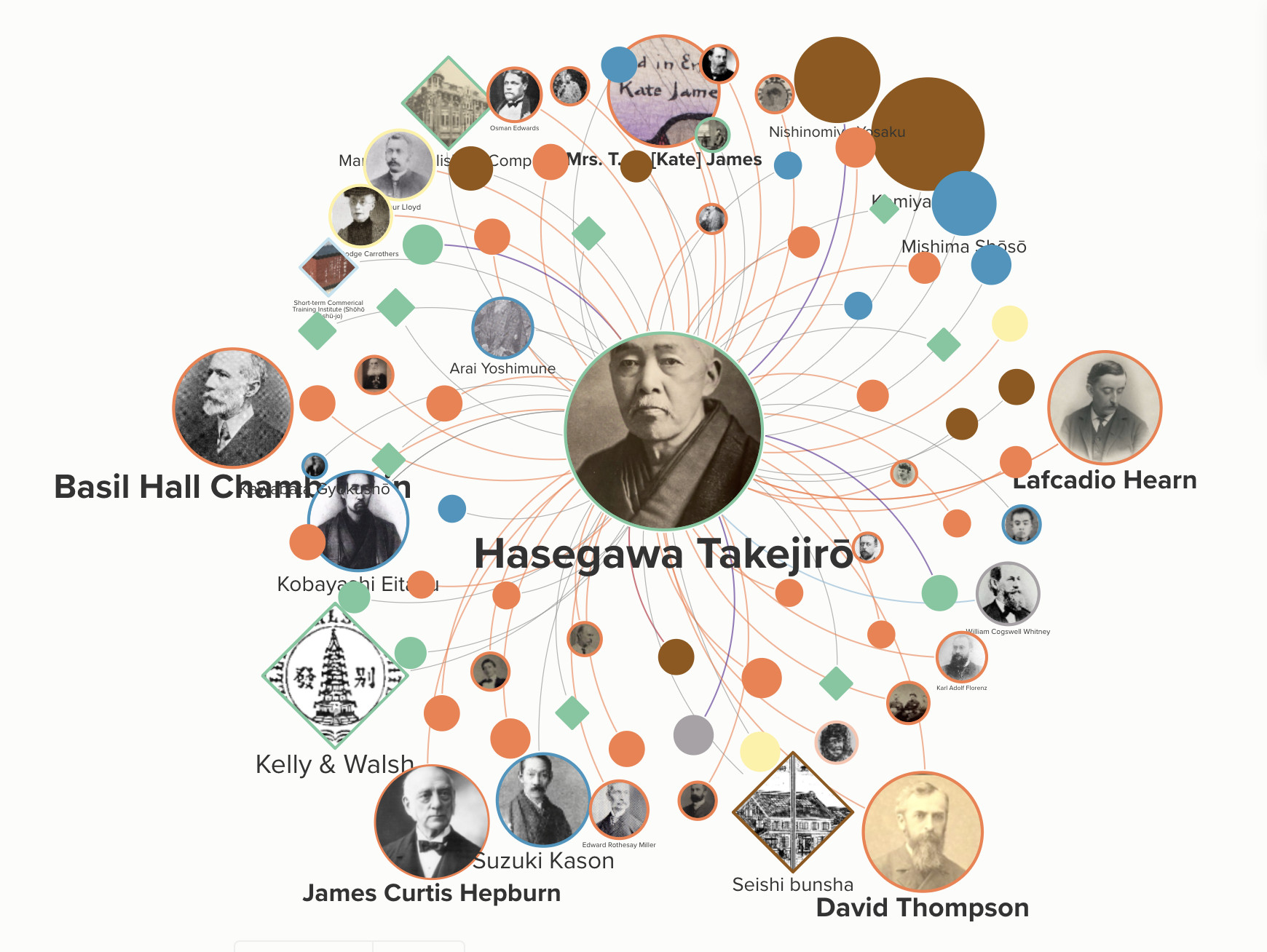
A screenshot focusing on Hasegawa Takejirō's direct connections.
How Was the Network Built?
Every connection in this network is based on archival, historical, or other kinds of scholarly evidence.
Relationships have been reconstructed from a wide range of sources, including publisher colophons, advertisements, trade catalogs, government directories, newspapers, memoirs, archival correspondence, school histories, church records, museum collections, contemporary scholarship, and bookseller records. Whenever possible, connections are supported by multiple independent sources.
The network includes more than people. It also maps institutions, publishers, schools, churches, bookstores, printing firms, government offices, and individual publications. Together, these entities illustrate the infrastructure that supported the production and international circulation of Japanese crepe-paper books during the late nineteenth and early twentieth centuries.
Rather than attempting to reconstruct every acquaintance or friendship, the project focuses on relationships that can be documented and that help explain how books were written, illustrated, printed, published, distributed, or promoted. The network exists both as a visualization on kumu.io and as a database.
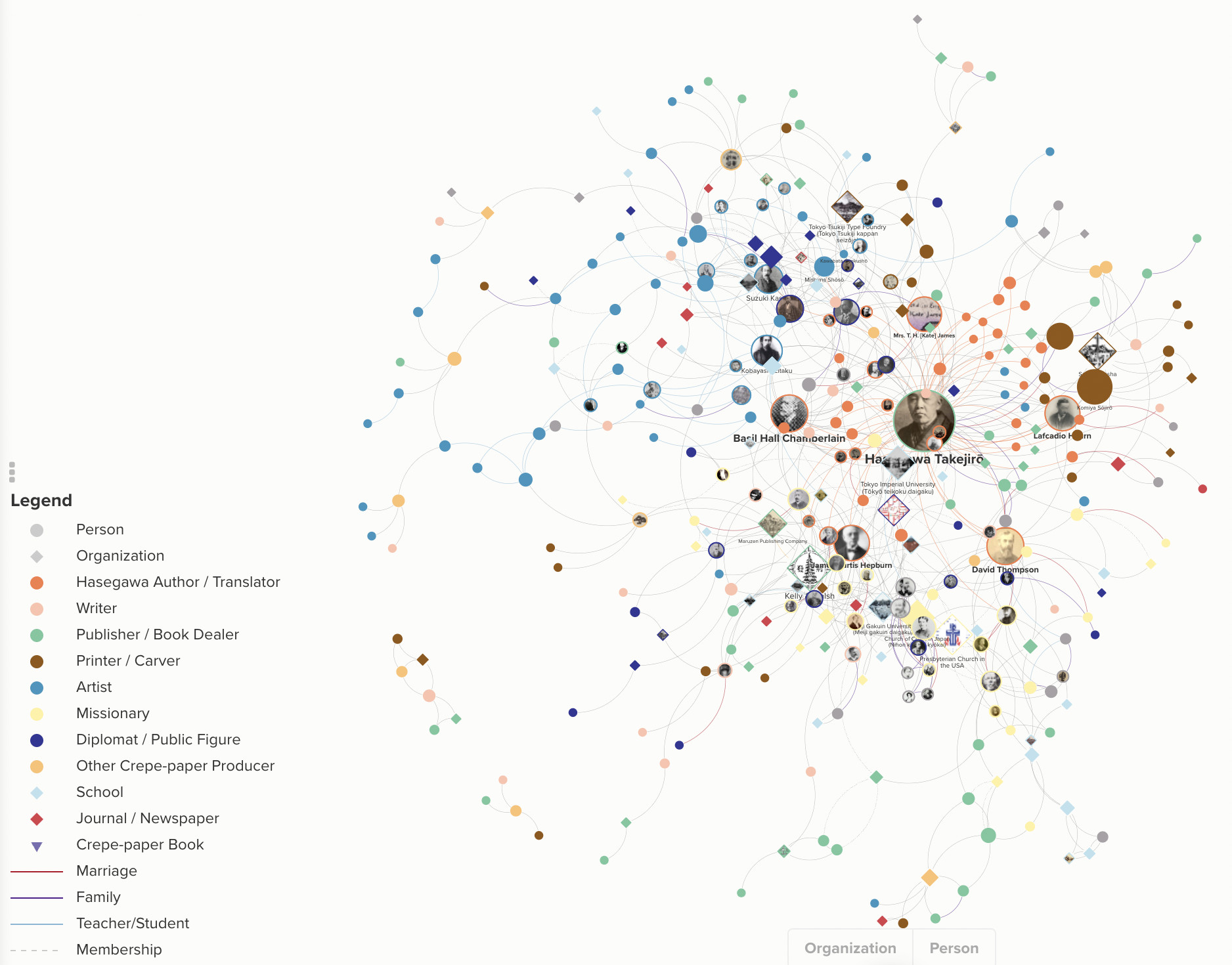
Screenshot showing Hasegawa Takejirō's extended connections as of August 2026. The network only continues to grow, so what you see may look quite different.
What Can a Network Reveal?
Viewing these materials as a network allows patterns to emerge that are difficult to recognize when studying individual biographies alone.
Readers may notice recurring collaborations between particular translators and publishers, the importance of missionary and educational institutions, or the central role played by bookstores and printers in connecting otherwise separate communities. The network also highlights individuals whose contributions have often received little scholarly attention, including women educators, translators, editors, and artists whose work helped shape the international reception of Japanese culture.
Most importantly, the network reminds us that crepe-paper books were never simply the product of one publisher or one artist. They were the result of collaborations that crossed languages, professions, institutions, and national borders.
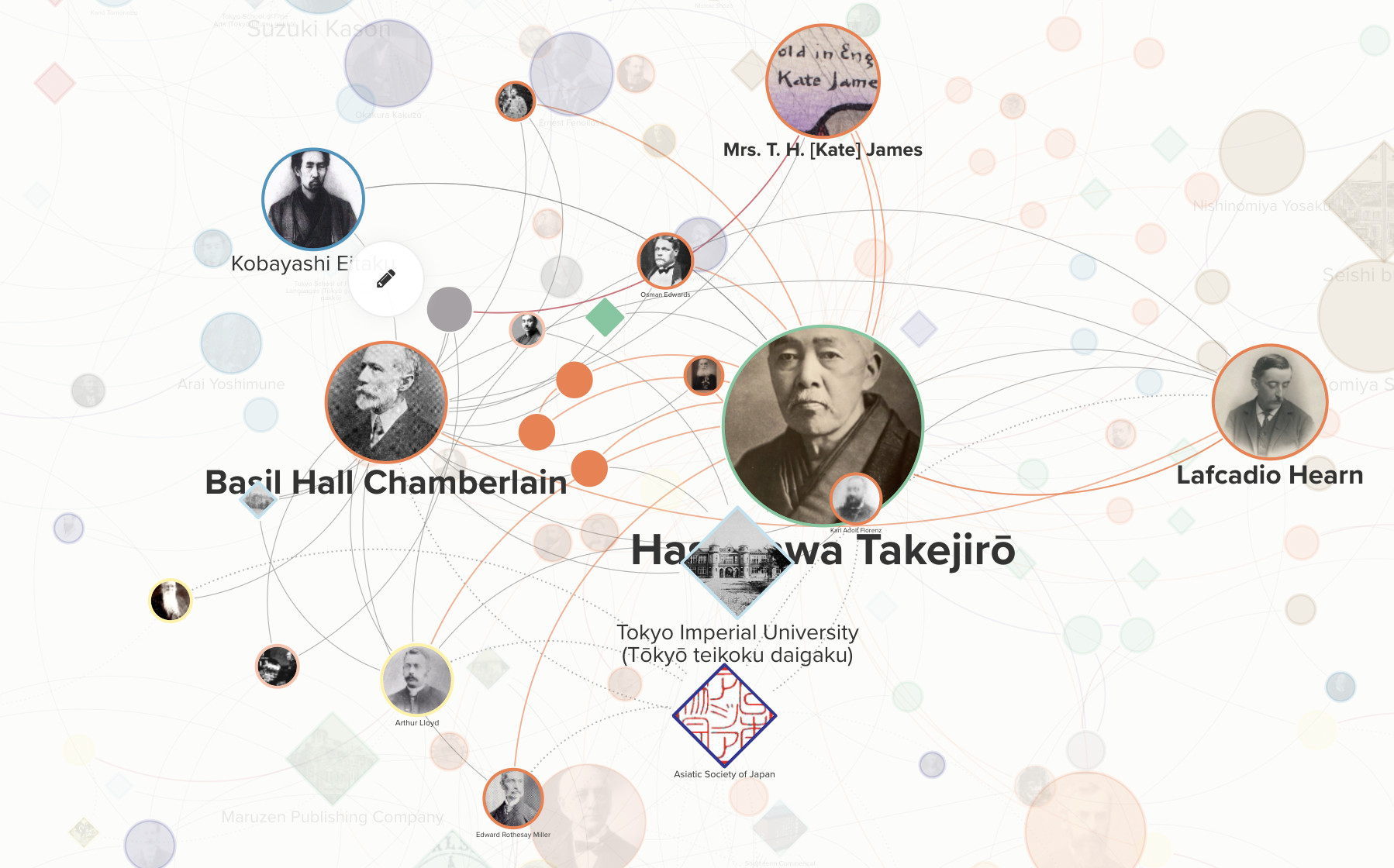
Screenshot of a focused view on the connections of Basil Hall Chamberlain.
Explore the Network
The visualization presented here is not intended as a final or complete picture. It is an evolving research tool that grows as new sources are discovered and additional relationships are documented.
Whether you begin with familiar figures such as Lafcadio Hearn or Basil Hall Chamberlain, or explore lesser-known translators, artists, missionaries, or booksellers, we hope the network encourages new questions about how these remarkable books were created and how Japanese ideas, stories, and artistic traditions reached readers around the world.