
Translation in Japanese Fairy Tale Series: Hasegawa's English Translators
by Tiana Pay '29
Victorian England and Japonisme
Over the span of thirty-seven years, starting in 1885 and continuing until 1922, Hasegawa Takejirō (長谷川武次郎, 1853-1938) published twenty-eight unique books in his Japanese fairy tale series. He accomplished this with the help of five translators: David Thompson, James Curtis Hepburn, Basil Hall Chamberlain, Kate James (Mrs. T. H. James), and Lafcadio Hearn. Each contributed their own distinctive voice and angle to these fascinating books to create stories that crossed cultural boundaries. While the popularity of Hasegawa’s series in the West may seem incidental at a glance, a look into the sociocultural context of the time reveals that there was nothing random about it at all—rather, Hasegawa’s books played into the literary and cultural development of Victorian England, which provided the perfect environment for these books’ inception and ensuing success.
The Victorian era lasted from 1837 to 1901, and witnessed significant societal and cultural changes. England became disillusioned with the Enlightenment, industrialization, and the strict, rationalistic, utilitarian values that accompanied them. This encouraged the rise of the Romantic movement, rooted in imagination and fantasy to oppose the stifling societal norms of the time.1Jack Zipes, Victorian Fairy Tales: The Revolt of the Fairies and Elves (Methuen, 1989), xiii-xiv. This ideological shift allowed fairy tales, which had previously been strictly suppressed for their purported lack of value in children’s education, to see a renaissance. Victorian writers used them as outlets for individual and social protest, and the creation of idealized, utopian worlds,2Zipes, xiii-xiv. and readers happily consumed this rediscovered form of entertainment. However, as fairy tales had been suppressed for their frivolousness, they became newly associated with moral lessons to demonstrate their value to children and lessen opposition to their reintroduction.3Micheal C. Kotzin, Dickens and the Fairy Tale (Bowling Green University Popular Press, 1972), 7-31.
Beyond redefining fairy tales to better accommodate English societal standards, the growing Victorian nostalgia and longing for childhood and child-like innocence also played a critical role in the popularization of fairy tales—many adults became infatuated with them as an escape from harsh realities of adulthood.4Kotzin, 7-31. In fact, Victorian fairy tales had two intended audiences: children, to influence with moral lessons, and adults, to challenge and reform their realities.5Zipes, xiii. Thus, Victorian fairy tales were carefully written to reach a wide readership, expanding beyond just England to include the wider anglophone world. They entertained children and fulfilled adults’ romanticization of childhood, while also expounding new Victorian values to England, the US, and beyond through their imaginative and moral storytelling.
With this revitalization of the fairy tale, Hasegawa was able to secure a guaranteed audience in the West for his Japanese fairy tale series. Meanwhile, his translators demonstrated many Victorian influences in their writing: Lafcadio Hearn most obviously exemplifies Victorian desires to capture and preserve childhood innocence in his contributions, with each story having a simple, pure plot with fantastical twists. Kate James also projected “a Victorian sentimentalism not present in the original version”6Christine M. E. Guth, “Hasegawa’s Fairy Tales: Toying with Japan,” RES: Anthropology and Aesthetics, no. 53/54 (Spring-Autumn 2008), 273. through adding emphasis on each character’s emotions, while Basil Hall Chamberlain demonstrated major influence from the Victorian fairy tale writing styles that maintained a conversational, imaginative storytelling tone. Victorian fairy tales’ quality of having a dual intended audience also manifests in Hasegawa’s books: while they did not include calls for societal change as found in their Victorian counterparts, they sought to appeal to children’s imaginations in addition to the exotic tastes of the Western world at the time.
Hasegawa’s fairy tales were by all means not the first fairy tales to be translated into English. To retaliate against the suppression of fairy tales, the English translated them from French, German, and Scandinavian. First, the English attempted to adjust them to fit the didactic norms of children’s literature at the time, but later tried to reinvigorate the fairy tale tradition in England through them.7Kotzin, 7-31. Notably, The Arabian Nights was translated into English. While less culturally accessible than fairy tales translated from other European countries, it garnered much popularity through Orientalistic fascination with unfamiliar cultures. Children’s tales from other countries were overall gaining popularity during this time as a development of Europe’s global colonialism, missionary activity, and tourism,8Guth, 270. and, mixed with Japonisme, formed the perfect environment for Hasegawa’s fairy tale series to obtain international success.
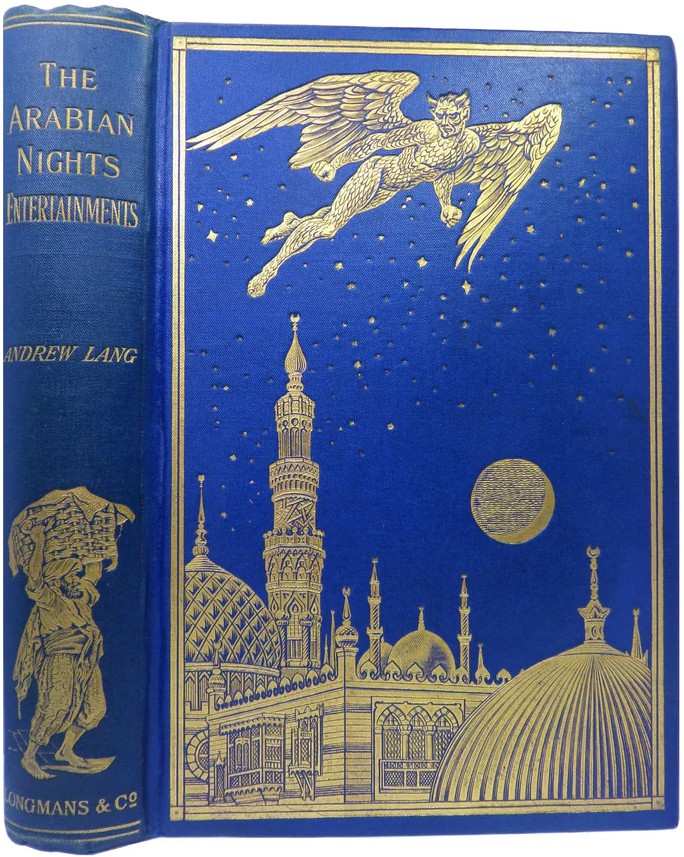
Andrew Lang, The Arabian Nights Entertainments, 1898. Cloth bound, hardcover. MFR Rare Books.
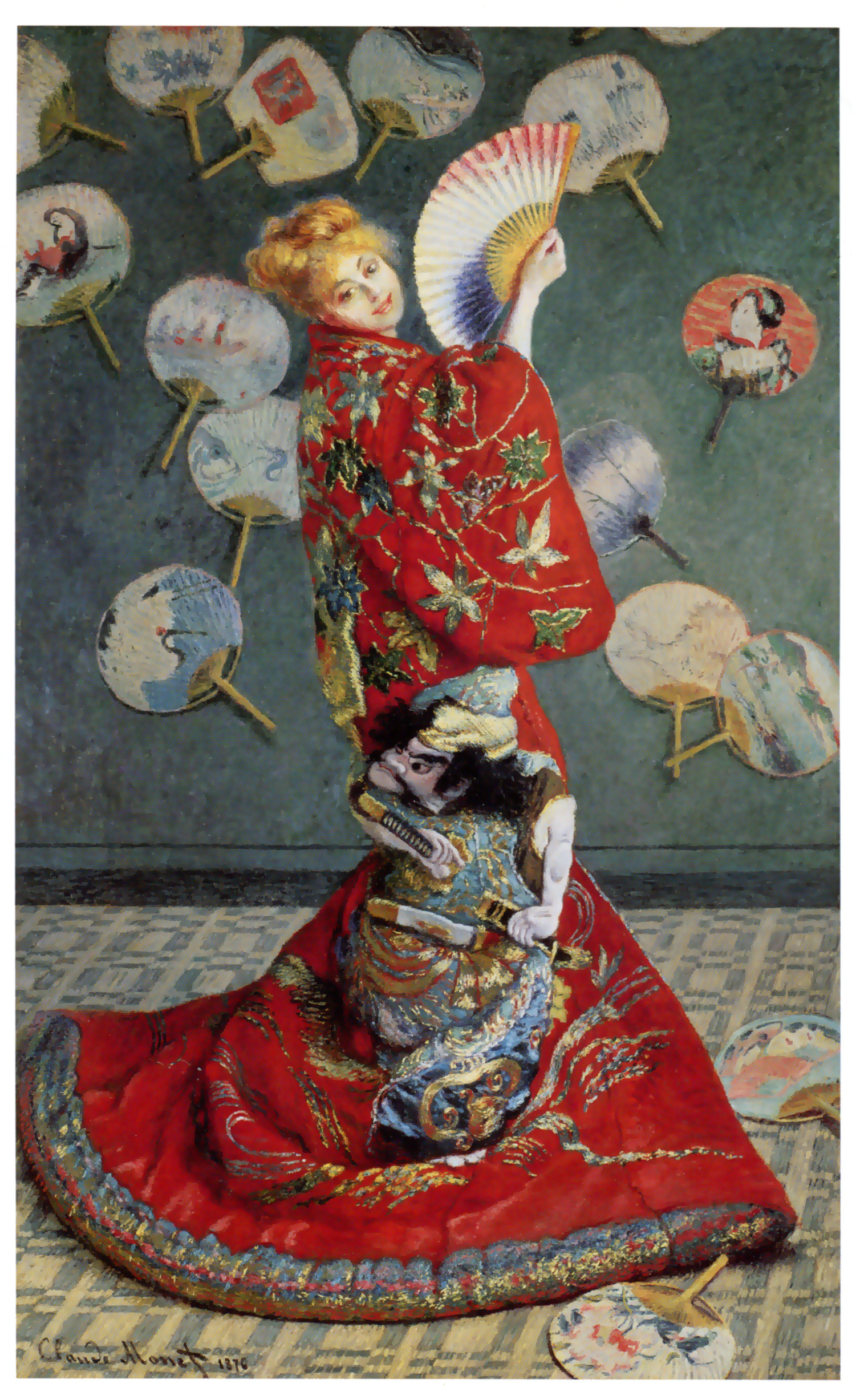
Claude Monet, La Japonaise (Camille Monet in Japanese Costume), 1876. Oil on canvas. Museum of Fine Arts, Boston.
Japonisme was the specific exotic taste for Japanese culture. Occurring throughout the Western world, it developed out of Orientalism and Japan opening up to international trade in 1858 with the signing of the Treaty of Amity and Commerce, or the Harris Treaty.9Lionel Lambourne, Japonisme: Cultural Crossings between Japan and the West (Phaidon Press, 2005), 7. Japonisme manifested as the mania for all things Japanese, including Japanese art, furniture, clothes, and aesthetics. Thus, Hasegawa’s fairy tale series’ traditional Japanese folktales, woodblock print illustrations, and creped paper presented the West with the exotic and romanticized representation of Japan they sought. Hasegawa’s translators themselves reflected this fascination of Japan, seen in Hearn’s gushing prefaces and Chamberlain’s detailed descriptions of settings. Combined with newly accessible steam ship travel—courtesy of the industrial revolution—this encouraged Hasegawa’s collaborators to travel to Japan, take an interest in Japanese folktales, and translate them. Without these sociocultural developments, these books would not exist.
Are They Really Translators?
I would like to make a note about using the term “translator” to describe Hasegawa’s collaborators before examining each of them more closely. While I will continue to use the term for sake of simplicity, it may not actually be the best suited for this purpose. While for Thompson and Hepburn, “translator” is a relatively appropriate descriptor, it becomes more complicated for Hasegawa’s other collaborators. James did not know Japanese well enough to truly translate the folktales directly from the language, Chamberlain could translate Japanese to English but chose to take many liberties when writing for Hasegawa, and Hearn used unknown oral sources while emphasizing the quality of his literary storytelling for Western audiences, putting into question their role as translators. Hasegawa himself seemed to also take note of this: while he did sometimes use translator (訳・訳術) to describe them, he also used writer (著者), or “by,” “told in English by,” or “rendered in English by” seemingly interchangeably. At times, he would even express his skepticism about the origins of the stories to his translators in the hope that they would rewrite them with greater authenticity.
Excluding James, who frequently used versions already translated into English as a basis for her books, each of Hasegawa’s translators took an original Japanese folktale and rendered it into English. They are then, by definition, translators. However, by modern standards, they only fall into the most basic definition of “translator,” and may better be thought of as adapting the folktales through localization. Localization is a step beyond translation that alters the original work to match the sociocultural understanding of the intended audience, in this case, a Western audience. This thus renders the translated work as comprehensible by an audience who has minimal knowledge of the original culture, and is useful in explaining the inaccuracies of some of the translations found in Hasegawa’s books, such as rendering “sake” as “wine,” or “oni” as “devil.” Of course, in the case of Chamberlain, it may be more accurate to simply label his works as appropriations—still using the original text as a basis, but otherwise disregarding it—due to the amount of alterations he made.10Yves Gambier, and Luc van Doorslaer, Handbook of Translation Studies: Volume 1 (John Benjamins Publishing Company, 2010), 3.
Nevertheless, it must be noted that folktales, by nature, are ever evolving and have never been constant, so differences between versions is nothing to balk at; in fact, stories can have significantly disparate regional variations. Furthermore, as folktales traditionally are an oral tradition, a story inevitably differs from person to person to fit their storytelling style. However, when foreign writers represent works they loosely base on Japanese folktales as translations, this proves to be problematic; it presents a version of Japan that has been adapted to Western norms as truly Japanese, undermining the very real cultural distinction between them. In the following descriptions, I highlight the liberties each of Hasegawa’s translators took in their contributions to his fairy tale series.
Hasegawa's English Translators
Hasegawa’s English translators for his Japanese fairy tale series ranged from missionaries, academics, to a mother. Each of these individuals’ backgrounds offers insights into their respective translation choices.
David Thompson (1835-1915)
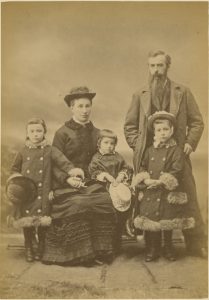 The first translator Hasegawa worked with was David Thompson. Born in Ohio in 1835, Thompson graduated from Franklin College and Wooster University. He moved to Japan in 1863 at the age of 28 as a Presbyterian missionary, learning Japanese quickly while teaching English and bible studies. He gained a skillful command of the language, translating the Book of Genesis into Japanese.11Frederic A. Sharf, Takejiro Hasegawa: Meiji Japan’s Preeminent Publisher of Wood-Block-Illustrated Crepe-Paper Books (Salem, Mass: Peabody Essex Museum, 1994), 55. He was called upon by Hasegawa to translate Japanese folktales for him due to their already established relationship, in addition to his Japanese language skills and experience teaching English; Hasegawa likely saw these two qualities as beneficial, as the original intention of the books was to be used by Japanese English language learners in addition to being sold abroad.12Rumi Ozaki, and Nana Hamana, Japanese fairy tales: wood-block-illustrated crepe-paper books of the Meiji period (1868-1912) (Tokyo Bijutsu, 2025), 218. Thompson’s status as a native English speaker with experience in teaching the language thus gave him credibility in both these aims. Moreover, during the time that he worked with Hasegawa, Thompson’s wife gave birth to their third child. His position as a parent also likely fueled his interest and willingness to work with Hasegawa to create these books.13Ozaki and Hamana, Japanese fairy tales, 231.
Thompson was responsible for translating the first six books that launched Heasegawa’s fairy tale series: Momotaro, or Little Peachling (1885), The Tongue-Cut Sparrow (1885), Battle of the Monkey and the Crab (1885), The Old Man Who Made The Dead Trees Blossom (1885), Kachi-Kachi Mountain (1885), and The Mouse’s Wedding (1885).
Out of these six, The Tongue Cut Sparrow, Kachi-Kachi Mountain, Battle of the Monkey and the Crab, and The Old Man Who Made Dead Blossoms Bloom were translated from the Enseki zasshi (燕石雑志).14Rumi Ozaki, “弘文社のちりめん本『欧文日本昔噺』シリーズの形成と『西洋昔噺』シリーズの開始” [From Kobunsha’s Chirimen Book Series "European Japanese Old Tales’’ Formation and Beginning of the ‘Western Old Stories’ Series], 白百合女子大学児童文化研究センター論文集 [Research Center for Children's Literature and Culture, Shirayuri University], (March, 2021), 4. Momotaro, or Little Peachling also seems to be based on the version found in the Enseki zasshi, but likely has other additional influences, while The Mouse’s Wedding was based off of two stories found in Kusazōshi (草双紙).15Ozaki, "From Kobunsha's Chirimen Book Series," 4.
Thompson’s translations, while relatively faithful to their original sources,16Ozaki, "From Kobunsha's Chirimen Book Series," 4. do display considerable Presbyterian influence. This can be seen in his translation of “oni” to “devils,” or in starting a character’s dialogue with “pray.” Additionally, unlike Hasegawa’s later translators, who all clearly had children in mind as the intended audience when they wrote their work, Thompson’s translation does not display this consideration as much. Rather, his faithful translations and use of difficult vocabulary such as “adroitly” and “importunately” point at his seeing these stories as useful for teaching English to a Japanese audience.
Moreover, the folktales he chose, excluding The Mouse’s Wedding, all have morals that can be framed in line with Christian values. He emphasized the moral lessons of these stories in his translations, which is not seen in the original versions, likely leveraging it as a way to further his proselytizing mission.17Guth, 272. His Christian moral emphasis may be why, while not shying away from death and torment, he explicitly excludes the cannibalism found in the original version of Kachi-Kachi Mountain. Him assigning the rabbit and tanuki (racoon dog) in this story to the masculine gender pronoun “he” may also demonstrate an influence of Presbyterian gender norms in his works, as their gender is never specified in the Japanese versions.
It is interesting, however, that despite his Christian motives for his work, he depicted a Shintō wedding and customs faithfully, even including the Shintō deity Ōkuninushi-no-kami (大国主神) as the God of Wealth in The Mouse’s Wedding. This may hint at his awareness of the Western audience these stories had, employing detailed descriptions to satisfy Western curiosity and cravings for knowledge about mysterious and exotic Japanese culture.
Overall, Thompson’s translation style highlights his position as a Presbyterian missionary, where he seeks to impose his ideology and religion onto Japan, while at the same time taking the time to learn their language and culture to better understand how to go about converting them.
James Curtis Hepburn (1815-1911)
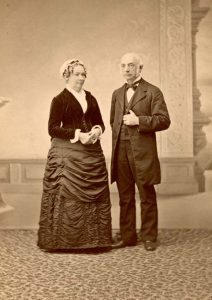 James Curtis Hepburn was born in 1815 in Pennsylvania. In 1836, he received his M.D. from the University of Pennsylvania. He moved to Singapore in 1841 and then to China in 1843 as a medical missionary, gaining an understanding of Chinese. He moved back to the US in 1846 before moving to Japan in 1859 at the age of 44. Here, he would begin to learn Japanese and curate a Japanese-English dictionary that would make Japanese language learning far more accessible to future travelers. His dictionary would also lead him to create a standardized system to romanize Japanese called Hepburn romanization, which is among his greatest contributions alongside translating the Bible into Japanese. He also helped found Meiji Gakuin University through his experience teaching English using the Bible, and contributed his medicinal knowledge to Japan.18Hamish Ion, “James Curtis Hepburn and the Translation of the New Testament into Japanese: A Case Study of the Impact of China on Missions beyond Its Borders,” Social Sciences and Missions 27, no. 1 (2014): 56–85, ATLAn3798127, https://doi.org/10.1163/18748945-02701004. Hepburn was also acquainted with David Thompson through their collaboration in translating biblical texts, which is likely how he became a translator for Hasegawa.
Hepburn only contributed one work to Hasegawa’s fairy tale series: The Old Man and the Devils (1886). The reason for him to contribute this translation may be due to the mysterious bump and the supernatural way the oni are able to interact with it, sparking his interest in the story through his background as a doctor.19Ozaki and Hamana, Japanese fairy tales, 231. Additionally, he took an interest in Japanese novels and stories as they were typically written in colloquial Japanese that would benefit Japanese language learners like Hepburn. The Old Man and the Devils was translated from one such novel, the Ujishūi monogatari (宇治拾遺物語), which is likely how he found the story and decided to translate it for Hasegawa.
Hepburn was quite faithful in his translation; regardless, like Thompson, the influence Presbyterianism had on him is evident in the fact that he translates “oni” to “devil.” He was more open to Westernizing his translation than Thompson, however. Whereas Thompson kept the original Japanese of words that had no good English equivalent, Hepburn does not do this, instead translating “sake” to “wine.” Furthermore, Western assumptions also seep into his translation, where he portrays the oni as having an aversion to sunlight. He additionally simplifies the story by excluding dialogue and the social hierarchy of the oni, which may be his attempt at making the story more accessible, or due to the time constraints he was under as a result of him also actively translating the Bible at that time.
Overall, both Thompson and Hepburn demonstrate significant similarities in their method of translation, with their background as missionaries, teachers, and translators reflected in their works.
Basil Hall Chamberlain (1850-1935)
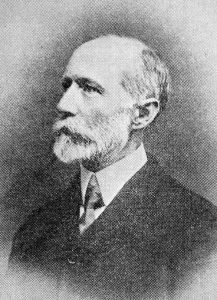 Unlike Thompson and Hepburn’s translations, which while faithful, lack literary merit, Hasegawa’s later translators excel literarily, though not without detriment to their validity as translations. Basil Hall Chamberlain is perhaps the most notable example of this.
Basil Hall Chamberlain was born in 1850 in England, and educated primarily in France. He had a very high linguistic capability and knew a variety of languages through his frequent travels. He arrived in Japan in 1873 at age 23, where he taught English at Tsukiji Naval Academy from 1874 to 1882. He gained significant proficiency in Japanese in the span of two years and was able to converse and read in the language. He joined the Asiatic Society of Japan in 1874, where he came into contact with researchers of various fields related to Japan and began researching Japan himself. He taught Japanese language to Japanese students at Tokyo Imperial University from 1886 to 1890, whereupon he retired to focus on research and writing.20Sharf, 37. He translated various works from Japanese to English, including the Kojiki, noh songs, and poetry, and also did considerable research on Ainu and Ryukyuan languages. His interest in Japanese culture, his literary and scholarly background, as well as his impressive knowledge of the Japanese language all likely contributed to Hasegawa’s interest in him writing for his series.
Chamberlain contributed four stories to Hasegawa’s fairy tale series: The Fisher-Boy Urashima (1886), The Serpent with Eight Heads (1886), The Silly Jelly-Fish (1886), and My Lord Bag-O’-Rice (1886).
The Fisher-Boy Urashima and The Silly Jelly-Fish are based on the Konjaku monogatarishū (今昔物語集), though it is thought that Chamberlain also referenced Kusazōshi (草双紙).21Rumi Ozaki, “長谷川武次郎のちりめん本出版活動の展開:『欧文日本昔噺』シリーズが20冊に達するまで” [Development of Takejiro Hasegawa’s chirimen book publishing activities: Until the ‘European Japanese Old Tales’ series reached 20 volumes], 白百合女子大学児童文化研究センター論文集 [Research Center for Children's Literature and Culture, Shirayuri University] 25 (March 2022): 34. The Serpent with Eight Heads is translated from the Kojiki. It is thought that My Lord Bag-O’-Rice’s translation comes from several sources, including: the Konjaku monogatarishū, the Otogi-zōshi (御伽草子), and Mukashigatari shichiya no kura (昔語質屋庫).22Ozaki, "Development of Takejiro Hasegawa's chirimen book publishing activities," 35.
While Chamberlain referenced the sources listed above for his contributions, he freely adapted these stories according to his whim, making “translator” a rough approximation of his role. Chamberlain by all means was a fastidious translator, evident in any of the other work he translated. However, his appreciation for European fairy tales and his nostalgia for childhood—a characteristic shared with Hearn and Victorian England—motivated his departure from faithful translation conventions.23Guth, 273. These characteristics were something he could only express freely in his non-academic work, resulting in his writing for Hasegawa becoming as loosely based on the Japanese texts as they were. Furthermore, translations of fairy tales at this time were rarely faithful, instead altering the original texts to fit into the favored, didactic style for children’s literature. Thus, while open for modern scrutiny, his contributions would not have been out of place for the time period.
Chamberlain mentions in his letters to Hearn of their varying tastes, “yours the romantic and exotic, mine the classical and puristic,”24Basil Hall Chamberlain, Letters from Basil Hall Chamberlain to Lafcadio Hearn (Hokuseido, 1936), 92-93. yet his style in Hasegawa’s fairy tale series is potentially more romanticized and exoticized than Hearn’s. This may be due to the fact that Chamberlain was particularly critical of classical Japanese texts, finding them lacking meaningful thought.25Basil Hall Chamberlain, More Letters from Basil Hall Chamberlain to Lafcadio Hearn and Letters From M. Toyama, Y. Tsubouchi and Others (The Hokuseido press, 1937), 136. For the Kojiki in particular, he found it illogical, difficult for Westerners to understand directly translated, and lackluster in its prose.26Basil Hall Chamberlain, “Kojiki,” (Wikisource, 1882), xiv, lxvii, https://en.wikisource.org/wiki/Kojiki_(Chamberlain,_1882). Combined with the fact that he had already previously translated the Kojiki, he would have found no reason to repeat it, instead choosing to reframe it in a traditional Western fairy tale fashion. This intention is clearly demonstrated in his rendition of The Serpent with Eight Heads, where he calls the Shintō deities “fairies.” Chamberlain, critical of Shintō and its standing as a religion and seeking to style the story after the Western fairy tales trope of a hero slaying a dragon, likely saw this as a reasonable translation.27Nanae Otsuka, “神話から英雄譚へ―ちりめん本「日本昔噺」シリーズにおけるチェンバレンとジェイムス夫人による『古事記』からの再話の比較―)” [From Myths to Heroic Tales - A Comparison of Retellings from the Kojiki by Chamberlain and Mrs. James in the Crepe Book Series ‘Japanese Old Tales’], 人文学研究所報 [Bulletin of the Institute for Humanities Research] 80 (September 2023), 77-79. Continuing his adherence to Victorian fairy tale traditions, Chamberlain includes moral lessons not necessarily present in the original version, such as emphasizing disobedience and foolishness brings about bad outcomes, or that brave heroes receive rewards in kind.
His translation style overall is very active and present. He is a conversational narrator, frequently using “I” and “me” to reference himself, asking a lot of questions, and including his own assessments, details, and opinions. Despite his critical, Western scholarly approach to Japan, his tone in the books evoke romanticizations of Japan as a fairy-tale location in itself, potentially playing into the exoticized view of Japan to entice foreign audiences.
All in all, while Chamberlain’s writing lacks the conspicuous Christian religious element of Thompson and Hepburn’s translations, he, too, places emphasis on telling moral stories. His translations follow Hepburn’s example in seeking to appeal to Western audiences through localizing the foreign aspects of the story. However, Chamberlain breaks from both by employing a conversational storytelling style, diverging from the original texts he referenced and putting into question whether the term “translation” applies to his contributions.
Mrs. T. H. (Kate) James (1845-1927)
Hasegawa’s most relied upon translator was Kate James. Also called Mrs. T. H. James, Kate James was born in Scotland in 1845 to an Episcopal clergyman. She and her husband, a member of the British navy, moved to Japan in 1876 when Kate was 31 years old. In Japan, she would have three children, sparking her interest in Japanese folktales to tell them.28Sharf, 48. She was part of the Asiatic Society of Japan alongside Chamberlain, demonstrating her interest in Japan and Japanese culture.29Ozaki, "From Kobunsha's Chirimen Book Series," 15-16. While she was praised by both Hearn and Chamberlain for her writing prowess, she had very little grasp of the Japanese language beyond basic, colloquial Japanese, limiting her contributions to be based in stories she heard orally or from preexisting translations of the tales.30Noboru Koyama, “Grace James (1882-1965) and Mrs T.H. (Kate) James (1845-1928): Writers of Children’s Stories,” in Britain & Japan Biographical Portraits, IX (Amsterdam University Press, Renaissance Books, 2015), 476, https://doi.org/10.1017/9781898823278.043. Regardless of this fact, she still contributed a significant number of stories to Hasegawa’s fairy tale series.
James translated a total of twelve stories for Hasegawa: The Matsuyama Mirror (1886), The Hare of Inaba (1886), The Cub’s Triumph (1887), Princes Fire-Flash and Fire-Fade (1887), The Wooden Bowl (1887), Schippeitaro (1888), The Ogre’s Arm (1889), The Ogres of Oyeyama (1891), The Enchanted Waterfall (1892), Three Reflections (1894), The Wonderful Tea Kettle (1896), and The Wonderful Mallet (1899).
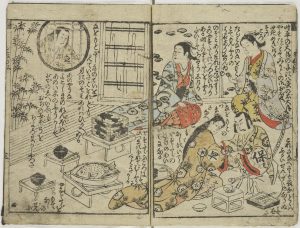
Each of these stories, while having Japanese text equivalents, were most likely compiled from the versions she was told by her Japanese friends, from referencing Kusazōshi (草双紙) picture books, and by referencing already completed English translations such as those by Chamberlain. The influence of preexisting translations of these stories is evident in The Hare of Inaba and Princes Fire-Flash and Fire-Fade, adapted from Chamberlain’s Kojiki, or Records of Ancient Matters (1882) and The Ogres of Oyeyama and The Cub’s Triumph, which pulled heavily on William Elliot Griffis’ translations in Japanese Fairy World: Stories from the Wonder-Lore of Japan (1880).
Due to James using preexisting English translations to make up for her inability to reference the original Japanese works, the term “translator” applies to her the least out of all of Hasegawa’s collaborators. Nevertheless, she did not simply plagiarize to create her stories. Rather, she very intentionally adapted them to be suited for a younger audience by simplifying the tales, adding more or altering details, and ending the stories in a complete, fulfilling, and moral way.
For example, James’ writing in Schippeitaro exemplifies one “translation” model, where she exotifies Japanese culture while at the same time rewords their folktales to fit Victorian fairy tale traditions. In Schippeitaro, James begins with a preface that details the character’s significance in Japanese religious beliefs. However, she then surprisingly starts the story with: “Long long ago, in the days of fairies and giants, ogres and dragons, valiant knights and distressed damsels; in those good old days, a brave young warrior went out into the wide world in search of adventures,” which clearly mimics Victorian fairy tale tradition. This duality exists in all of Hasegawa’s fairy tale books to some extent.
The Hare of Inaba and Princes Fire-Flash and Fire-Fade are the best examples of James’ intentional adaptation of the stories: both of these end with happy, moral lessons, whereas the original stories found in the Kojiki continue on to chronicle the messy lives of the morally ambiguous main characters. Her referencing preexisting English translations also results in her stories lacking consistency in how terms are translated from Japanese to English, as sometimes she reinvents deities or emperors as kings or princes, while at other times keeps the Japanese term—such as calling the Emperor “Mikado”—highlighting the very palpable influence they had on her work. Despite this, her own tone becomes evident in dialogue, which often is heavily reminiscent of the speaking styles of Victorian women.
James’ rendition of the stories are more dramatic and personable, providing each of the characters with emotions and values not found in Japanese versions.31Otsuka, 80. Indeed, Guth explains, “Kate James's retellings allowed her to explore creatively themes that were applicable to her own child-rearing experiences in Japan, often projecting a Victorian sentimentalism not present in the original versions.”32Guth, 273. This manifested in her altering the original Japanese versions to best fit her image of a children’s tale—exhibited in her depictions of good daughters/people or endings featuring a happily married couple—which exemplify her perceptions of ideal morals, conduct, and lessons for children.
James utilized a strong storytelling tone throughout her stories to engage and appeal to children, and while she would not reference herself directly like Chamberlain did, she would include the listener in her retellings through the second person pronoun “you.” While not a professional writer or skilled in Japanese, her works were praised by both Chamberlain and Hearn,33Lafcadio Hearn, The Japanese Letters of Lafcadio Hearn, with Boston Public Library (Boston, New York, Houghton Mifflin Company, 1910), 277, http://archive.org/details/japaneseletterso00hear_0. demonstrating her talent for writing compelling children’s stories that maintained their distinctiveness despite being based on other English translations.
Overall, James’ contributions may be the most well suited to be called fairy tales, considering their intentional writing style geared towards children, the moral lessons of the stories, and their happy endings. Furthermore, partly due to her inability to access the original Japanese texts, her writing is very simple and comprehensible, lacking the rigidity found in Thompson and Hepburn’s translations and making ideal children’s stories.
Lafcadio Hearn (1850-1904)
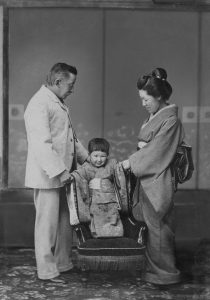 Last of Hasegawa’s translators is Lafcadio Hearn. Hearn was born in 1850 in Greece. He was raised and educated in England and later attended a French Catholic college. While he gave up Catholicism, his knowledge of French would help him in 1869 when, at the age of 19, he immigrated to the US and became a writer for a newspaper about French literary translation. He moved to Japan in 1890 at the age of 40 with a job with Harper’s Magazine. He eventually quit to move into education in Matsue where he met his wife, Koizumi Setsu (小泉セツ, 1868-1932). In 1896, he moved to Tokyo—appointed to teach English literature at Tokyo Imperial University—as well as officially married Koizumi, becoming a naturalized Japanese citizen and adopting her name to become Koizumi Yakumo (小泉八雲).
Hearn was deeply curious about Japanese culture and would actively seek out opportunities to learn more about it. He thus was one of the most sympathetic Westerners in Japan, readily accepting Japanese culture and superstitious beliefs and taking an interest in mythology and folktales. Christianity’s lack of influence on his perspective enabled him to embrace Japan’s culture as much as he did,34Sukehiro Hirakawa, Lafcadio Hearn in International Perspectives (BRILL, 2007), 15. and he would write prolifically about it in both academic and creative works for Western audiences.35Rumi Ozaki, and Nana Hamana, Japanese Fairy World by Lafcadio Hearn: wood-block-illustrated crepe-paper books of the Meiji and Taisho periods (Tokyo Bijutsu, 2025), 218. He published many works, including Glimpses of Unfamiliar Japan (1894) and Kwaidan: Stories and Studies of Strange Things (1904). Despite his curiosity and love of Japan, however, he never obtained full proficiency of Japanese.
Hearn wrote a total of five stories for Hasegawa: The Boy Who Drew Cats (1898), The Old Woman Who Lost Her Dumpling (1903), Chin Chin Kobakama (1904), The Goblin Spider (1899), and The Fountain of Youth (1922).
His contributions formed the second of Hasegawa’s fairy tale series. While the exact origin of these stories is unknown, it is thought that they are Hearn’s rendition of oral stories he collected through his time traveling in Japan, or were told to him by his wife as she did for his Kwaidan book.36Ann King Herring, “Early Translations of Japanese Fairy-Tales and Children’s Literature,” Phaedrus 13 (1988), 98. Due to this ambiguity of origin, his stories’ authenticity as Japanese folktales was questioned by Hasegawa and resulted in delays in their publishing:37Sharf, 45. Hearn himself acknowledges that he discovered that The Fountain of Youth was not of Japanese origin, despite the fact that the person who told him the story never heard the tale in a language other than Japanese.38Lafcadio Hearn, Some New Letters and Writings of Lafcadio Hearn, with Sanki Ichikawa (Kenkyusha, 1925), 313.
Hearn was perhaps the most experienced writer out of all of Hasegawa’s translators. He had a clear, straightforward writing style that highlighted his intended audience: Westerners and their children. This led his contributions to step away from the original intention of these books to be both a tool for English language learning and for export, demonstrated by the prefaces of Chin Chin Kobakama and The Goblin Spider offering informative descriptions of Japanese culture and superstitions. Hearn’s storytelling style is slightly reminiscent of Chamberlain, as occasionally, he does insert himself into the story as the narrator. However, he does this sparingly, and instead focuses on developing a fully fleshed out, comprehensible plot. He frequently makes use of repetition, found in almost all of the stories, and includes a message to be gleaned from each tale, though not necessarily moral in nature.
He simplifies the supernatural creatures of Japan into fairies and goblins, though he does use “oni” instead of “ogre” and keeps the original name of the Buddhist statues found in The Old Woman Who Lost Her Dumpling. This shows how he was overall more accepting of the supernatural and superstitious beliefs of Japan, and he made sure to include some elements of it in each story.
Rather than being just a translator or a recorder of the stories he collected, he holds a position as a storyteller in his own right. He was very intentional in designing each of the stories to be enjoyable to children while showcasing aspects of Japan that would be difficult to experience to the average traveler. In fact, Hearn was so talented at maintaining and nurturing a Japanese spirit in his works that the Japanese translation of his ghost story anthology, Kwaidan, is highly appraised by the Japanese as a collection of native folktales despite having an intended Western audience.39Hirakawa, 12-14. So while his works may not be actual translations, he was a very gifted storyteller, even gaining appreciation by native Japanese for his works.
Overall, while the Japan depicted in Hearn’s stories is not the same as the one found in traditional Japanese folktales, he still manages to earn the respect of Japanese readers. He accomplishes this through expressing his own fascination with Japan and his desire to convey its charm to Western audiences back home, distinguishing him from Hasegawa’s other translators through his overwhelming acceptance of Japanese culture.
Hasegawa’s English translators, while differing in their professions, their motivations to translate, and their translation styles, display considerable similarities. They were each influenced by Western sociocultural developments, such as Victorian England’s renewed interest in fairy tales and the European fascination with Japan through Japonisme, that proved to be an underlying presence in all of their contributions. Analyzing their works also shines a light on the greater historical trends of globalization, Western perceptions of Japan, and Japanese efforts to establish themselves globally. Through these translators and their works, we can glimpse the developments of the world as it was over a century ago.
Works Cited
- 1Jack Zipes, Victorian Fairy Tales: The Revolt of the Fairies and Elves (Methuen, 1989), xiii-xiv. ↩︎
- 2Zipes, xiii-xiv. ↩︎
- 3Micheal C. Kotzin, Dickens and the Fairy Tale (Bowling Green University Popular Press, 1972), 7-31. ↩︎
- 4Kotzin, 7-31. ↩︎
- 5Zipes, xiii. ↩︎
- 6Christine M. E. Guth, “Hasegawa’s Fairy Tales: Toying with Japan,” RES: Anthropology and Aesthetics, no. 53/54 (Spring-Autumn 2008), 273. ↩︎
- 7Kotzin, 7-31. ↩︎
- 8Guth, 270. ↩︎
- 9Lionel Lambourne, Japonisme: Cultural Crossings between Japan and the West (Phaidon Press, 2005), 7. ↩︎
- 10Yves Gambier, and Luc van Doorslaer, Handbook of Translation Studies: Volume 1 (John Benjamins Publishing Company, 2010), 3. ↩︎
- 11Frederic A. Sharf, Takejiro Hasegawa: Meiji Japan’s Preeminent Publisher of Wood-Block-Illustrated Crepe-Paper Books (Salem, Mass: Peabody Essex Museum, 1994), 55. ↩︎
- 12Rumi Ozaki, and Nana Hamana, Japanese fairy tales: wood-block-illustrated crepe-paper books of the Meiji period (1868-1912) (Tokyo Bijutsu, 2025), 218. ↩︎
- 13Ozaki and Hamana, Japanese fairy tales, 231. ↩︎
- 14Rumi Ozaki, “弘文社のちりめん本『欧文日本昔噺』シリーズの形成と『西洋昔噺』シリーズの開始” [From Kobunsha’s Chirimen Book Series "European Japanese Old Tales’’ Formation and Beginning of the ‘Western Old Stories’ Series], 白百合女子大学児童文化研究センター論文集 [Research Center for Children's Literature and Culture, Shirayuri University], (March, 2021), 4. ↩︎
- 15Ozaki, "From Kobunsha's Chirimen Book Series," 4. ↩︎
- 16Ozaki, "From Kobunsha's Chirimen Book Series," 4. ↩︎
- 17Guth, 272. ↩︎
- 18Hamish Ion, “James Curtis Hepburn and the Translation of the New Testament into Japanese: A Case Study of the Impact of China on Missions beyond Its Borders,” Social Sciences and Missions 27, no. 1 (2014): 56–85, ATLAn3798127, https://doi.org/10.1163/18748945-02701004. ↩︎
- 19Ozaki and Hamana, Japanese fairy tales, 231. ↩︎
- 20Sharf, 37. ↩︎
- 21Rumi Ozaki, “長谷川武次郎のちりめん本出版活動の展開:『欧文日本昔噺』シリーズが20冊に達するまで” [Development of Takejiro Hasegawa’s chirimen book publishing activities: Until the ‘European Japanese Old Tales’ series reached 20 volumes], 白百合女子大学児童文化研究センター論文集 [Research Center for Children's Literature and Culture, Shirayuri University] 25 (March 2022): 34. ↩︎
- 22Ozaki, "Development of Takejiro Hasegawa's chirimen book publishing activities," 35. ↩︎
- 23Guth, 273. ↩︎
- 24Basil Hall Chamberlain, Letters from Basil Hall Chamberlain to Lafcadio Hearn (Hokuseido, 1936), 92-93. ↩︎
- 25Basil Hall Chamberlain, More Letters from Basil Hall Chamberlain to Lafcadio Hearn and Letters From M. Toyama, Y. Tsubouchi and Others (The Hokuseido press, 1937), 136. ↩︎
- 26Basil Hall Chamberlain, “Kojiki,” (Wikisource, 1882), xiv, lxvii, https://en.wikisource.org/wiki/Kojiki_(Chamberlain,_1882). ↩︎
- 27Nanae Otsuka, “神話から英雄譚へ―ちりめん本「日本昔噺」シリーズにおけるチェンバレンとジェイムス夫人による『古事記』からの再話の比較―)” [From Myths to Heroic Tales - A Comparison of Retellings from the Kojiki by Chamberlain and Mrs. James in the Crepe Book Series ‘Japanese Old Tales’], 人文学研究所報 [Bulletin of the Institute for Humanities Research] 80 (September 2023), 77-79. ↩︎
- 28Sharf, 48. ↩︎
- 29Ozaki, "From Kobunsha's Chirimen Book Series," 15-16. ↩︎
- 30Noboru Koyama, “Grace James (1882-1965) and Mrs T.H. (Kate) James (1845-1928): Writers of Children’s Stories,” in Britain & Japan Biographical Portraits, IX (Amsterdam University Press, Renaissance Books, 2015), 476, https://doi.org/10.1017/9781898823278.043. ↩︎
- 31Otsuka, 80. ↩︎
- 32Guth, 273. ↩︎
- 33Lafcadio Hearn, The Japanese Letters of Lafcadio Hearn, with Boston Public Library (Boston, New York, Houghton Mifflin Company, 1910), 277, http://archive.org/details/japaneseletterso00hear_0. ↩︎
- 34Sukehiro Hirakawa, Lafcadio Hearn in International Perspectives (BRILL, 2007), 15. ↩︎
- 35Rumi Ozaki, and Nana Hamana, Japanese Fairy World by Lafcadio Hearn: wood-block-illustrated crepe-paper books of the Meiji and Taisho periods (Tokyo Bijutsu, 2025), 218. ↩︎
- 36Ann King Herring, “Early Translations of Japanese Fairy-Tales and Children’s Literature,” Phaedrus 13 (1988), 98. ↩︎
- 37Sharf, 45. ↩︎
- 38Lafcadio Hearn, Some New Letters and Writings of Lafcadio Hearn, with Sanki Ichikawa (Kenkyusha, 1925), 313. ↩︎
- 39Hirakawa, 12-14. ↩︎