
Researching Crepe-paper Books
A Reference Guide
What Counts as a "First Edition"?
One of the questions we are asked most frequently is whether a particular crepe-paper book is a first edition.
At first glance, the answer seems as though it should be straightforward. Collectors often hope to identify the earliest printing of a title, while librarians and booksellers frequently describe copies as “first editions,” “later editions,” or “reprints.” Yet the more we study Hasegawa Takejirō’s remarkable crepe-paper books, the more difficult those labels become.
In fact, asking whether a crepe-paper book is a “first edition” may be the wrong question altogether.
Side-by-side comparison between the 1886 1st edition (left) and a later 1889 reprint (right) of the story The Fisherboy Urashima. Please use the slider to compare subtle differences in color and texture between the outfits of the two sitting figures.
Books That Never Stood Still
Unlike many modern books, Hasegawa’s publications were not produced once and left unchanged. Instead, they evolved continuously over the course of several decades.
A copy of Momotarō printed in the 1880s might look very different from one produced twenty years later, even though both carry the same title and tell essentially the same story.
Between printings, publishers and printers made numerous changes. Advertisements were updated as new books entered the catalog. Publisher addresses changed when businesses moved. Text placement was altered. Covers were redesigned. Colors shifted. Patterns changed. Individual woodblocks were repaired or recut as they wore down. Even the texture of the crepe paper could vary significantly from one production run to another.
No single change necessarily created what we would normally call a “new edition.” Instead, the books gradually accumulated revisions over time as Hasegawa fulfilled the demand for his various publications in the way he best saw fit.
Why Were They Always Changing?
Part of the answer lies in how these books were made.
While Hasegawa’s publications used letterpress and moveable type for Romanized text in many languages, his publications also relied heavily on traditional Japanese woodblock printing. Each page was printed from carved wooden blocks, often with separate blocks used for different colors. Over years of printing, blocks naturally wore down or became damaged. Printers repaired them, replaced individual sections, or carved entirely new blocks when necessary.
After printing, the paper itself was crinkled to create the distinctive crepe texture (chirimen), another handmade process that could vary from one production run to the next.
These were not mechanically identical objects rolling off a printing press. Each copy reflects the decisions and craftsmanship of the people who produced it.
Side-by-side of the 1885 1st edition (left) vs. the 1940 14th edition reprint (right) of The Old Man Who Made the Dead Trees Blossom.
Side-by-side of the 1885 edition (left) vs. the 1940 reprint (right) of The Old Man Who Made the Dead Trees Blossom. Please note the differences in spacing between the same copies of text, as well as the changes in color between the old man’s clothes, onlookers, and tree leaves.
A Publisher Who Adapted
Hasegawa Takejirō was also an astute businessman.
His books were marketed internationally and remained popular for decades. Rather than freezing each title in its original form, he continually updated his publications to meet changing circumstances. New translators contributed revised English texts. Images were reused across publications. Additional advertisements promoted recently published titles. Business partnerships shifted. Artists and printers came and went.
Instead of viewing these updates as interruptions to a fixed publication, it is more helpful to think of them as part of the normal life of a successful book.
Side-by-side comparison of The Fisherboy Urashima. Please note the differences in the color and texture of each figure’s clothing, as well as the distinct print variations and colors located in the waves.
Looking Beyond "Editions"
For collectors, it is natural to ask whether a book is a first edition. But Hasegawa’s crepe-paper books encourage us to ask different questions.
- What advertisements does this copy contain?
- Which publisher’s address appears on the title page?
- Does the cover use an earlier or later design?
- Have any illustrations been recut?
- How does the coloring compare with other surviving examples?
These questions reveal the publication history of an individual copy far more effectively than assigning it a simple edition number.
Comparing Copies: A Guide
If no two production runs are exactly alike, how do researchers compare copies?
Rather than relying solely on labels such as “first edition” or “reprint,” we examine a wide range of material and bibliographic evidence. Individually, these features may reveal only a small part of a book’s history. Taken together, however, they can help us understand when a copy was produced, how it relates to other surviving examples, and how Hasegawa’s publications evolved over time.
When examining a crepe-paper book, we typically look at the following characteristics:
Publisher’s Address
Hasegawa Takejirō’s business moved over time, and different addresses appear on title pages, advertisements, and colophons. Changes in address can often help narrow the period during which a particular copy was produced.
Advertisements
Publishers frequently updated the advertisements printed at the back of their books. Because these catalogs changed as new titles were introduced or older ones disappeared, they provide valuable clues about when a book was printed.
Translator
Many stories were translated more than once or revised over time. Changes in wording, spelling, or translator attribution may indicate a later production run or a different intended audience.
Illustrator
Although many titles retained the same illustrations for years, artists occasionally changed, illustrations were revised, or damaged woodblocks were replaced with newly carved versions.
Cover Design
Cover colors, decorative borders, typography, and title labels often changed throughout a book’s publication history. These differences can sometimes distinguish earlier and later printings.
Binding Style
Variations in thread binding, endpapers, wrappers, and construction techniques may reflect different workshops, production periods, or export practices.
Crepe Texture
The distinctive crinkled paper (chirimen) was created after printing. Some copies exhibit a deep, heavily textured crepe, while others are more lightly crinkled, reflecting differences in paper and finishing techniques.
Paper and Pigments
Paper thickness, tone, and quality can vary between copies, as can the pigments used during printing. Differences in color are not necessarily signs of fading—many represent intentional variations between production runs.
Woodblock Changes
Woodblocks gradually wore down with repeated use. Publishers repaired damaged blocks, recut missing sections, or occasionally created entirely new blocks. Comparing illustrations closely can reveal these subtle but important changes.
Size
Although most titles follow standard formats, slight differences in trimming or paper dimensions sometimes occur and may help distinguish different production runs.
Printer’s Information
When present, printer names and colophons provide valuable evidence about who produced the book and when. Changes in printers often coincide with broader shifts in Hasegawa’s publishing network.
No single feature can determine exactly when a crepe-paper book was produced. Instead, researchers compare many pieces of evidence at once. Much like assembling a puzzle, each characteristic contributes to a broader understanding of the book’s place within Hasegawa Takejirō’s remarkable publishing history.
Comparison between the two colophons (publishing pages) from a 1886 1st edition (left) and 1898 reprint (right) of The Hare of Inaba.
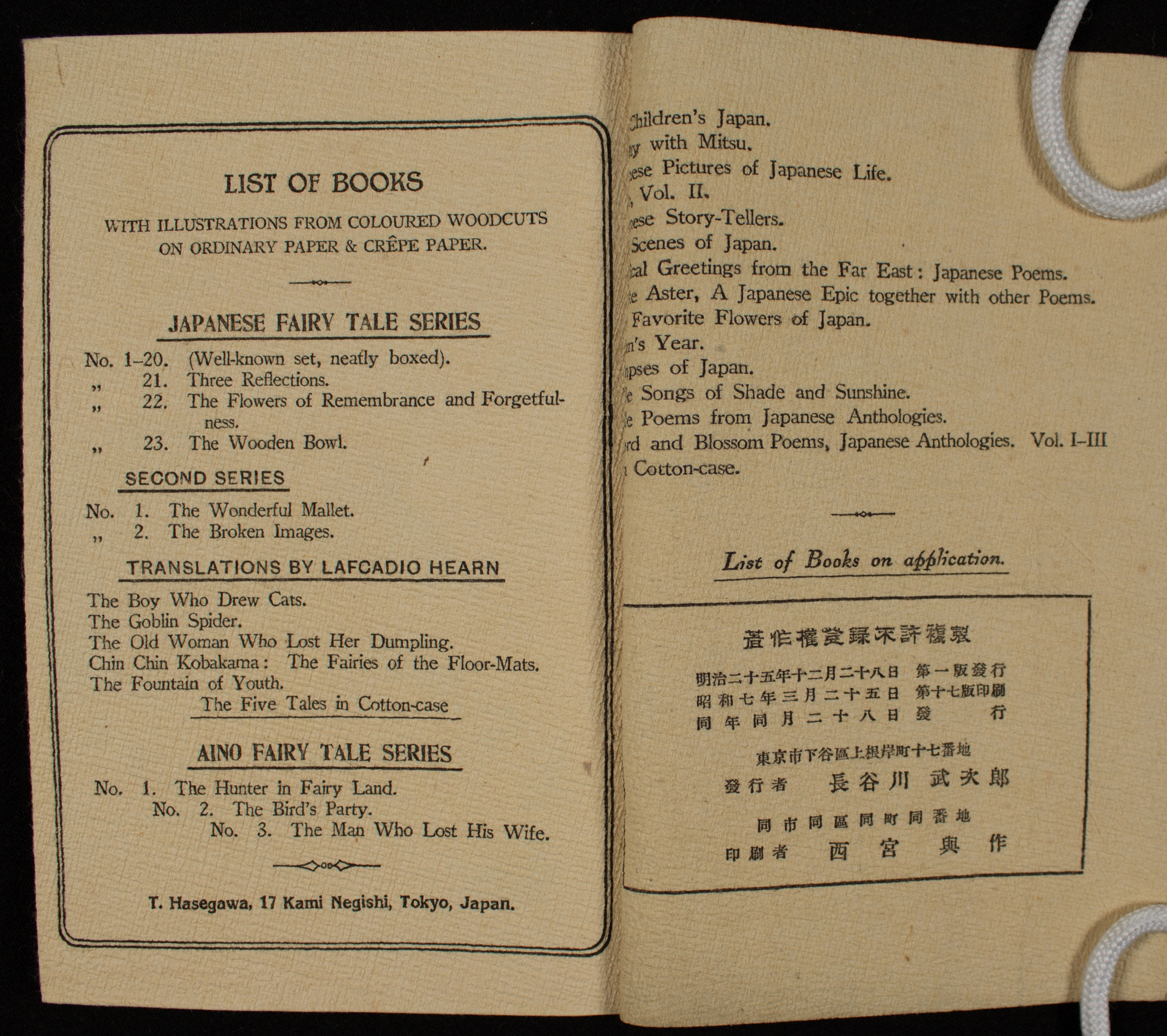
A unique advertisement printed on the back of a 1932 17th edition of The Enchanted Waterfall, advertising Hasegawa’s other published works.
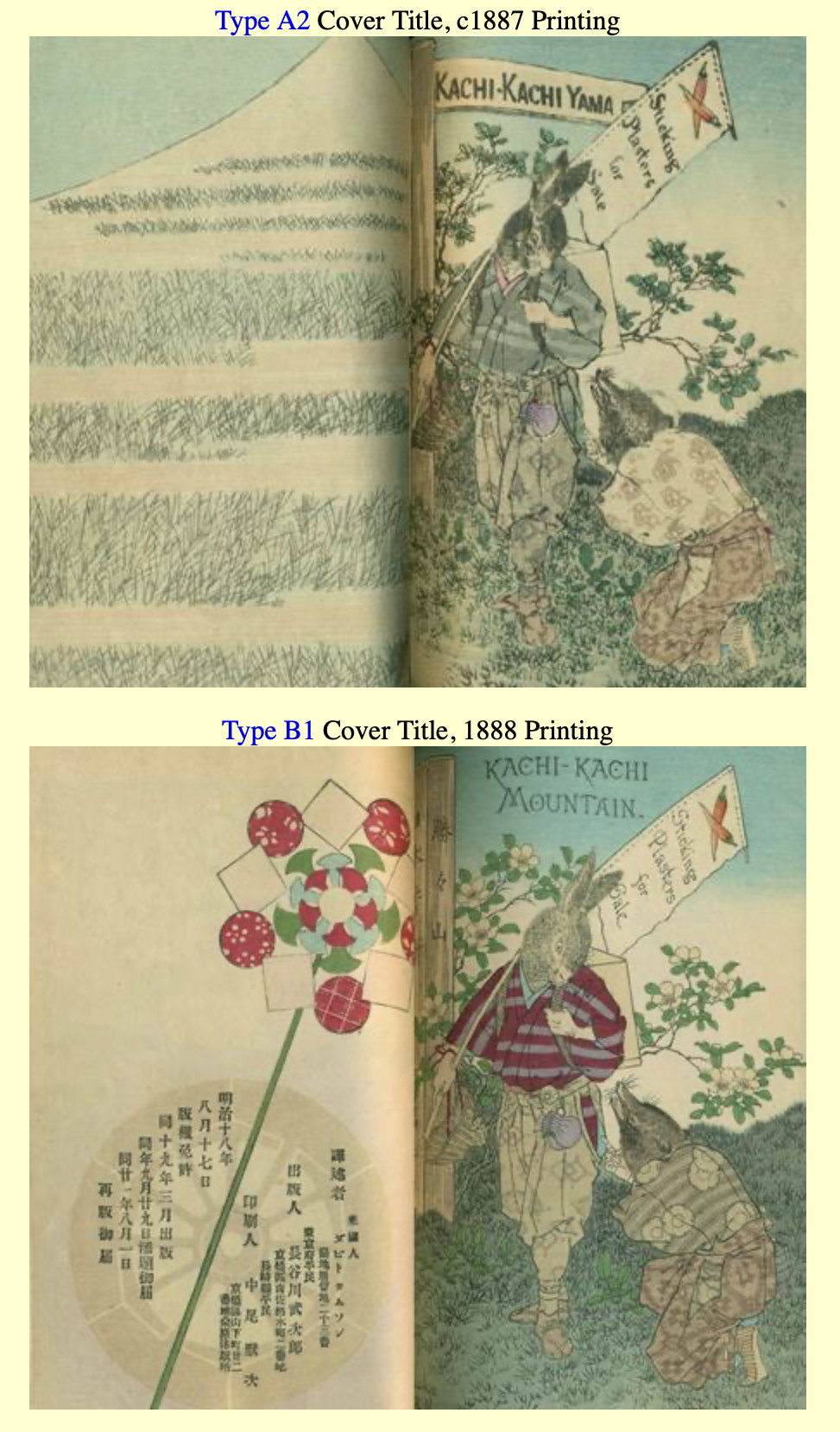
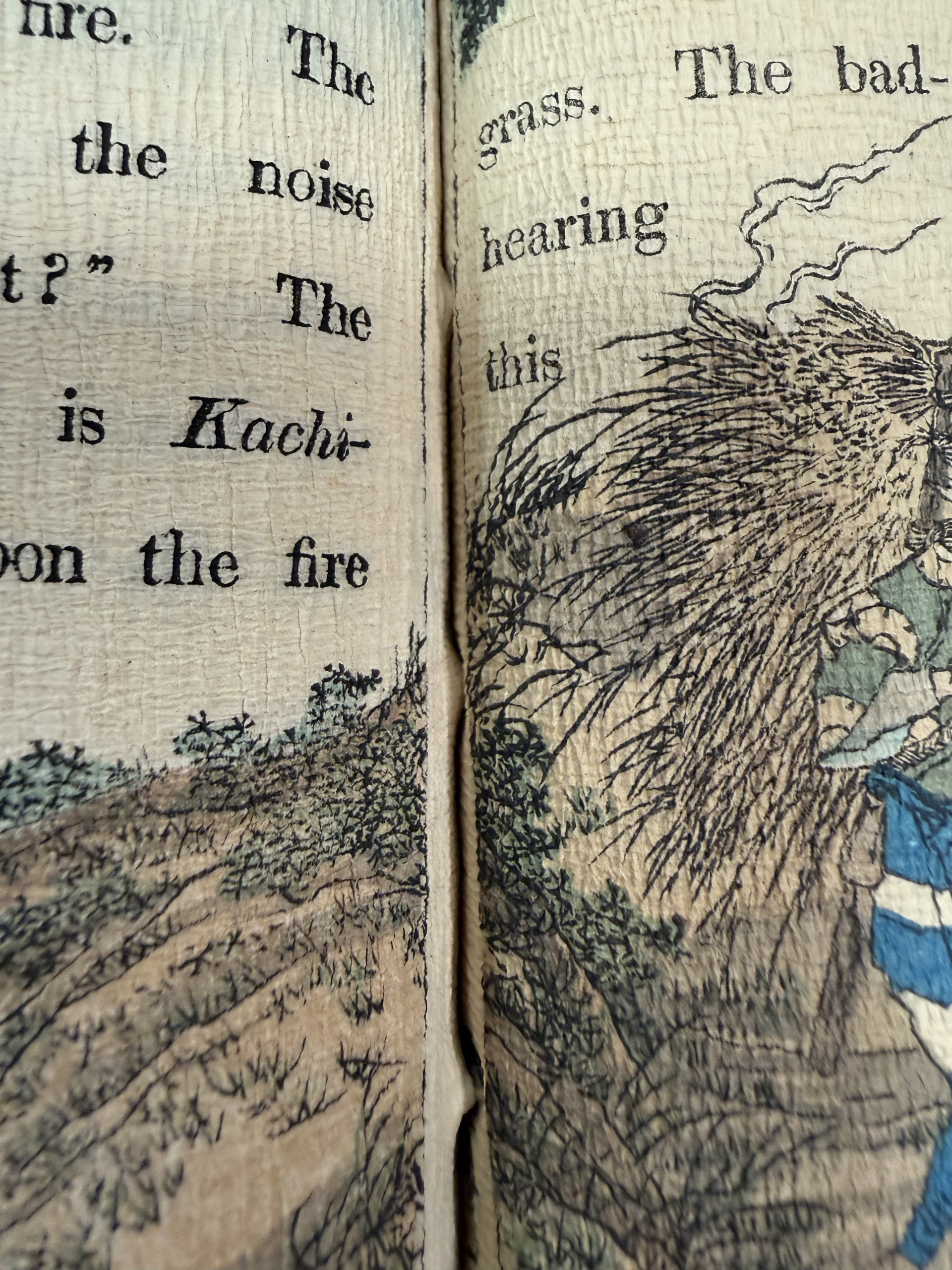
Comparison between two distinct printings of the same story, Kachi-Kachi Mountain, with large differences between the overall title, cover design, and publication information. Image Source: Baxley Stamps
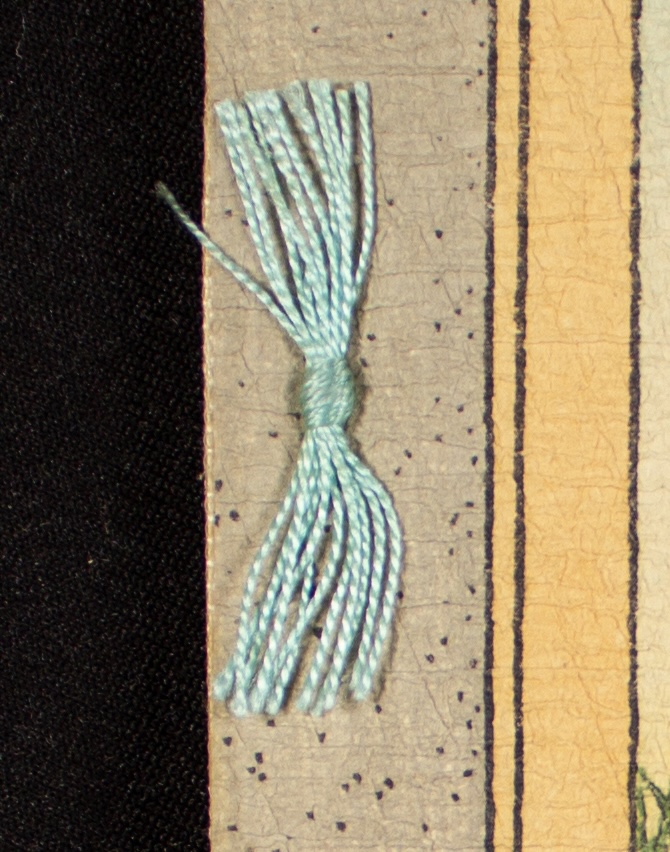

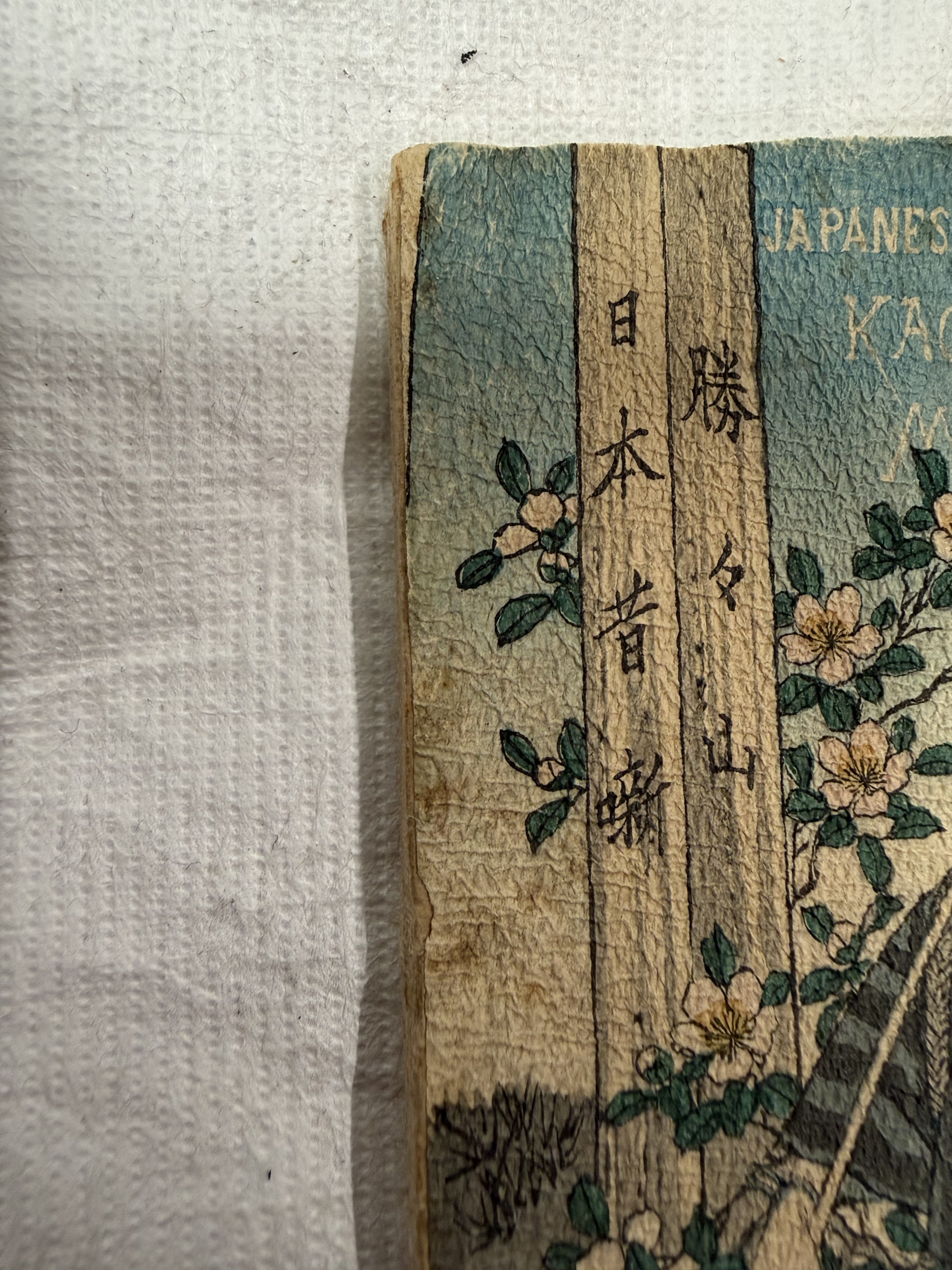
Please click through this gallery to view the differences between the musubi-toji style of binding (blue silk) and a more Western-influenced style of binding using glue (no visible silk).
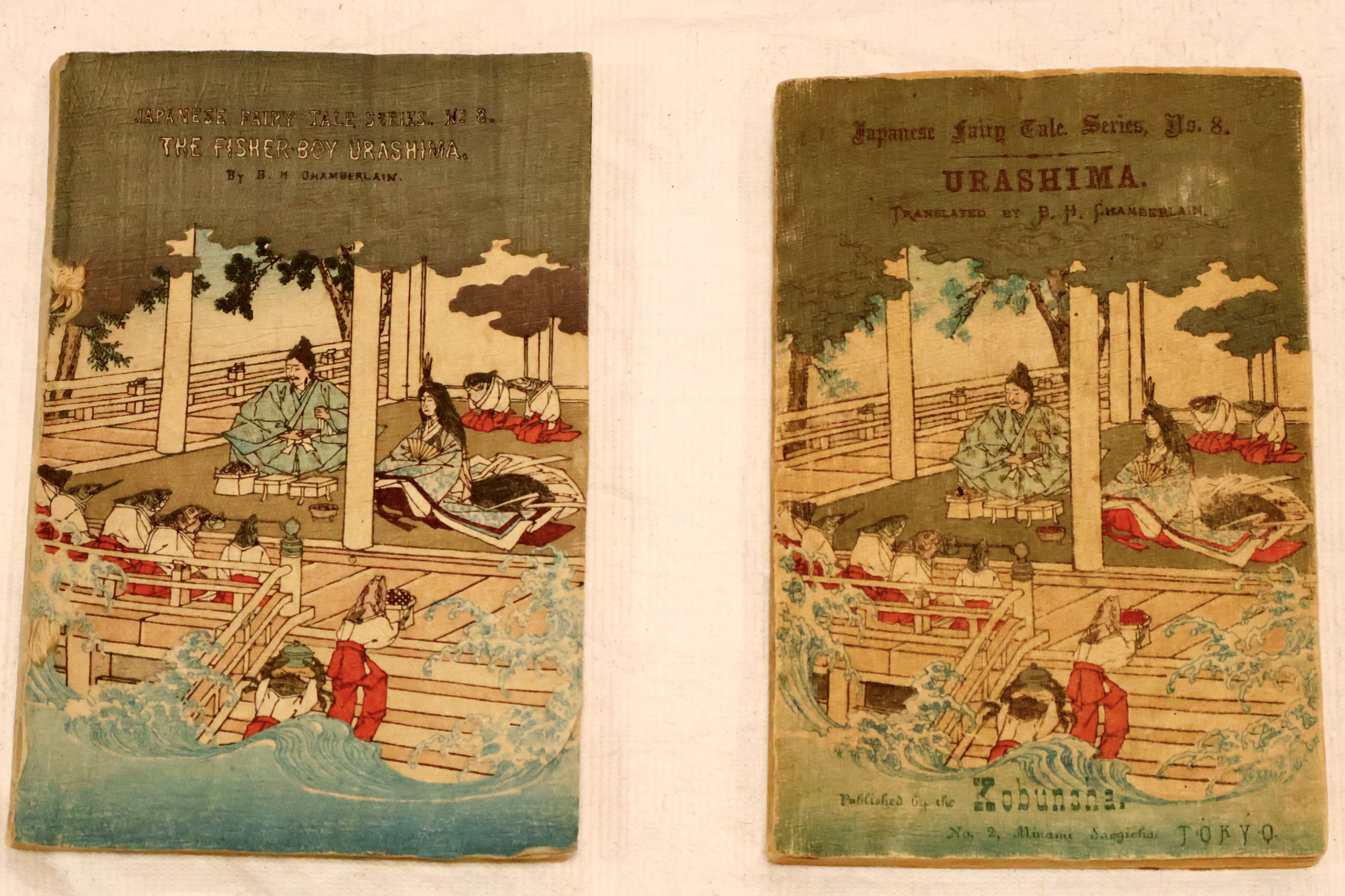
Slight size differences between an 1889 reprint (left) and a 1886 1st edition (right) of The Fisherboy Urashima.
Every Copy Has a Story
One of the joys of studying Hasegawa’s crepe-paper books is discovering that no two copies are exactly alike.
Some preserve early advertisements that disappeared from later printings. Others contain revised translations or newly carved illustrations. Some were printed with richer pigments, while others display evidence of well-worn blocks that had produced thousands of impressions before them.
Each surviving book represents a particular moment in the ongoing life of a publication.
Rather than searching for a single “correct” edition, we can appreciate these books as evolving works that were continually renewed by publishers, artists, printers, and craftsmen. Their differences are not flaws or anomalies—they are part of what makes Hasegawa’s crepe-paper books such fascinating objects to study today.
St. Olaf College Special Collections
Rolvaag Memorial Library Special Collections offers students and scholars access to printed materials from the 15th century to the present. The crepe-paper books you see here can be accessed in-person through our library.