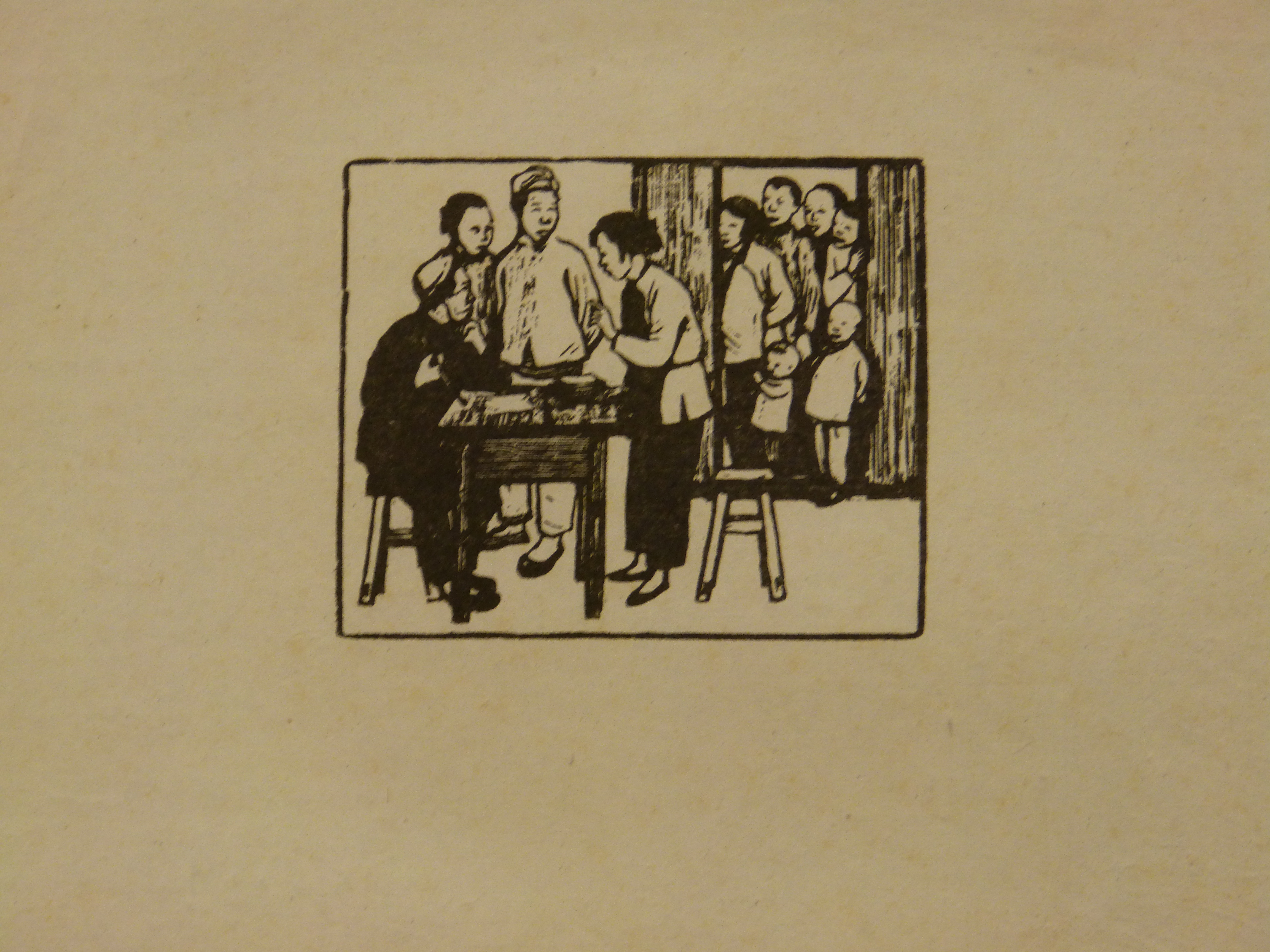
Ma Xiwu Mediates a Marriage Case
Gu Yuan古元 (1919-1996)
Wood block print, 1940s
Villagers look on as the accused, hands up on the right, argues against the charges made against him. The men behind him look on and laugh at the proceedings. The mediator is Ma Xiwu, seen on the left side in an offensive stance, with a group of women behind him. He is defending the woman’s complaints against the man.
20thCentury Woodblock Prints and Gu Yuan
Erin McHugh
Woodblock prints are an integral part of China’s culture: artistically, politically, and socially. Historically, woodblock printing dates back to the mid-sixth century, when it was used to spread Buddhism. However, over the course of the twentieth century, artists began to design, carve and print woodblocks for different purposes. Starting in the 1930’s, China experienced a new woodblock print movement. Lu Xun (1881-1936), a pivotal figure behind the modern Chinese woodcut movement, saw woodcuts as a medium to convey political expression, by promoting social and political change. While many prints were in black and white and were created with subjects expressing criticism of society and social order, woodblock printing technique took a different spin during the 1940’s. At this time, Chinese woodblock prints began to function as political propaganda for the Communist Party. The style began to embrace social realism and was influenced by the former Soviet Union.
Woodblock printing took on this new face following the Long March when the Red Army trekked from southern China to Yan’an, in Shaanxi Province. When China’s coastal cities fell to Japan in 1937, this area was an attractive refuge for left-leaning young artists who wanted to contribute to propaganda efforts. The Communist Party used these emerging artists to their advantage by putting them to work producing images for military newspapers. Initially, Yan’an artists began experiments with folk style in order to reach a wider audience, especially the illiterate peasantry. However, the art of Yan’an was also developed as a model for Mao’s vision of culture and diverged sharply from the styles and subjects of artists in other parts of China.
In 1938, the Lu Xun Academy of Arts and Literature opened its doors. At that time, Gu Yuan was a teenager and joined the school. Xu Beihong, who was a well-known artist teaching at the academy, saw the talent in Gu, stating that Gu was “one of the greatest talents in China’s art circles” and “a great artist in the Chinese Communist Part” (Huang). At the Academy, Gu received fundamental technical training and later became a teacher himself. Through his training, Gu Yuan presented the Communist society through his prints as undergoing vibrant transformation and optimistic construction. This unique style of Gu Yuan can be attributed to his upbringing. He was born into a peasant family in southern Guangdong. In 1939, he arrived in Yan’an to pursue the new socialist dream, and one of the most important experiences for Gu, was when he spent a few months working as an administrative assistant in a small village near Yan’an.
Gu Yuan had a special political agenda he wanted to convey through woodcuts. Instead of depicting China’s countryside in poverty, Gu chose not to present the true reality. He produced graphic art the way he thought reality ought to be under Communism. Therefore, he projects the optimism of the period, reflecting a problem-less and refreshing China. Gu’s woodcut portraying the political nature of the Community Party is exemplified in his work, Ma Xiwu Mediating a Marriage Dispute Case. Gu captures a compelling mediation scene that is very dramatic. At the same time, this woodcut is purposely crafted to draw positive attention to the Communist Party. It is set in the countryside, which is something that the peasants could feel a personal connection to. Gu was well positioned to create this work because of his familiarity with rural China. He positions Ma Xiwu, a Communist commissioner, as the focal point of the woodcut. As Gu places Ma in the center, he depicts him attempting to sort out the lawsuit. The symbolism of the village gate is like an arc over Ma’s head, which conveys a sense of Ma’s confidence and dominance. He is speaking with authority and righteousness, in comparison to the rural old man, who looks as if he admits his wrongdoing. The notion Gu is trying to get across is that things get done and are able to get started when there is a Communist leader involved. This sense of encouragement is spread to those even around the Communist official. For example, the couple standing behind the commissioner seems both optimistic and determined. The scene suggests openness as the setting is in a public square and also popular participation due to the fact that villagers seem to be agreeing with the Communist official. Ma is depicted as just and wise, implying that not only is he able to solve a case and end it on happy terms, but also to represent the correctness of the Communist party as a whole. It serves as a mechanism to get villagers to see what is only on the surface and follow what seems to be a party that everyone can be a part of, benefit from, and be happy with.
From a historical standpoint, the story behind the Marriage Dispute Cases derives from the 1940’s. It is based on the tale of a father who did not let his daughter marry the man she wanted and loved. Instead, the father made a selfish choice and set her up with a merchant. The daughter felt angry, disappointed, and betrayed by her father. To add to the sad story the man the father set his daughter up to marry decided to take the daughter and marry her without any consent. The father became outraged and immediately filed a lawsuit against the man. The Communist commissioner, namely Ma Xiwu, came into town as the hero to solve the case. Eventually, Ma persuades the old father that marriage should not be treated as a commodity. Additionally, Ma criticized the man’s decision of taking the girl and let him know that his actions were unacceptable and not respectful. Later on, the case became quite popular and turned into a famous story called, “The Reunion of Liu Qiao” (Huang).
In conclusion, Gu Yuan captures the modern Chinese Communist Party’s objectives in his prints. Gu Yuan’s woodcuts intertwine Communist intentions with an altered reality of people’s lives in rural China in order to inspire the peasants to take action and support the Party. Gu’s works blended Western art forms with a Chinese folk medium, which was supported by Chairman Mao. This technique was a staple of the Communists’ propaganda scheme to win over the people. Overall, Gu was a political artist and used his art as a propaganda weapon to successfully promote Communism through woodcut prints such as Ma Xiwu Mediating a Marriage Dispute Case.
Selected Bibliography
Andrews, Julia F., and Kuiyi Shen. The Art of Modern China. Berkeley and Los Angeles, CA: University of California Press, 2012.
Huang, Philip C.C. “Court Mediation in China, Past and Present.” Modern China. no. 3 (2006): 275-306. http://www.jstor.org/stable/pdfplus/20062641.pdf?acceptTC=true&acceptTC=true&jpdConfirm=true (accessed November 24, 2013).
Hung, Chang-Tai. Two Images of Socialism: Woodcuts in Chinese Communist Politics. working paper., Carleton College. http://repository.ust.hk/dspace/bitstream/1783.1/1264/1/bladerunner_REQUNIQ1082534920REQSESS2195312118200REQEVENTREQINT11894REQAUTH0.pdf.
Kraus, Richard. The Party And the Arty in China: The New Politics of Culture. Oxford, UK: Rowman & Littlefield Publishers, Inc., 2004.
Von Spee, Clarissa. The Printed Image in China From the 8th to the 21st Centuries. London: The Trustees of the British Museum, 2010.