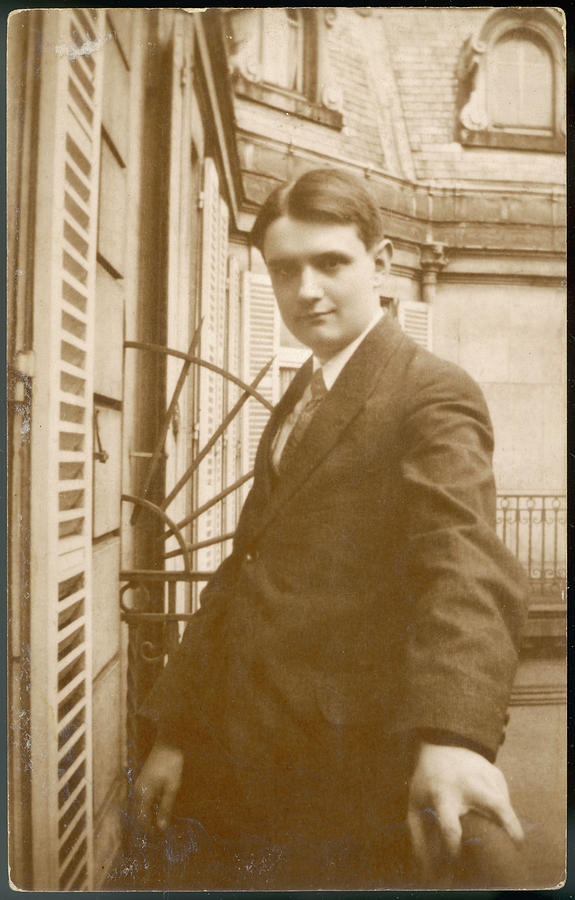
From the moment he landed in Paris, Georges Auric was a social butterfly, flitting around from group to group and making connections with exactly the right people.

This was not the image I had in mind. I had this idea of Auric as the old moth stuck outside the window, watching all the butterflies dance around the alluring lamp. Boy, was I wrong.
Colin Roust’s book Georges Auric: A Life in Music and Politics has been a central source in my research. This biography is incredibly detailed. Seriously, do I really need to know that Francis Picabia, Auric’s friend and colleague in the Parisian Dadaist movement of the 1920s, contracted ophthalmic herpes zoster (a form of shingles that affects the eye)? No. No I do not. But many other details have been very important in learning more about Auric and the people he associated with, which is perhaps even more important for this paper than for a typical research paper.
Considering the chronological focus of this class, I decided to skim the early childhood chapter of Roust’s book. From that, I gleaned a few important pieces of information. First, Auric was not from Paris. He was born in Lodève, a small town of just over 8,000 people in southern France known for its ancient history and tourism industry.
After he began to develop an affinity for music, Auric, his parents, and his half-brother Marcel moved to Montpellier, where the 8-year-old Georges began studying at the Conservatoire. Second, I learned that Auric’s parents were both supportive of their son’s musical ambitions and had the economic means that allowed them to give up everything to help him move to Paris in 1913 (age 14). Last, I learned that he was considered a prodigy. These biographical details are important to note because, in some ways, Auric was an outsider (or at least different) when he lived in Paris, even though in other ways, he was not.
There is far too much information to fully discuss Auric’s life in Paris in the the 1920s. Most important to this paper, I believe, is the knowledge of who Auric interacted with and who he spent his time with. In addition to spending time with Cocteau and the other five composers making up Les Six, Auric worked with the Dadaist movement, and knew other musicians and artists such as Louis Aragon and André Breton. Several of these groups or individuals had rivalries between them, and Auric managed to act as a bridge between them.
Generally, critics praised Auric, but when they criticized him, it was about his lack of refinement, otherness, or accused him of being a parvenu.
Earlier, I mentioned Auric being a social butterfly in the musical and artistic life of 1920s Paris. But perhaps “butterfly” is not the right metaphor. Yes, Georges Auric was a part of many different creative groups and social circles during the 1920s, but he shared the strong feelings of each movement and group and made significant contributions to artistic life in Paris, despite being much younger than the friends he interacted with.
If Auric was a butterfly, then the flapping of his wings caused so many storms in the Parisian artistic scene of the 1920s. I will be sure to not underestimate his effect again.
- Roust, Colin. Georges Auric: A Life in Music and Politics. New York: Oxford University Press, 2020. DOI: 10.1093/oso/9780190607777.003.0001.