Astrid & Ivar Ivask
Beginnings
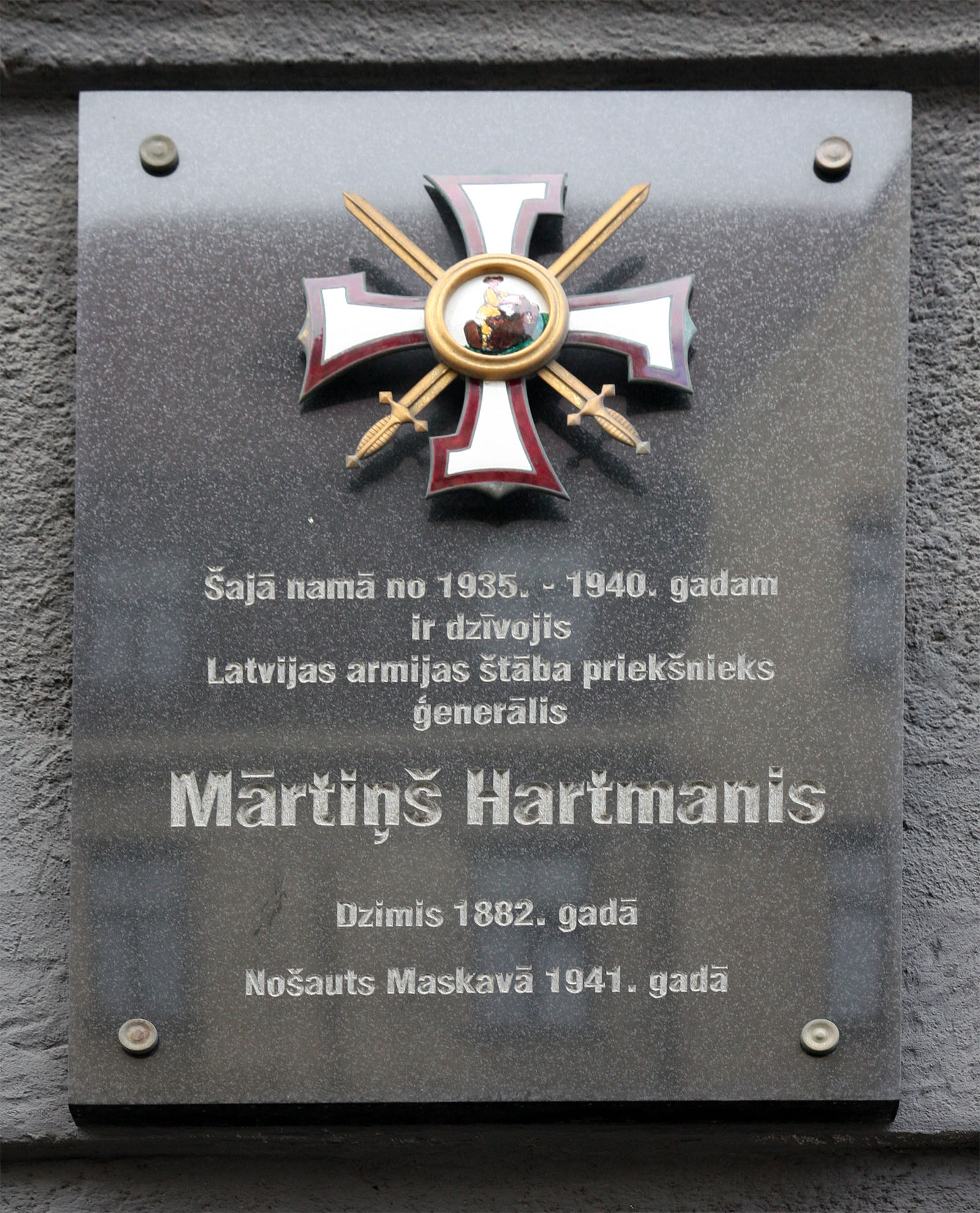
Ivar Ivask was born December 22, 1927, to Friedrich and Ilze Ivask.1 Growing up, he spent time going between Riga, the capital of Latvia, and a small town in Estonia called Rongu.2 Astrid Ivask (neé Hartmanis) was born to Martins and Marija Hartmanis August 7, 1926 in Riga.3 Martins Hartmanis was a general for the Latvian Army, leading him to being deported by the Soviets as a potential threat in 1940.4 Four years later, Astrid, her mother, and her brother fled the oncoming Soviet army, with the shadow of their father’s deportation and death prompting such action.5 Ivar Ivask and his family also fled in 1944, with both families eventually ending up in Germany.6 Both Astrid and Ivar were skilled in languages. Ivar gained a degree in German literature, and Astrid obtained a master’s degree in romance languages in 1949.7 They met as students at the University of Marburg while living as Displaced Persons in Germany.8 Astrid and Ivar got married in 1949, just before immigrating to the United States.9 The Ivasks landed in Minnesota, where Ivar completed his PhD in German Literature at the University of Minnesota.10 Meanwhile, the Ivasks joined the St. Olaf community, becoming German and Russian language faculty members.11
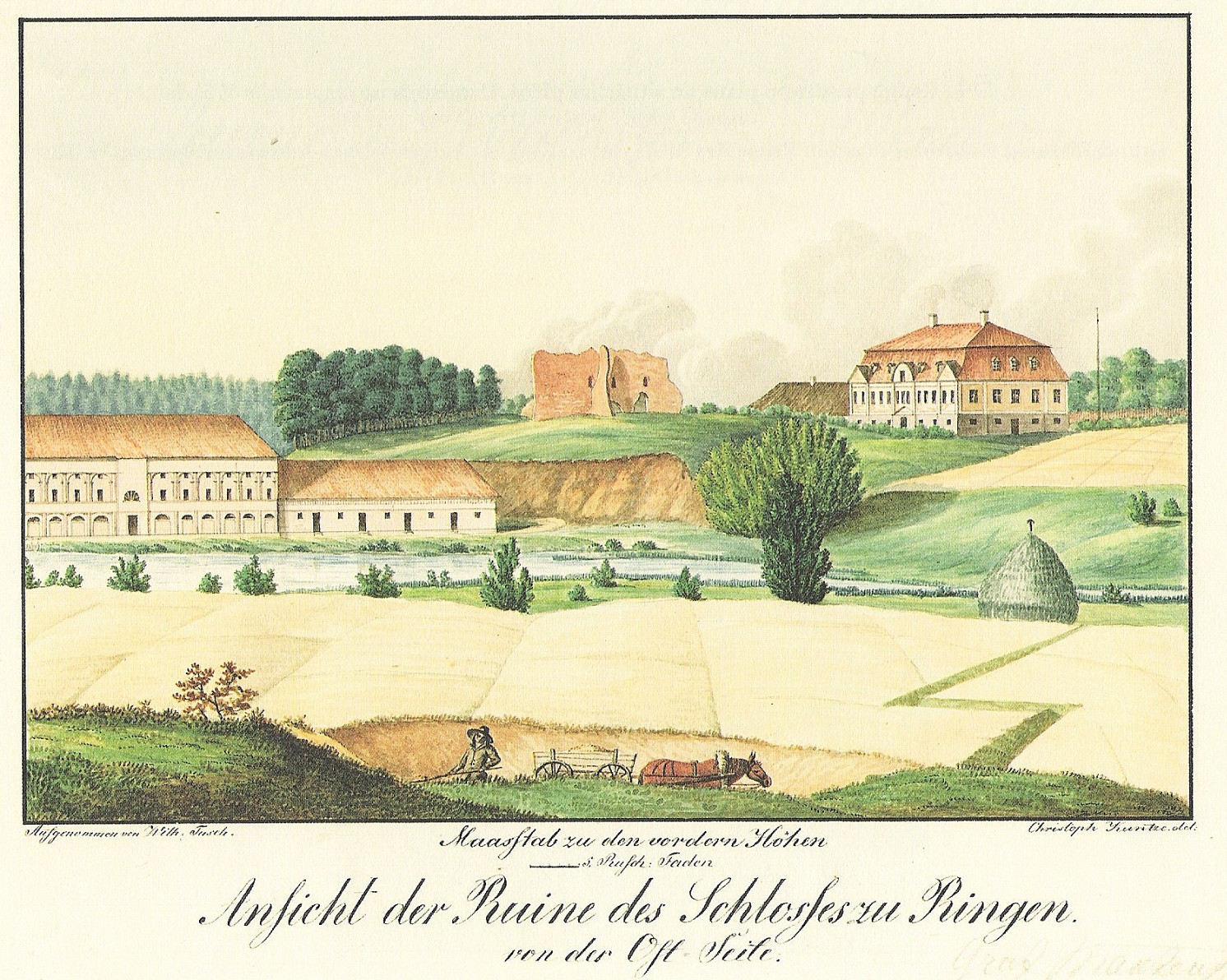
Beloved Professors
Astrid taught in St. Olaf’s Russian language department, serving as chair for many years before becoming a part-time professor.12 Ivar Ivask taught in the German department, serving as chair from 1958 until the couple’s departure in 1967. During their time at St. Olaf, it is clear that the Ivasks became beloved members of the community.13 In addition to being literary scholars, both Astrid and Ivar Ivask were poets themselves. In a 1967 article published in the St. Olaf Messenger, they are asked what their thoughts on poetry are. Ivar states, “‘Poetry is a way of life,’” and Astrid adds, “The poet must be open to experiences as a child, and at the same time as free as a child from the societal pressures towards constant activity.”14 While at St. Olaf Ivar Ivask published his first sets of poems in Estonian.15
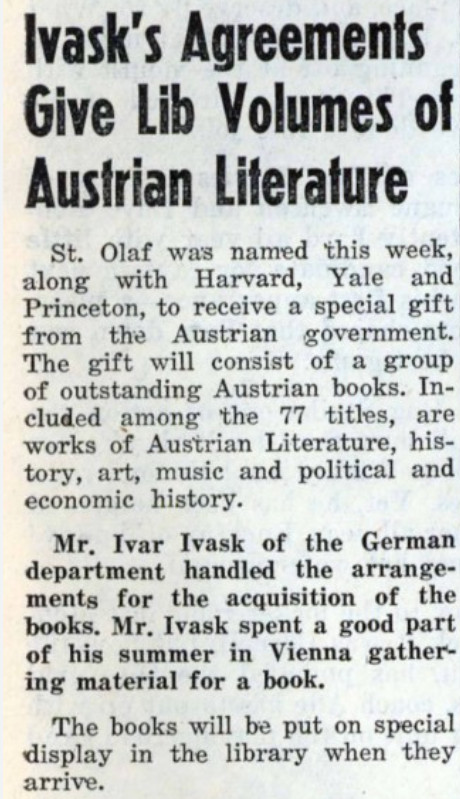
“Ivask’s Agreements Give Lib Volumes of Austrian Literature.”
This article from the St. Olaf Messenger credits Professor Ivask as one of the key reasons why St. Olaf received a gift from the Austrian Government. Along with Harvard, Yale, and Princeton, St. Olaf received 77 works of Austrian literature to be put on special display in the library.
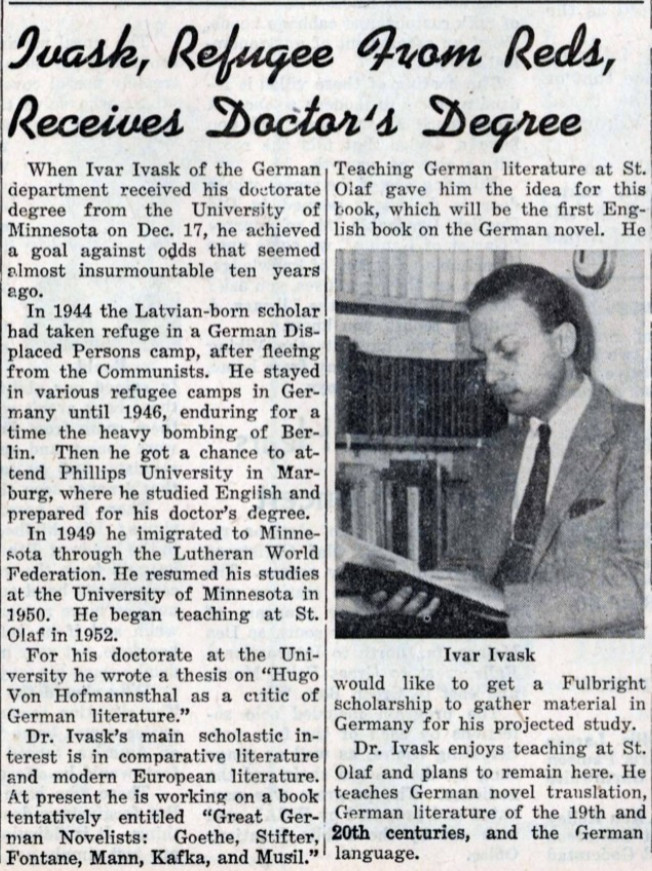
“Ivask, Refugee from Reds, Receives Doctor’s Degree.”
In this article in the St. Olaf Messenger Professor Ivask is congratulated on receiving his doctorate from the University of Minnesota in German literature. The article also touches on Ivask’s background as a displaced person and immigrant from Estonia.
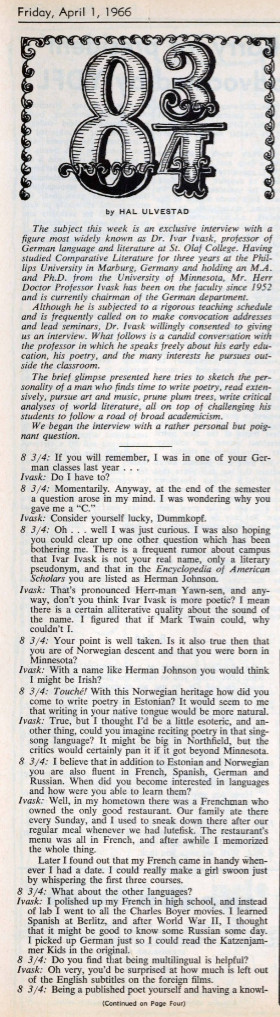
“8 ¾” by Hal Ulvestad.
This article is a satirical interview with Professor Ivask for the April Fools edition of the St. Olaf Messenger. Ivask discusses the theory that he is using a pen name. Beyond the satirical elements, there is a real discussion of Ivask’s poetry and his skills with many languages.
“My absence of almost half a century had added only a couple of annual rings to its eternity”
– Ivar Ivask, 1988.16
Poetry and Beyond
Throughout their lives, both Ivar and Astrid wrote poetry in a variety of languages.17 Ivar published his first collection of poems in Estonian, with later poems being in German, and English.18 Within their poems, the idea of homecoming is addressed. In the 1986 edition of the Baltic literary journal Lituanus, Ivar Ivask published a selection of poems from his Veranda Collection. In poem 22, he writes of his nanny, who became his mother figure after the death of his own mother in his childhood.19 They were separated when Ivar’s family fled Latvia, and they only were able to reunite in 1988, once the USSR allowed him into the country for the first time since his departure in 1944.20
Astrid Ivask touches on her distance from home in the poem The Ionian Sea: Ithaka, which was published in the 1987 edition of Lituanus.21 Astrid writes, “Fortunate is he, who after long wandering is waited for at home. To wander is easy for us all; turning back is difficult. Not every exile comes at last to Ithaka” (Ivask, 10). Their momentous return to the Baltics took place for the first time in 1988, where they were able to visit their birthplace of Riga, as well as the small city of Rongu in Estonia.22 While there, Astrid could see and visit a monument to her father, 48 years after his death in the Russian deportation camps.23 Ivar was able to visit his family burial plot, where he saw the graves of relatives who stayed in Estonia, as well as markers for those who were separated.24 In a 1988 article in World Literature Today, Ivar states, “Here I stood facing the first annual ring of our family tree and felt truly at home” (Ivask, 395). The Ivasks confronted their forced exile through poetry, and eventually also their reconnection. After that visit home, they continued to write poetry, review literature and enjoy life. Ivar Ivask passed away on September 23rd, 1992.25 After having her family property returned in 2001—which had been seized by the USSR—Astrid moved back to Riga. She lived there until her death on March 24, 2015.26
Sources
- M. Laak and A. Sakova, “Situating Oneself Within the Estonian Language and World Literature: Ivar Ivask’s Relational Ways of Self-Understanding,” Folklore (Tartu, Estonia) (TARTU) 79, no. 79 (2020): 72.
- I. Ivask, “A Home in Language and Poetry: Travel Impressions from Estonia, Latvia, Lithuania, and Russia, Autumn 1988,” World Literature Today (NORMAN) 63, no. 3 (1989): 395.
- Obituary of Astrid Hartmanis Ivask, The NORMAN Transcript, March 31, 2015.
- Obituary of Astrid Hartmanis Ivask, The NORMAN Transcript, March 31, 2015.
- Obituary of Astrid Hartmanis Ivask, The NORMAN Transcript, March 31, 2015.
- A. Sakova, “Reading Estonian Literature through a German Lens: How Ivar Ivask Became a World-Renowned Literary Scholar / Lugedes Eesti Kirjandust Läbi Saksa Kirjanduse Prisma Ehk Kuidas Ivask Ivaskist Sai Tuntud Kirjandusteadlane,” Methis. Studia Humaniora Estonica 17, no. 21/22 (2018): 152.
- Obituary of Astrid Hartmanis Ivask, The NORMAN Transcript, March 31, 2015; Laak and Sakova. “Situating Oneself Within the Estonian Language and World Literature: Ivar Ivask’s Relational Ways of Self-Understanding,” 72.
- Obituary of Astrid Hartmanis Ivask, The NORMAN Transcript, March 31, 2015; Obituary of Ivar Ivask, Independent (United Kingdom), September 30, 1992; Laak and Sakova. “Situating Oneself Within the Estonian Language and World Literature: Ivar Ivask’s Relational Ways of Self-Understanding,” 72.
- Obituary of Ivar Ivask, Independent (United Kingdom), September 30, 1992.
- Sakova, “Reading Estonian Literature through a German Lens: How Ivar Ivask Became a World-Renowned Literary Scholar / Lugedes Eesti Kirjandust Läbi Saksa Kirjanduse Prisma Ehk Kuidas Ivask Ivaskist Sai Tuntud Kirjandusteadlane,” 150-152.
- Laak and Sakova, “Situating Oneself Within the Estonian Language and World Literature: Ivar Ivask’s Relational Ways of Self-Understanding,” 72.
- St. Olaf Academic Catalog, 1962-1963, 12. This catalog contains A Record of 1962-63, the eighty-ninth year of St. Olaf College. It also contains the announcements for the year 1963-64.
- D. Brunet. “Opinions on poetry, morality highlighted in current ‘Touch’,” The Manitou Messenger (1916-2020), 1967; “Ivask Refugee from Reds, Receives Doctor’s Degree” The Manitou Messenger (1916-2020), 1954; “Ivask’s Agreements Give Lib Volumes of Austrian Literature” The Manitou Messenger (1916-2020), 1957; H. Ulvestad, “8 3/4” The Manitou Messenger (1916-2020), 1966.
- Brunet. “Opinions on poetry, morality highlighted in current ‘Touch’,” 1967.
- J. Talvet, “Along The Annual Rings of The Heart: The Poetry of Ivar Ivask,” Journal of Baltic Studies 30, no. 1 (1999): 40.
- Ivask, “A Home in Language and Poetry: Travel Impressions from Estonia, Latvia, Lithuania, and Russia, Autumn 1988,” 395.
- Talvet, “Along The Annual Rings of The Heart: The Poetry of Ivar Ivask,” 40. Ivar wrote in English, Germany, and Estonian; World Literature Today; “A Tribute to Astrid Ivask: A Literary Light.” Accessed June 23, 2026. https://worldliteraturetoday.org/blog/literary-tributes/tribute-astrid-ivask-literary-light. Astrid wrote poems in Latvian and English. She also translated her own poems and Ivar’s.
- Talvet, “Along The Annual Rings of The Heart: The Poetry of Ivar Ivask,” 40.
- I. Ivask, “In The Circle of The Veranda: Poems From the Veranda Book,” Lituanus, No. 1 (1986): 11.
- Ivask, “A Home in Language and Poetry: Travel Impressions from Estonia, Latvia, Lithuania, and Russia, Autumn 1988,” 396.
- A. Ivask, “The Ionian Sea: Ithaka,” Lituanus, No. 3 (1987): 10.
- Ivask, “A Home in Language and Poetry: Travel Impressions from Estonia, Latvia, Lithuania, and Russia, Autumn 1988,” 391.
- Ivask, “A Home in Language and Poetry: Travel Impressions from Estonia, Latvia, Lithuania, and Russia, Autumn 1988,” 398.
- Ivask, “A Home in Language and Poetry: Travel Impressions from Estonia, Latvia, Lithuania, and Russia, Autumn 1988,” 395.
- Obituary of Ivar Ivask, Independent (United Kingdom), September 30, 1992.
- Obituary of Astrid Hartmanis Ivask, The NORMAN Transcript, March 31, 2015.
Images
- (Heading) “Juask Refugee from Red, Receives, Doctor’s Degree,” The Manitou Messenger (1916-2020), 1954.
- “Rõngu linnuse varemed W.Tusch 2,53.” Scan from the original work. Wilhelm Tusch. Wikimedia commons. United States of America Public Domain, {{PD-US}}. https://commons.wikimedia.org/wiki/File:R%C3%B5ngu_linnuse_varemed_W.Tusch_2,53.jpg
- “Juask Refugee from Red, Receives, Doctor’s Degree,” The Manitou Messenger (1916-2020), 1954.
- “Ivask’s Agreements Give Lib Volumes of Austrian Literature,” The Manitou Messenger (1916-2020), 1957.
- Ulvestad, H. “8 ¾.” The Manitou Messenger (1916-2020). 1966.
- “Commemorative plaque to Martins Hartmanis,” Wikipedia, Mārtiņš Bruņenieks, September 23, 2010. Published under Creative Commons. https://commons.wikimedia.org/wiki/File:Commemorative_plaque_to_Martins_Hartmanis.jpg