September was still a month of beautiful weather, lots of outdoor activities, and adjustments for all of us at work and school.
- September was the month I got started on my research in earnest. I participated in the conference “Eco-Emotions: On Water” right away during the first week of September. The topic fit in perfectly with my research project, which is on cultural imaginaries of hydropower development as represented in Norwegian literature, film, and other media. Since the audience included humanities scholars working on a lot of different cultures and languages, I decided to present a brief overview of my project that focused on recurring ideas about rivers, sound, and creativity, rather than diving too deeply into a particular example. The most exciting part was hearing from other thinkers and scholars, including keynotes by Andri Snær Magnason, whose books Dreamland and Of Time and Water are closely related to my project, and Tarek El-Ariss, whose memoir Water on Fire is now on my reading list.
- That first weekend, some friends invited us out to Lågøya, an island that used to be owned by a Norwegian fuel oil company. After moving the storage tanks they originally built there onto the mainland, they turned it into a vacation spot for their employees. Our friends even said they knew someone who had grown up living their all summer as a child with her mom and siblings, and she said her dad would just row over from the plant to the island after work to join them. The cabins have been restored and are now managed by DNT, the Norwegian Trekking Association. The island was just a short ferry ride from Oslo, but it felt really removed from everyday life. The cabin was really too spacious just for the three of us, and the kids had fun fishing for crabs and other sea life (just to look at–not to eat!), swimming, and paddling around in rowboats. It was this weekend that I realized it was starting to actually get dark at night! We also had an incredible chance encounter with a good friend of one of my colleagues back at St. Olaf, who heard us speaking English and got curious about where we were from. Turned out, we had a common acquaintance! This resulted in a dinner invitation to eat one of the traditional Norwegian dishes during the fall, fårikål (lamb and cabbage stew).
-
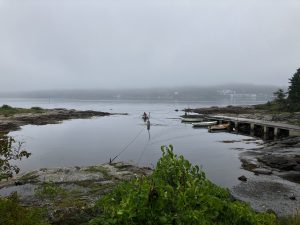
- Ryan and Annabel rowing out from Lågøya
-
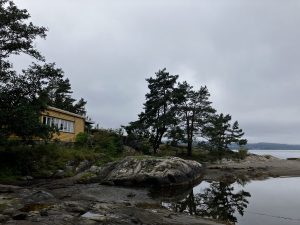
- The cabin
-
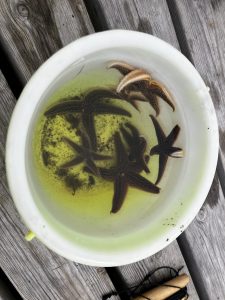
- Starfish the kids scooped into a bucket
- The parliamentary election happened on September 8. The race was close, and some were predicting that there would be a shift to a “blue administration,” which is conservative in the Norwegian color code, not liberal (or socialist, as they say). But a “red” coalition ended up prevailing, even though the Progress Party (their furthest right party) received the second largest number of votes. This meant that Norway kept its previous prime minister, Jonas Gahr Støre. Probably the biggest news was how poorly the traditional Conservative Party, Høyre, performed. This has led to its leader, the former prime minister Erna Solberg, stepping down. Because people knew the race would be close, there was a lot of talk leading up to the election about voting for smaller parties further to the left in order to help them get over 4% of the vote, which gives them a “boost” in the number of seats in parliament they receive. This also gives them more influence in the future government because the Labor Party can’t govern without the support of these smaller parties. Basically, there are more choices and, especially recently, less predictability in Norwegian politics than in the US, as their society responds to new challenges. But there is also an incredible amount of agreement and frankly, I was often surprised by how minor the differences in policy were, although there are distinct differences in rhetoric. In general, I would say there is much more civility, and the voter turnout was really high–80% of eligible voters participated, with over 60% voting before election day. US turnout in 2024 was 64%.
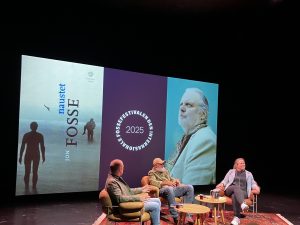
Lesesirkel, Fossefestivalen
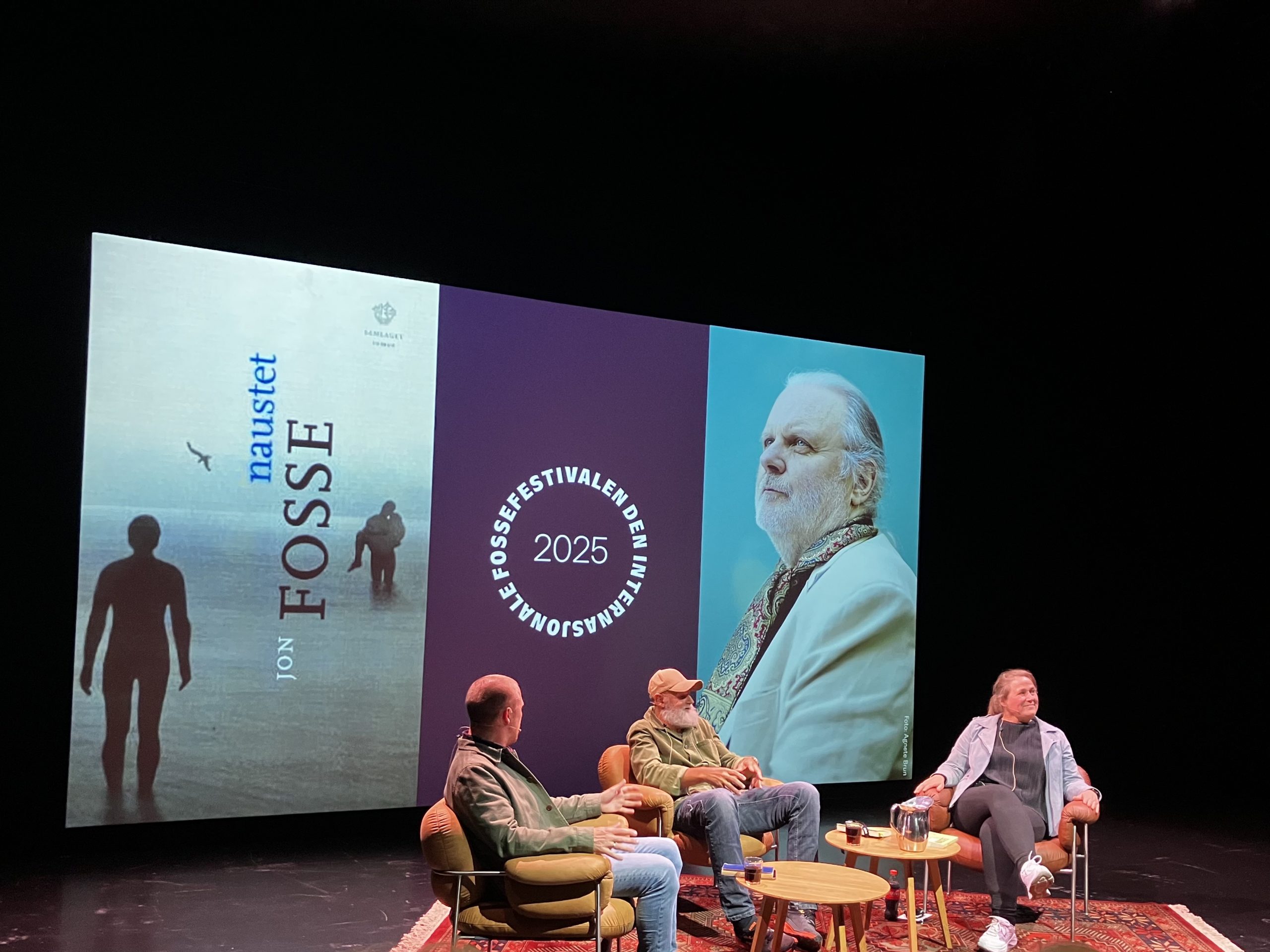
- I have been attending a lot of literary events to rediscover a sense of joy and discovery in my field and take in a lot of Norwegian language in my own discipline. Every fall, there is a festival focused on Nobel prize-winner Jon Fosse’s work, and although I couldn’t find tickets at a suitable time to any plays, I attended a “reading circle,” where notable authors discussed one of his novels, Naustet (the Boathouse). I hadn’t read this one before, so it was a good excuse to read it as well. Crown Princess Mette-Marit ended up being a last-minute special guest at the reading, so I’ve been saying I crossed another royal off of my bingo card. (I saw Queen Sonja at St. Olaf, but missed Prince Haakon’s visit, so Mette-Marit is my substitute.)
- Ryan and I continued our quest to visit every coffee shop on a coffee map he found at his favorite spot, Supreme Roastworks. It mostly features places that roast their own coffee, or that serve coffee from local roasters. We’ve found some real gems, but no true rivals to Ryan’s favorite. Fuglen is still one of our go-to’s, but we’ve added Kuro to that list.
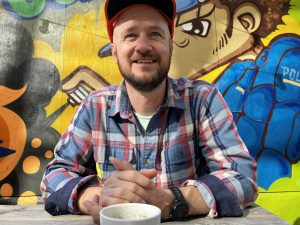
Ryan enjoying his coffee from Fuglen
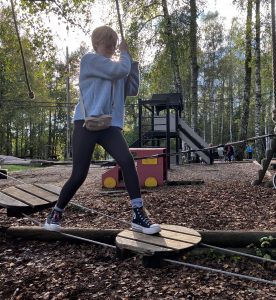
- We went on several family jogs in the woods, either with Annabel, or just as a pair while Annabel went to soccer practice. On one of these jogs, we found a really cool park with a ropes course that I guess is just a neighborhood initiative, not really a project by the city government. It seems like a regular gathering spot for families, but it is kind of weird that my kid has almost outgrown parks! (Almost–this one has a zipline and is still 11-year-old approved.)
- I went to my first loppemarked (flea market) in Oslo. I don’t know how I managed to avoid this tradition in the past, but it is a fall staple for especially school bands to hold flea markets as fundraisers for the year. Ryan was really hoping to buy skis at the Grorud flea market, but someone had stolen all their outdoor equipment before the flea market opened! In one of my classes, I’ve taught about differences in class, race, ethnicity, and immigrant status between different neighborhoods.

People lined up to peruse the housewares and antiques at the flea market
Groruddalen has traditionally been viewed as working class and in more recent decades as an immigrant area. My students have watched the TV show Dalen vår, which features different families from the area, and we’ve read the novel Tante Ulrikkes vei, about Stovner, which is a few subway stops away from us, so I’ve enjoyed experiencing the neighborhood firsthand. An interesting thing about Norwegian media culture is that the government provides funding for local newspapers, so Grorud even has its own newspaper, which is a good source for news on local events and businesses.
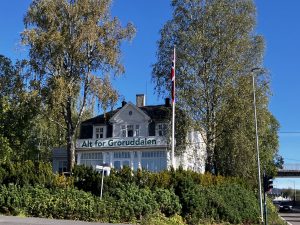
The local newspaper office. The sign says, “Everything for Grorud.”
- There were fewer museum outings this month, but we did visit the Technical Museum with some friends. They happened to have a room dedicated to models that included a model of a hydropower plant at Rjukan, one of the most famous developments in Norway.
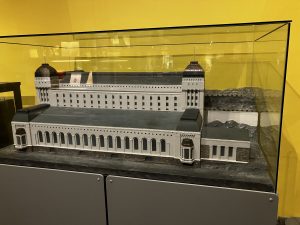
The Såheim “opera”
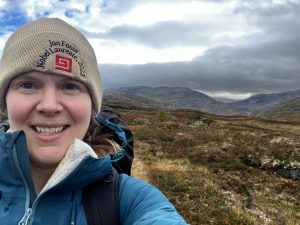
- Fall vacation happened over the last few days of September and the first few days of October. We really wanted to get one good backpacking trip in, so we took the train to Hallingskeid and hiked to a DNT cabin called Kaldavasshytta. We were really lucky that it didn’t rain at all, but this hike was tough. We tried to avoid going up the steepest route, which Annabel and Ryan had done before in 2023, so we choose a much longer route that had several smaller climbs spread out over more miles. The path took us up close to several small glaciers, a first for me, I think. We didn’t arrive at the cabin until after dark, so Annabel was a kid hero for persisting all the way there. (And I was a parent hero for having insisted that we buy proper hiking boots.) We spent a full day resting at the cabin and then hiked down to the Myrdal train station. From there, we hiked back to Hallingskeid along the Rallarvegen, a road that was built to facilitate construction of the railroad from Oslo to Bergen. This was easy hiking (but still far) along the river, which included one dam and power station owned by the railroad. (Because of my project, I always haul out my camera and read all of the signs when we come across any kind of hydropower infrastructure in the wild.) We headed back to Oslo October 2nd, so this trip rounded off a busy September and the chilly weather up in the mountains made us feel like it was truly starting to be fall.
-
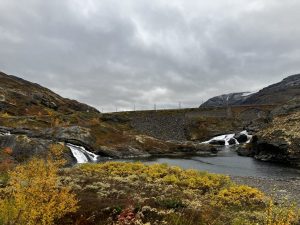
- Railway dam built to power the train
-
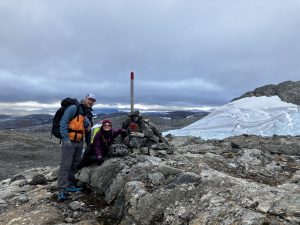
- Posing by the glacier
-

- Annabel taking in the view after a steep climb