The fact that I am writing my August blog on December 16th gives some indication of how full our days in Oslo have been. The delay may also be due to the lack of sun that we’ve been experiencing for weeks now. In mid-November, there was a brief window of wintery weather–frost, some light snow, and a few cold, clear days. But for several weeks, it’s been nothing but clouds, drizzle and above-freezing temperatures. Amidst the gloom, it’s comforting (and strange) to look back on our pictures from August when we tried to go swimming outside every day … Here are some August highlights:
- Moving out of our house was daunting. It didn’t help that I decided our leaky bathroom shower
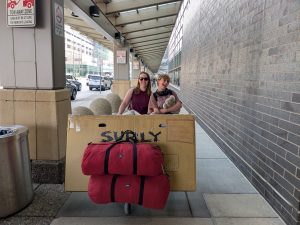
Me and Annabel with all our luggage
head had to be fixed before we left and ended up breaking a pipe and costing us $500 or so. But somehow everything got packed up and moved to our basement, the house ended up empty and clean, and we put our suitcases and Ryan’s bike into an obscenely large SUV that we rented for the drive up to the airport.
- Our apartment (technically a rekkehus/rowhouse) in Oslo is in the Rødtvet neighborhood in Groruddalen. Groruddalen is valley to the east of Oslo that has been an industrial area since the mid-1800s. In the 1950s and 60s, suburban housing was constructed for the workers moving to Oslo after World War II. The different types of housing have spread out up the sides of the valley, with larger “villas” backing up to the Lillomarka forest, duplexes and row houses like ours a little further down, and larger apartment buildings closer to the T-bane (subway) line. There are a lot of different immigrant backgrounds represented in our neighborhood, so we hear many different languages spoken in the playground near the local school and in the grocery store.
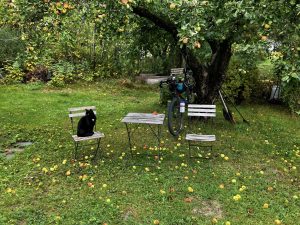
The backyard apple tree and one of the neighborhood cats
- Logistics had to be taken care of right away, including figuring out how to sign into my old bank accounts and get payments working, going to the police station to register our arrival, and getting a library card (top priority in our family). I also moved into my office at the University of Oslo and caught up with my host, who has been so helpful and reassuring during the long (and uncertain) process of planning this sabbatical. Ten years ago, I worked in the same building as a PhD candidate, so it feels like a significant milestone to be back here as an associate professor.
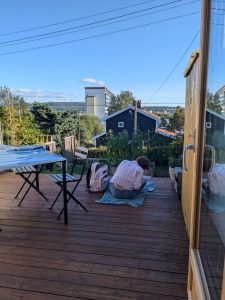
Annabel on our cozy deck
- School arrangements have been a cultural experience in themselves. This is the third time I’ve spent a full academic year in Norway, so I already know a fair amount about the immigrant system, banking, and other practical matters, but I’ve never had a child in school here. Thanks to another Fulbright parent, we found out that we should contact the local school to get Annabel registered, and that they would then refer us to Språksenteret (the Language Center) for a placement session. We were able to get an appointment for this only a few days after we arrived, and it was striking how thorough the assessment was. A teacher met with Annabel for almost three hours, and there were evaluations in reading and writing (in both English and Norwegian), math, science, social studies, and KRLE, a subject they have in Norway that focuses on Christianity, religion, “livssyn” (life stance/philosophy), and ethics. In the end, they recommended that Annabel receive intensive Norwegian instruction at Språksenteret, which is about 35 minutes from our apartment by bus. Because it’s so far from our house, Annabel receives a free monthly transit card from the school. It took a few weeks, but Annabel worked up to taking the bus home from school alone every day. (I usually ride with them in the morning so we can chat and to help motivate me to get an early start.) Annabel’s classmates are from all over the world, and the school does a good job of incorporating their backgrounds and experiences into instruction. School started the third week of August, so getting Annabel ready and settled was a big part of this month. Another odd feature of Norwegian school is that the daily schedule is really varied: Annabel starts at 8:15 most days, but at 8:00 one day and 9:30 on another. School gets out at 2:30, 3:20, or 1:30, depending on the day. There is after school programming for younger kids, but from 5th grade and up, families arrange any afterschool activities on their own. It was important to Annabel to find a dance class right away, which we did, and now soccer is also part of our schedule twice a week (more on that later).
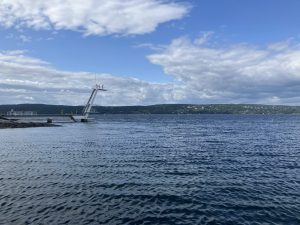
Ingierstrand
- Exploring the city kept us busy, especially during the first two weeks of August. Annabel and I went to the National Museum, and we went to a few bakeries to try different boller (sweet rolls in various flavors). We also did a lot of swimming. There is a small lake about a ten minute walk from our house. When we first arrived it was pretty cold, but Annabel loves swimming and talked us into jumping in regardless. We also took a bus down the Oslo fjord to Ingierstrand, which has a 10-meter diving tower that Ryan has been wanting to jump off since the last time we were here in summer 2023. (Annabel and I managed the 5-meter tower, but only Ryan braved the tallest one.) We also took a ferry out to Langøyene, which might be our favorite island in the fjord for swimming and swam in Sognsvann, an established tradition for us at this point.
- In the cultural activities category, we dropped by Vigeland’s park, which Annabel had been to many times
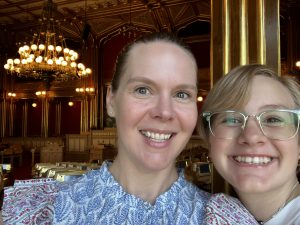
Annabel and I at Stortinget (the Norwegian parliament)
as a baby but of course doesn’t remember, and Annabel and I took a tour of Stortinget (the Norwegian parliament). One of my regular courses is an advanced Norwegian language course focused on Norwegian society and politics, so I know a fair amount about what goes on in this building, but the tour was still educational, and it was exciting to see the building from the inside. (Annabel got embarrassed when the tour guide couldn’t remember a word in English, so he said it in Norwegian, and I translated it for him. I am growing accustomed to be very embarrassing these days.)
- I met a number of colleagues who are part of the Eco-Emotions research group to get a private tour of an exhibit at the Munch Museum that focused on how ideas about the body and health during his lifetime were influential in Edvard Munch’s work.
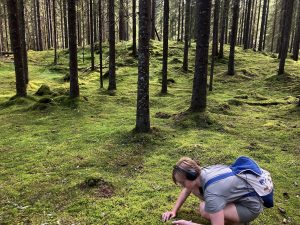
Annabel picking blueberries
- Blueberries were in season when we arrived, so we did some berry-picking on a few of our hikes. One trip was a quest to find enough blueberries to make jam. Although the jam turned out a bit runny, it was good enough to eat on pancakes the next day. The forest around Oslo has several cabins that are like rest stops for people when they are out hiking or skiing. They sell coffee, waffles, and other treats, and you can refill your water bottle and use the bathroom there as well. Our closest cafe in the woods this time is Lillomarka sportsstue. There used to be mining in this area in the 1700s, so we found a few old mine shafts marked with historical signs on our way there. Somewhere in the middle of this month, we realized how much more we were walking than we typically do back in Minnesota.
- Fulbright orientation happened during the third week of the month, which also happened to be Annabel’s first
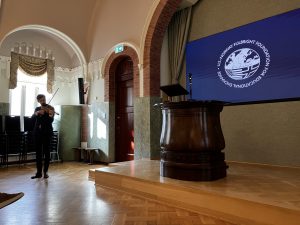
Hardanger fiddle player at the Fulbright reception
week of school. The logistics of this were a little tricky, but it was fantastic to meet all our fellow Fulbrighters, and I even led a session on influential books and films that provide a good introduction to Norwegian culture. The first time I had a Fulbright, I got stuck in London for three days due to some unique travel challenges, so I missed the entire orientation.
- Once Annabel started meeting some kids the same age, the outings with kids started. We went to the Botanical Garden with a new friend, and we met up with a friend from years past at a park where they had put out all kinds of building materials, hammers, nails, and paint, and were letting community members build a miniature town. The kids were totally engrossed by this activity and there were lots of colors and creativity on display.
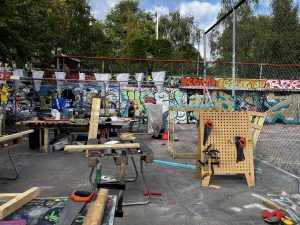
Area for construction play in the park
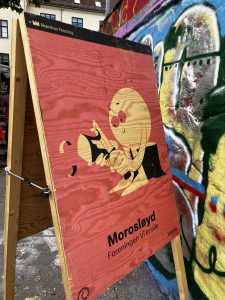
“Morosløyd”–basically carpentry for fun
- I managed to catch a premiere screening of Affeksjonsverdi (Sentimental Value) that was introduced by the Norwegian director Joachim Trier and the Swedish actor Stellan Skarsgård. This was something of a sentimental experience for me, since his 2006 film Reprise was probably the first contemporary Norwegian film to make a strong impression on me.
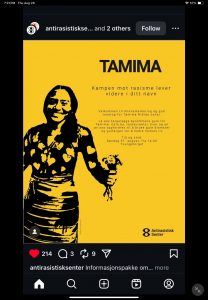
- There was also a horrifying racist attack this month on a young welfare worker named Tamima Nibras Juhar, who had immigrated to Norway from Ethiopia in 2008. A large memorial was held downtown, and everyone wore her favorite color, yellow, and brought yellow flowers in tribute to her.
- August was campaign season in Norway, since the parliamentary election was held on September 8. The election news coverage was relentless, but it is always striking for an American that the campaign season is so short. Of course, everyone knows the election is coming, but they don’t start campaigning in earnest until after people are back from summer vacation at the beginning of August. There were a lot of demonstrations as well, meant to influence voters but also the general discourse and policy proposals around the election. I observed one climate rally and found it interesting to see the language being used and the specific issues in focus. In this election cycle, climate groups were especially emphasizing the need for a plan for phasing out oil.
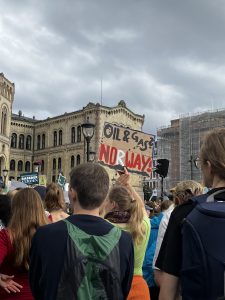
Climate rally in front of Stortinget
- Already by the end of August, we were realizing how busy our days were. It’s difficult not to feel pressure to be getting as much as possible out of our time here, but we’ve had to keep in mind that we also need to live our daily lives. (Oh, and I have that research project to do as well.) But August was really a month for getting our bearings and putting systems in place to be comfortable in our day-to-day lives.