Picasso was always more interested in popular music rather than traditional classical music, an interest which led him to composers like Satie and de Falla, and ultimately led to him designing cubist sets and costumes, designs which in turn influenced the audiences perception of the music, and even the content of the musical works themselves. Dr. Lewis Kachur tells us how Picasso frequently depicted tenors (a clarinet like instrument) and guitars in his cubist works, and how Picasso had a perchance for a mixture of songs, as well as unconventional contemporary music 1. Dr. Kachur ultimately argues that Picasso, by returning to his cultural and ethnic heritage, in combination with his incorporation of the poplar into his art allowed him to establish himself in the Parisian art scene. From here Picasso continued his foray into modern media. This departure from traditional painting styles to modern media could be viewed in parallel with French composers attempts to depart from traditional German classicism. This would make Picasso an ideal set designer and artist in the eyes of those like Cocteau, who was strongly in support of a whole new french style of music.
It was in 1917, in Paris, where Picassos relationship with the Ballets Russes began. James Beechey and Richard Stone, discussing the ballet “The Three Cornered Hat”, tell how Picasso’s association with Diaghilev (a patron and founder of the Ballet Russes), bolstered Diaghilev’s status, allowing his work to be seen as more palatable by the general public 2. Interestingly, Picasso had some dirt impact on the musical composition of the ballet, adding authentic spanish touches to de Fallas score, and proposing the opening fanfare. Massine (the choreographer), also developed a creative relationship with Picasso, Massine taking influence from the design of the costumes and Picasso taking feedback from Massine on the designs. In this way Picasso had both an influence on the musical content of the ballet, as well as to the movement of the dancers on stage, in addition to his work on the scenery and costumes.
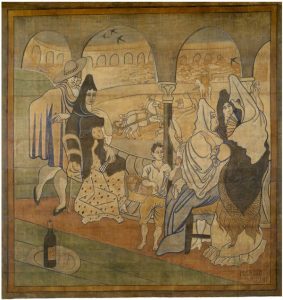
Pictured below, the curtain for “The Three Cornered Hat”
Kachur, Lewis. “Picasso, Popular Music and Collage Cubism (1911-12).” The Burlington Magazine, vol. 135, no. 1081, 1993, pp. 252–260. JSTOR, www.jstor.org/stable/885513. Accessed 3 Mar. 2020.
Beechey, James, and Richard Shone. “Picasso in London, 1919: The Première of ‘The Three-Cornered Hat’.” The Burlington Magazine, vol. 148, no. 1243, 2006, pp. 666–679. JSTOR, www.jstor.org/stable/20074584.