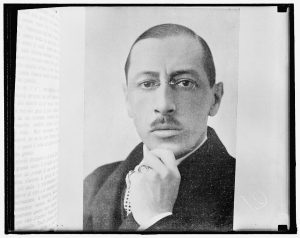
Igor Stravinsky, ca.1937. Photograph. https://www.loc.gov/item/2016872669/
I expected to find a wide variety of sources when researching Igor Stravinsky, due to the combination of his compositional success, his influence and residence within three western nations, and his consideration of himself as a neoclassical composer. There were many sources that analyzed Stravinsky’s music, which evolved from progressive French neoclassicism to serialism, but there were fewer sources that sought to show connections between his personality and his music.
Jonathan Cross, a musicologist at University of Oxford, unpacks elements of Stravinsky’s personal and musical life in his biography.1
In particular, there is a chapter that describes specific characteristics of Stravinsky’s personality that seem to be influential on his self-identified neoclassical style. Cross paints Stravinsky as a creative genius with a desire to be adored. I started to see patterns tying Stravinsky to Paris – his concern for physical appearance, interest in fashion, and need for glamour. These interests, along with his numerous affairs, some rumored and some documented, showed me a side of Stravinsky that contrasted my previous associations. Here was a man that was much more curious, chaotic, and muddled than his music.
How did Stravinsky come to be labeled as a neoclassical composer? In my second source, a photo book captioned by Robert Craft,2
Stravinsky’s fellow conductor and close friend, I read excerpts from interviews where Stravinsky addressed the way critics viewed his music. When critics found his music too geometrical, Stravinsky implored, “But the essence of art, the meaning of creative work, is to give definite form to that which was amorphous.”3 He wanted to give organization to individually meaningless ideas. Stravinsky claimed repeatedly that he did not see himself as a revolutionary. Perhaps he was just using his inventive insight to avoid musical stagnation, wanting to promote his music by tying some of its traits, such as clarity, haunting wind lines, and less emotive figures, to the image of the French neoclassical movement.
What then, is the significance of the juxtapositions between aspects of Stravinsky’s personality, carried out primarily in his private life, and his compositional characteristics? How do I reconcile someone with a weakness for glamour and romance with a composer who has absolute precision and order in his music? Perhaps the complications within his private life spurred him to want more organization in his music, a clarity that tied him securely to the neoclassical movement in Paris in the 1920s. Or, the disharmony and complex emotions within his personal life left him with no capacity to compose emotive music. In my paper, I plan to explore more connections between Stravinsky’s personal life and his compositional techniques, particularly surrounding his affair with the woman would eventually become his second wife, Vera de Bosset.
1 Cross, Jonathan. Igor Stravinsky London, UK: Reaktion Books, 2015: 76-104
2 Stravinsky, Igor, Robert. Craft, and Rita. McCaffrey. Igor and Vera Stravinsky : a Photograph Album, 1921 to 1971, New York: Thames and Hudson, 1982: 12-31.
3 Stravinsky, Igor, Robert. Craft, and Rita. McCaffrey. Igor and Vera Stravinsky : a Photograph Album, 1921 to 1971, New York: Thames and Hudson, 1982: 18.