There are a lot of sources out there about Francis Poulenc. This wasn’t a particularly profound discovery; after first hearing his Sonata for Flute and Piano a few years ago, I was fueled with the desire to discover more about his music and his subsequent popularity in the French musical scene of the 1920s.
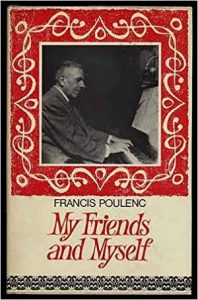
Of course, some of the most informative sources I have explored are ones with ‘Francis Poulenc’ in the by line. My Friends and Myself records a series of conversations Poulenc had with Stepháne Audel.[1] These conversations shine light on how Poulenc perceived his relationships with fellow composers, acquaintances, and inspirations. Francis Poulenc: Articles and Interviews has a little something pertaining to just about any major moment in Poulenc’s life and composition endeavors.[2]
While these books and many other sources have played a substantial role in my research, one book that I have heavily relied on is Keith Daniel’s Francis Poulenc: His Artistic Development and Musical Style.[3] The book is part of a larger series “Studies in Musicology” that was overseen by George Buelow, Professor Emeritus of Musicology at Indiana University.
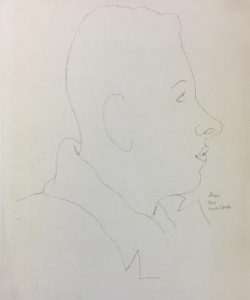
Superficially, one of the most helpful things about this book is that it is liberally footnoted; it has directed me towards other sources (such as the ones mentioned above) that have been extremely helpful. But, beyond the footnotes, this book critically analyzes the progress of Poulenc’s musical style and follows the development of his own unique musical fingerprint. Daniel argues that Poulenc had different stages in his ever-changing musical journey each defined by a specific life event or, influential figure that he encountered and interacted with. He then analyzes the bulk of Poulenc’s works as both a function of the genre and a function of distinct time periods that he established as important, characteristically different time frames. While he does not go into much detail about specific pieces, he covers a lot of ground and brings up many points that inspire further thought.
Interspersed between musical analysis and arguments about different influences are bits of information or claims that help me, as the reader, understand vital relationships that Poulenc had throughout his life. Daniel frequently pulls quotes from letters and writing by Poulenc and his associates that act as convincing evidence for many of the arguments that he makes. These primary source references also reinforce many of the relationships, including the one Poulenc had with Satie, that Daniel emphasizes.
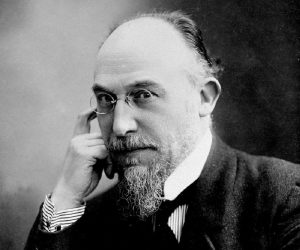
One of the most interesting parts of Poulenc’s life, to me, is his seven year relationship with Erik Satie. Satie is frequently recognized as an influential figure in the search for France’s musical identity in the early twentieth century. On the surface, what appeals to me about their relationship was the way it fell apart. I get quite the kick out of their falling out. It was a product of some bad partying habits that Satie wasn’t a fan of, an antagonizing gift from Poulenc and fellow Les Six member Georges Auric, and Poulenc’s not-so-subtle befriending of Satie critic and musicologist, Louis Laloy. On a more serious note, I think it is interesting that this dispute came at a time where Poulenc’s influences had seeming shifted away from Satie and more towards Igor Stravinsky. Poulenc’s compositions around this time embodied uncharacteristic dissonance and heaviness that weren’t very “Poulenc” , but were pretty distinctly “Milhaud” or “Stravinsky”.
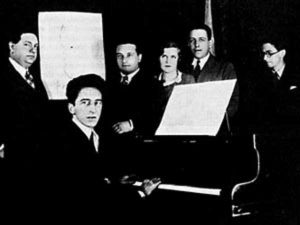
While I am still refining the inner-workings of my claim and argument, it is undeniable that Daniel’s book is a wonderful reference to have as I continue to explore Poulenc’s contributions to French musical identity. Poulenc’s music is undoubtedly influenced by many different composers. I have also had a chance to explore each of their lives through Daniel’s and others’ writings and hope to further elaborate on them in our first essay assignment of the semester.
Ultimately, Poulenc’s “Frenchness” is complex and difficult to discern. Daniel’s book serves as a brilliant entryway for further exploration into Poulenc’s contribution to French music and into Poulenc’s own personal and spiritual experiences with the music that he wrote.
It was after the premier of Poulenc’s Les Biches (1924) that he and Auric fell out with Satie.
_____________________________________________________________________________________
[1] Poulenc, Francis, and Audel Stéphane. My Friends and Myself. London, 1978.
[2] Poulenc, Francis. Francis Poulenc, Articles and Interviews: Notes from the Heart. Edited by Nicolas Southon. Farnham: Ashgate, 2014.
[3] Daniel, Keith W. Francis Poulenc: His Artistic Development and Musical Style. Ann Arbor, MI: UMI Research Press, 1982.