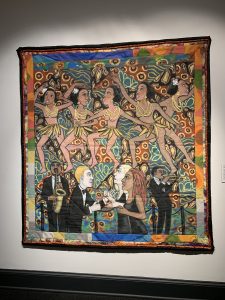
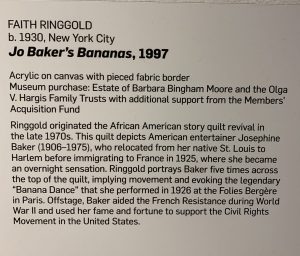
This past interim, I had the opportunity to spend the month of January in Washington D.C. with Professor Epstein while taking a course called “Democracy and the Arts in Washington DC”. Towards the beginning of the trip, we visited the National Museum for Women in the Arts. Touring around the museum we came across a mixed media work Jo Baker’s Bananas by artist Faith Ringgold. Professor Epstein pointed this piece out to me, telling me that it would be relevant to the themes and ideas we will explore in Music 345 this semester. And, now, the time is finally here for me to dive deeper into the 1920s and the influences of jazz, Josephine Baker, and the avant-garde…
Approaching the history of race relations just about anywhere in the world is always a challenge. The “Negrophilia” trend of 1920s Paris is no exception. The question we were asked to respond to in this blog post is challenging; it asks us to decide whether Parisians really loved, respected, and celebrated African American artists.
There had to be some love in 1920s Paris for African American artists. Love, however, has a variety of definitions and various degrees of genuineness. Some may classify superficial love as in-genuine, but I think that it can certainly exist to some degree regardless of how genuine it is. African American artists and their art forms were largely consumed superficially and taken as un-serious novelties. Yet, superficial things, experiences, and perspectives are often adored and frequently partaken in. It is clear that there was little done to celebrate or respect African American culture. However, celebration, respect, and love can all exist independently of each other but none of them are mutually exclusive. Love can surely exist without respect. The jazz culture of 1920s Paris is a sure example of this.
Bernard Gendron describes how:
“The postwar avant-gardes did not restrict themselves merely to being aficionados, mere consumers of ‘negro’ culture, but quite actively brought their negrophilia to bear in a variety of different ways in their own aesthetic practices. They appropriated ‘negro’ culture, parodied it, and subjected it to pastiche and bricolage…”[1]
In response to Josephine Baker’s rise to stardom and jazz concerts of the time, Matthew F. Jordan shares that:
“Audiences poured in to take a peek at La Baker and see what the fuss was about. The many accounts of the packed houses with audiences screaming with disdain and delight, sometimes at the same time, show the extent to which the show… hit its mark.”[2]
Each of these scenarios exemplifies the relatively short-lived success that La revue nègre, Josephine Baker, and jazz had in the Paris of the 1920s. The fascination and love held for African American culture motivated audiences, inspired performances, and pushed the artists and musicians of the avant-garde into new territories. Racism was alive and well in Paris in more subtle forms than the ones found in America’s Jim Crow south. Yet, fascination, curiosity, and inspiration of African American art forms does not constitute a kind of love that feels genuine by our modern definition. Ultimately, in 1920s Paris, there was an evident coexistence of admiration and disrespect for African American culture. Today, these attitudes and ideas about jazz can only authentically reveal what French people thought about it in the cultural context of the time.
What does this all mean for our present-day relationships with the music and arts of the “Other”? Well, today, our portrayals of unfamiliar music often entail a successful, incorrigible, yet uncharitable and stereotypical “othering” in art and music. This is most often a standardization of musical scales, patterns, ideas, or other elements that we intentionally or unintentionally associate with a certain type of music or with a type of music and the people who make that music. I think the most important takeaway of our judgement about the Parisians of the 1920s is to recognize and negate similar patterns that may have permeated into modern popular culture, in our personal lives, or anywhere in between.
Some food for further thought: TED Talk by Jonell Logan encourages her audience to to consider notions of culture, cultural ownership, and the role that historical institutions play in forming these definitions through the frame and consideration of “otherness”. Logan is an arts advocate, curator, and the founder of the 300 Arts Project.
_____________________________________________________________________________________
[1] Gendron, Bernard. Between Montmartre and the Mudd Club: Popular Music and the Avant-Garde. Chicago: Univ. of Chicago Press, 2002.
[2] Jordan, Matthew F. Le Jazz: Jazz and French Cultural Identity. Urbana, IL: University of Illinois Press, 2010.