
the poster as Propaganda
The Poster as
Propaganda
No “one-size-fits-all” definition of propaganda exists. But there is consensus among experts regarding certain identifying characteristics. Propaganda is…
- the broad and intentional (relying on “mass production” and “mass audience,” and with an agenda)
- dissemination of (propagation)
- information and ideas (falsehoods or manipulations of truth)
- through words and/or word substitutes (e.g., images, parades, slogans, songs, exhibits)
- created to influence the public (public opinion and/or behavior)
- in order to gain advantage (see “with an agenda”) in a manner that inhibits critical reflection and response.
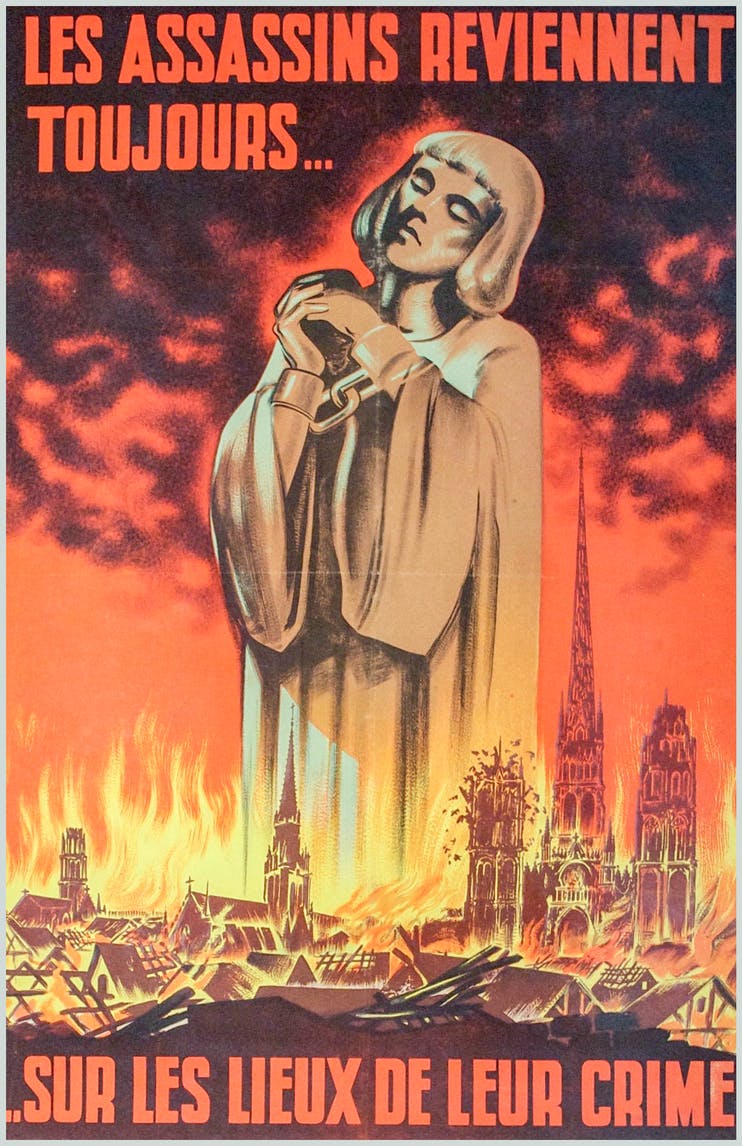
- While your answer to this question will likely change or become more refined as your knowledge of its context increases, on the basis of what you know right now, what is the message of the poster? Who is the targeted audience?
- How do the graphic elements you identified through the “Guided Looking” exercise serve the propagandistic objective of the poster?
- How does the text of the poster serve the propagandistic objective of the poster? If the poster is predominantly textual, offer some reasons why the decision to feature text over image was made.
Posters convey propaganda efficiently and economically. However, as the definition of propaganda suggests, they provide more evidence about the propagandist than about the audience. The posters themselves provide no evidence about the reception of propaganda produced by Nazi Occupying authorities and its impact on public opinion and behavior. The absence of any voice of the Occupied is a gap, an archival silence (SAA-ACRL/RBMS Joint Task Force on the Development of Guidelines for Primary Source Literacy (JTF-PSL) 2018), within the poster collection. Identify and describe the gaps, silences, or contradictions in a single poster. What are some possible reasons for them? What visual or rhetorical evidence is there of the power relationship between Occupiers and Occupied? How do this poster’s gaps and archival silences enhance your understanding of the broader context of World War II?
No Results Found
The page you requested could not be found. Try refining your search, or use the navigation above to locate the post.