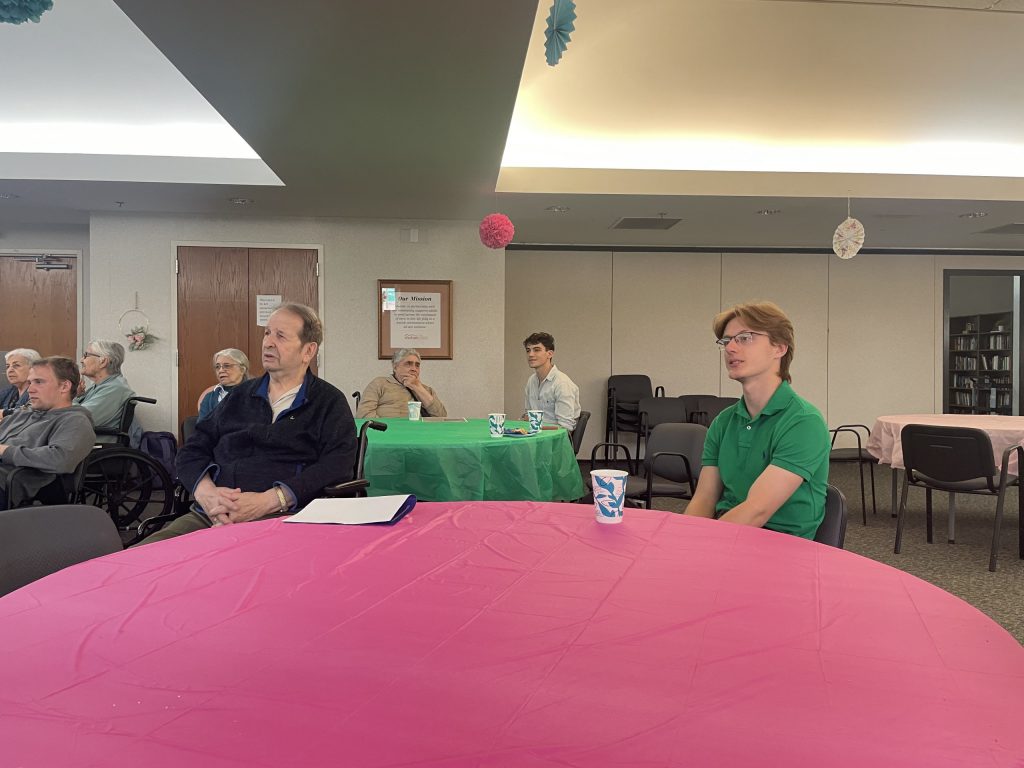
Throughout the Spring semester, students in Prof. Dossi’s fourth-year Russian-language course (RUSSN 372) visited with Russian-speaking residents at Sholom Senior Living Facility in St. Louis Park, Minneapolis.
At the end of the semester, Sholom hosted final celebration where the students sang songs, recited poetry, and delivered “About Me” posters for each of the residents. They also prepared an online dictionary of basic care-giving related phrases and words accessible through a QR code for Sholom staff. These initiatives were aimed at helping the staff to connect with residents and overcome the language barrier in care-giving contexts.
You can access the dictionary here. Sholom posted about the event on their Facebook page.
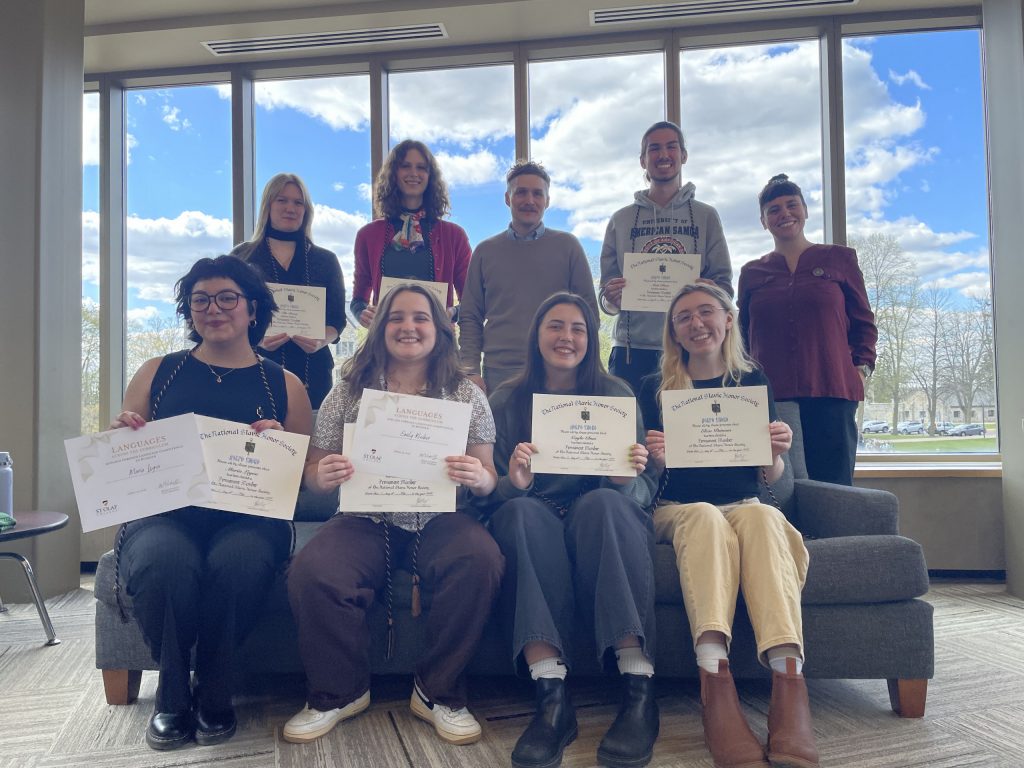
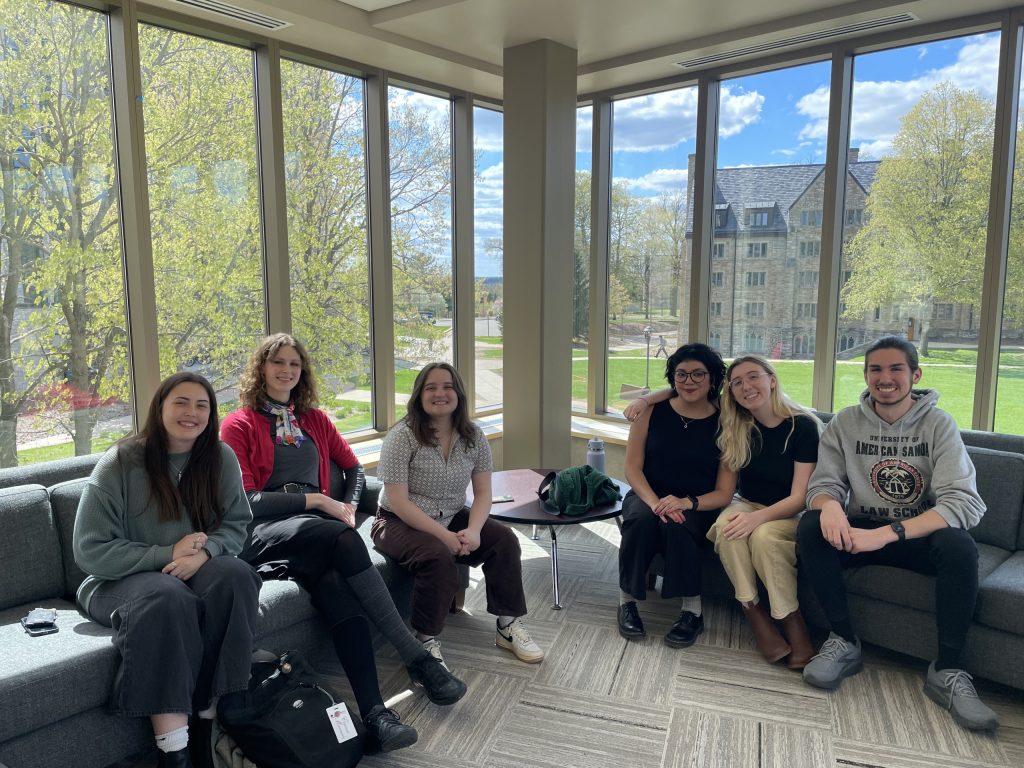
Front Row (From Left): Maria Leyva, Emily Kleiber, Cayla Chun, Eliza Putnam. Back Row (From Left): Elle Davis, Maggie Walker, Prof. Morse, Matt Olson, Prof. Dossi. Max Thomas not pictured.
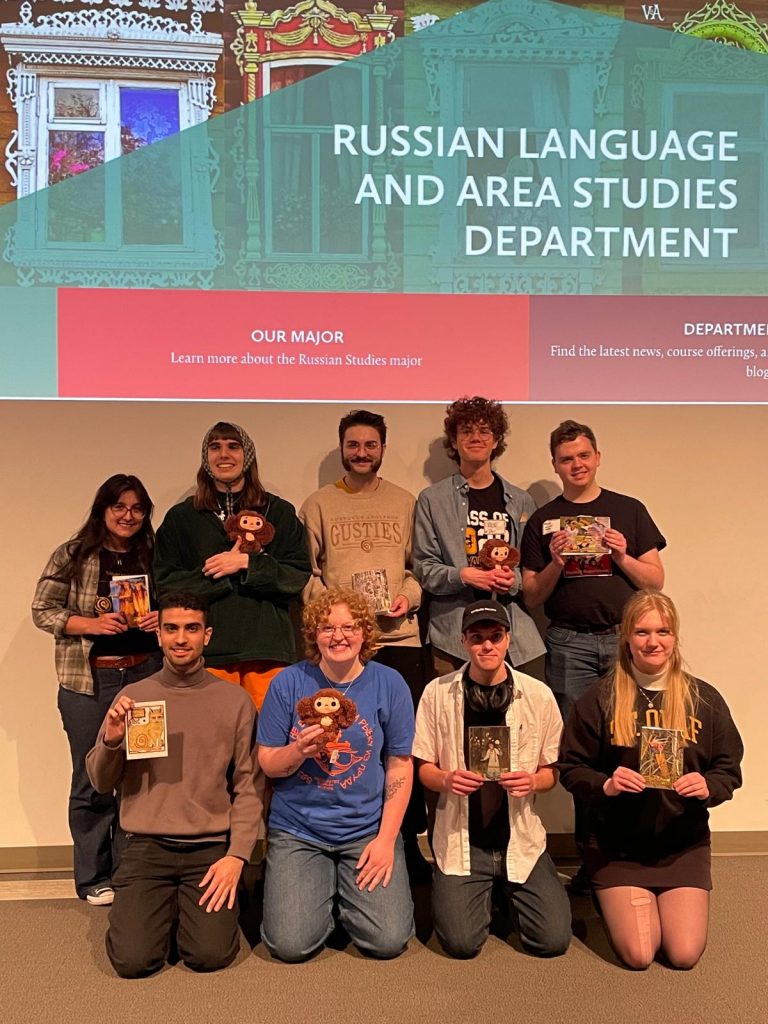
We congratulate our honors students, Cayla Chun, Eliza Putnam, Elle Davis, Emily Kleiber, Maggie Walker, Maria Leyva, Matt Olson, and Max Thomas, on being initiated into Dobro Slovo, the National Slavic Honors Society.
Dobro Slovo National Slavic Honors Society, established in 1926 at the University of California at Berkeley, serves as the leading national Slavic honors society for students of Slavic languages in the United States. Dobro Slovo recognizes the hard work and dedication of students, faculty, and universities aimed at the study of Slavic languages and cultures and currently boasts a membership of 6000 members across over 130 universities.
Congratulations Cayla, Eliza, Elle, Emily, Maggie, Maria, Matt, and Max!
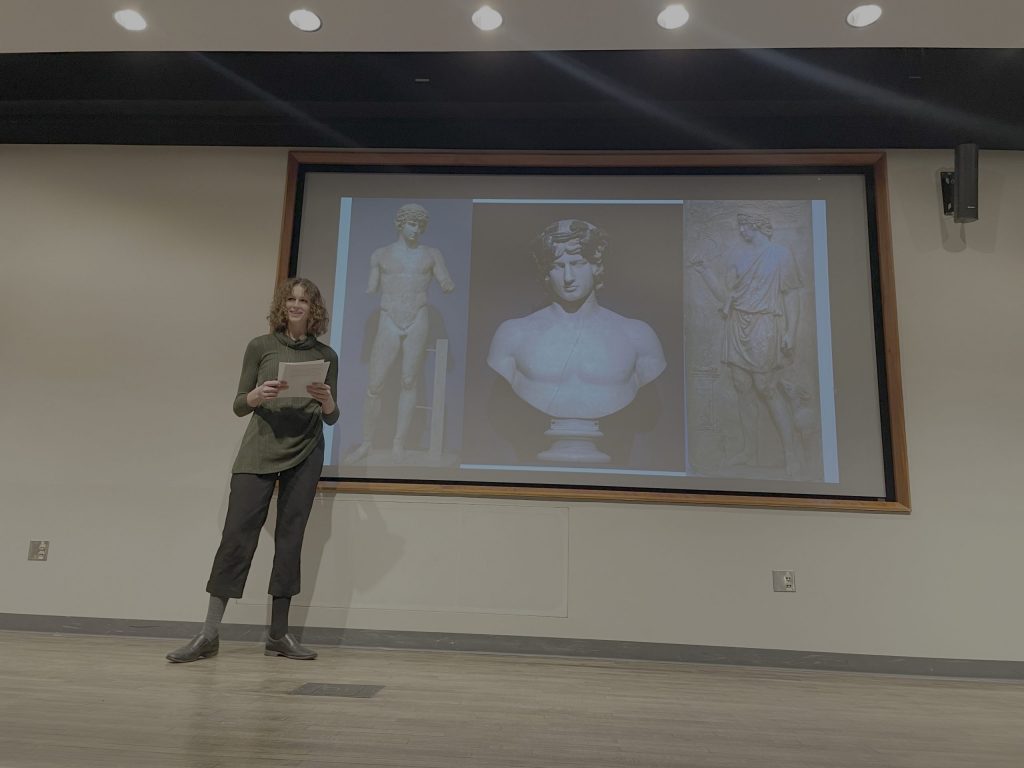
Emily Kleiber (’26) and Cayla Chun (’26) presented papers they wrote in Prof. Dossi’s course on Queer Russian Literature (Fall 2026) at national undergraduate conferences.
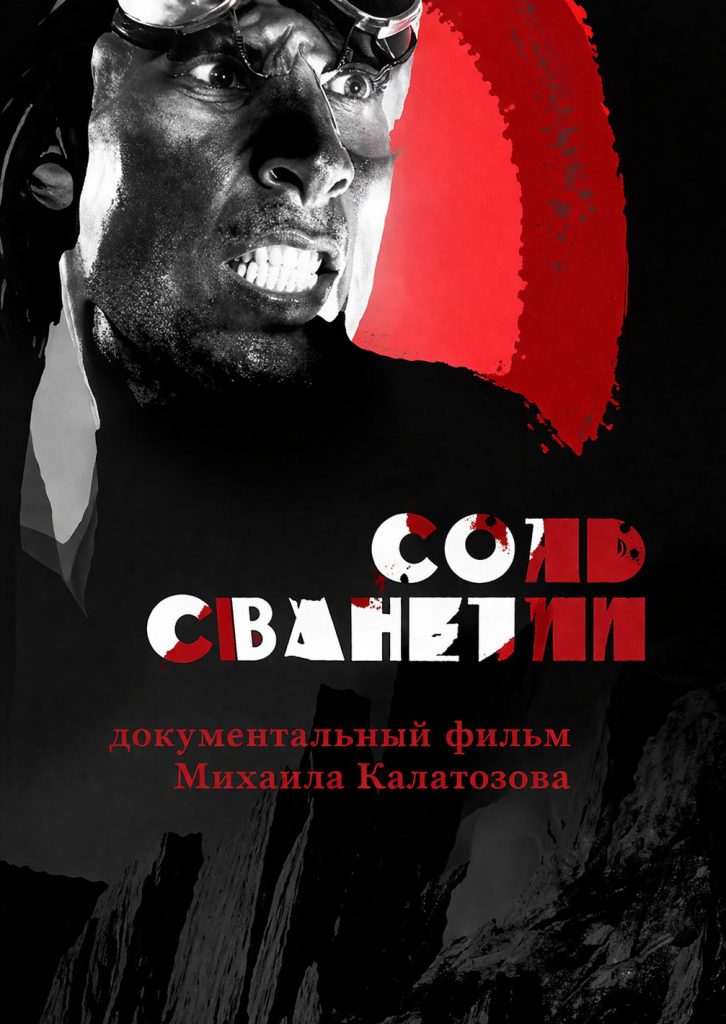
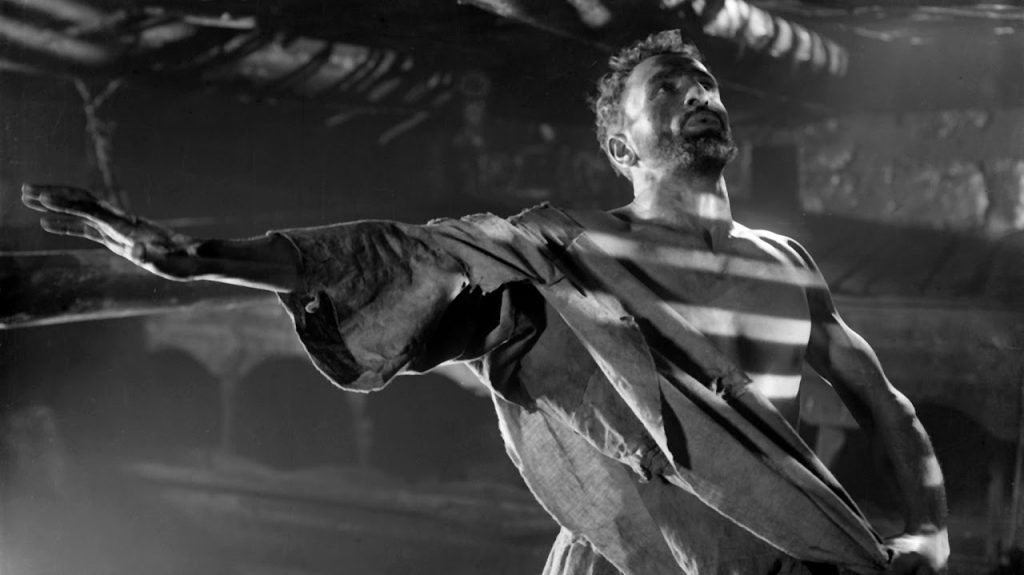
As part of the Muslim in Russian Literature film festival, Emily Kleiber (’26), Shalizeh Takloobighash (’29), Zlata Krutova (’29), Hayden Williams, and Michael Oaks provided live musical accompaniment to Mikhail Kalatozov’s silent film masterpiece, Salt for Svenetsia (1930).
The film portrays the Svan people living in the mountains of Soviet Georgia, where they have been cut off from the outside world pretty much year round due to harsh winters and dangerous peaks of the mountains. Among many things they lack, salt is the most important. Without salt, their livestock can die and their survival can be at risk. When the Soviet engineers arrive to build a road to connect Svanetia to the lower land, everything changes.
You can learn more about the film festival here. The RLAS department plans to organize further silent film screenings with live musical accompaniment on an annual basis.
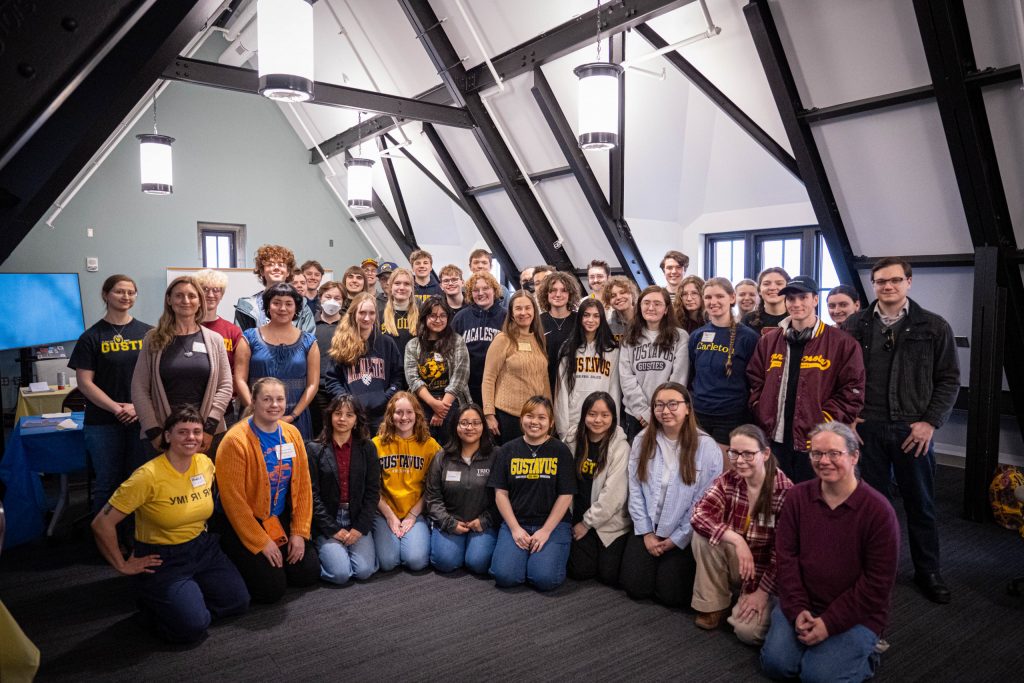
Around 40 students and faculty from Russian-language programs across Minnesota gathered at St. Olaf for the inaugural Minnesota Collegiate Olympiada of Spoken Russian.
On Saturday, April 11, St. Olaf hosted the first-ever college-level “Olympiada” or Olympics of Spoken Russian in Minnesota. We invited around 40 students and faculty from the Russian language programs at the University of Minnesota, Macalester, Gustavus Adolphus College, and Carleton).
Students competed at the first-, second-, and third-year language levels in three different events: the oral interview, poetry recital, and “bilety” or cards, which required them to draw two random topics cards and choose one to speak about.
Traditional Russian and Central Asian food for the event was provided by .
Next year’s Olympiada is provisionally scheduled for mid-April and will be hosted by Macalester.
The Medalists. Front Row (From Left): Taha Alnasser (UMN), First-Year Silver; Liv Whitmore (Macalester), Third-Year+ Gold; Silas Buryak (UMN), Second-Year Silver; Elle Davis (St. Olaf), Third-Year+ Silver. Back Row (From Left): Gaia Miller-Guitton (St. Olaf), First-Year Bronze; Parker Chelikowsky (St. Olaf), First-Year Gold; Franklin Brezee (Gustavus), Second-year Bronze; Paul Murphy (St. Olaf), Second-Year Gold; Charlie Rhodes (Carleton), Third-Year+ Bronze.
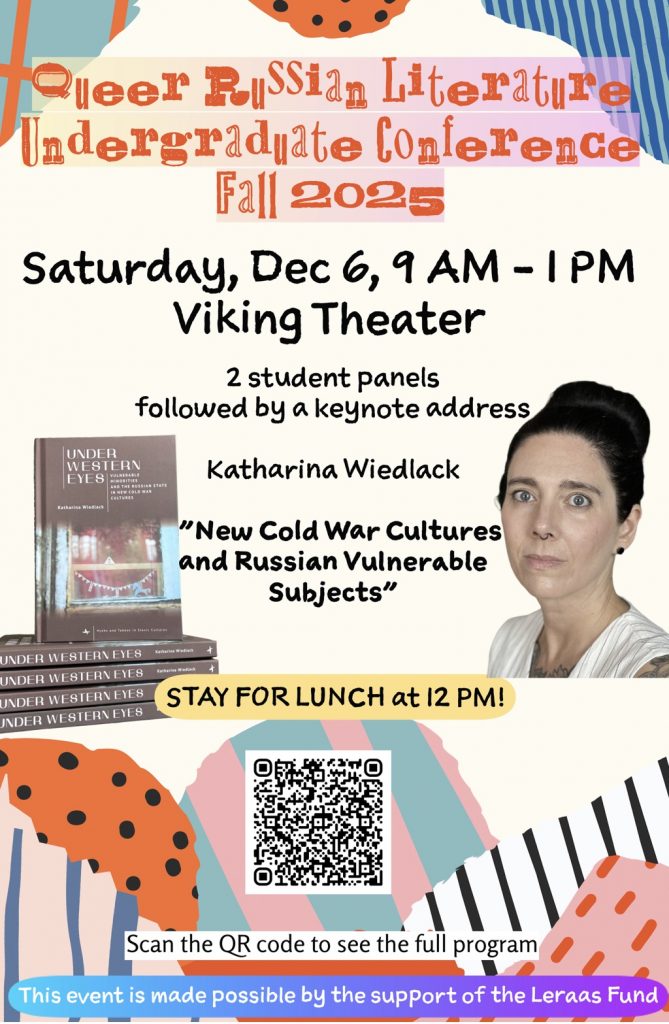
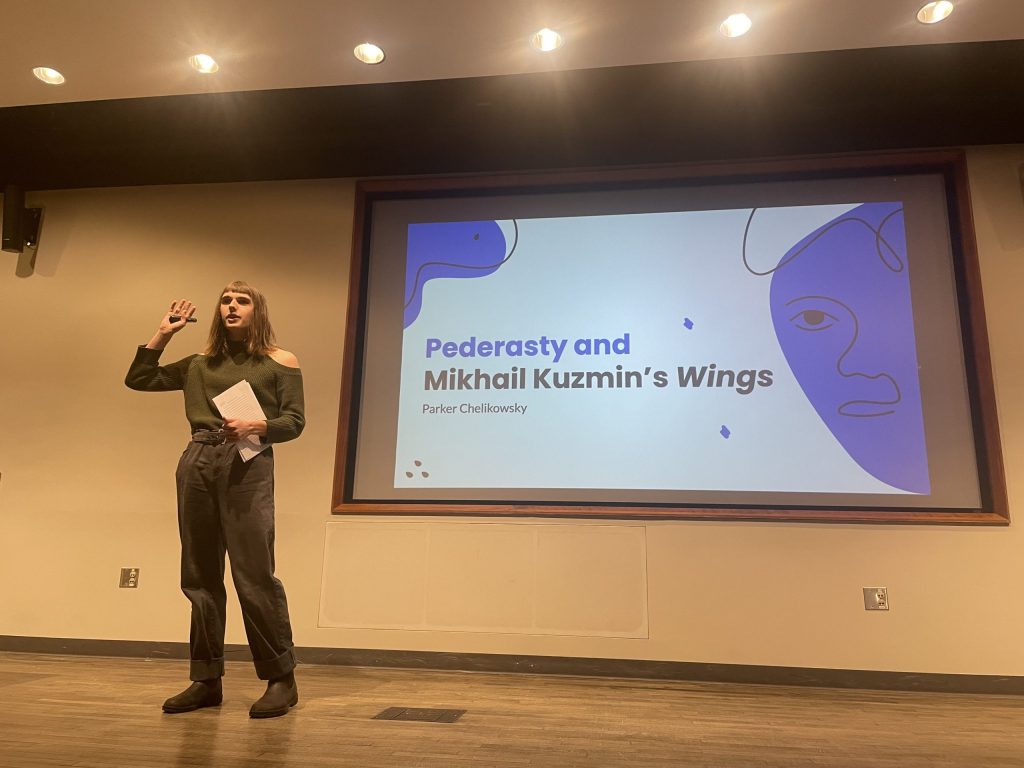
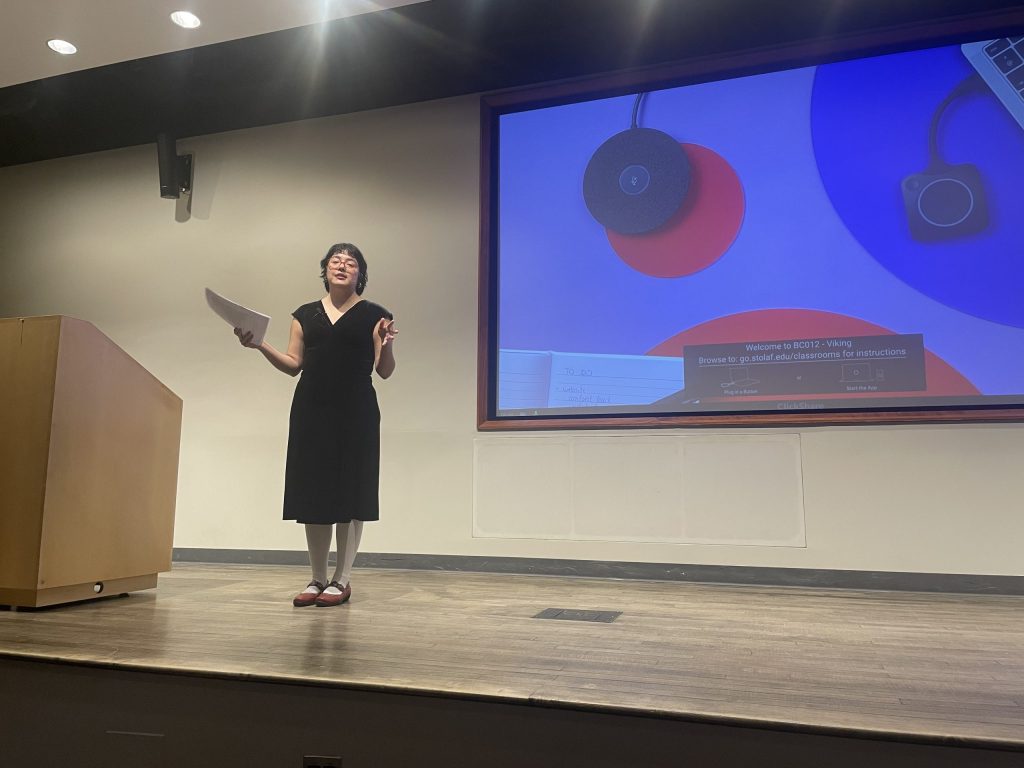
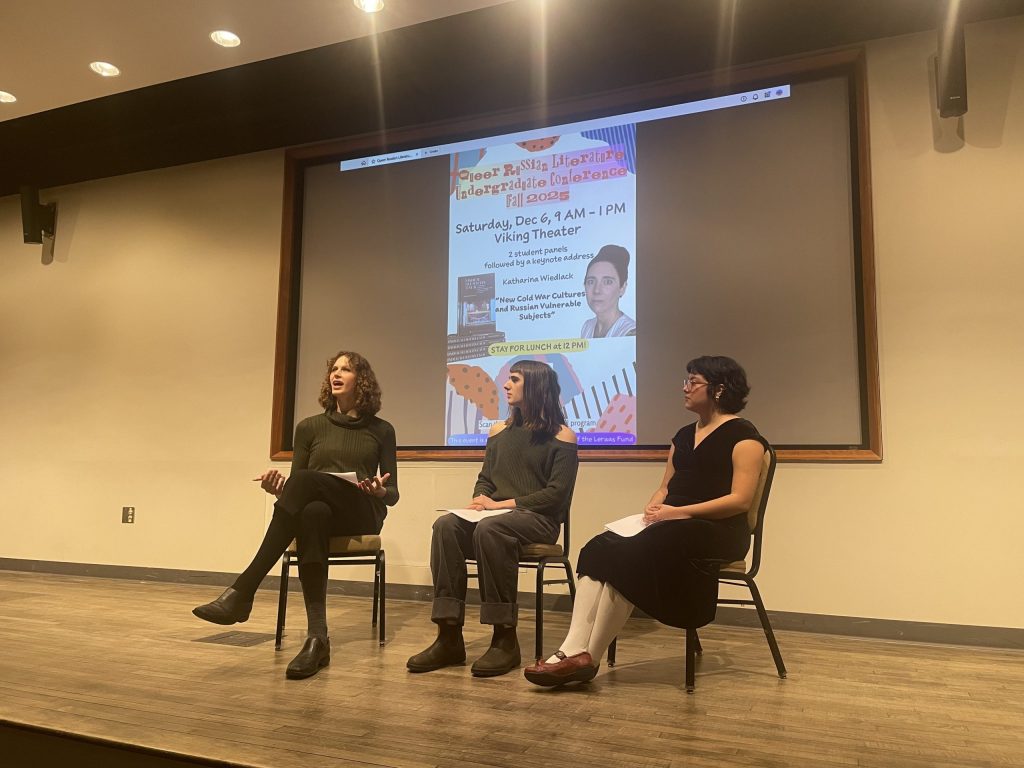
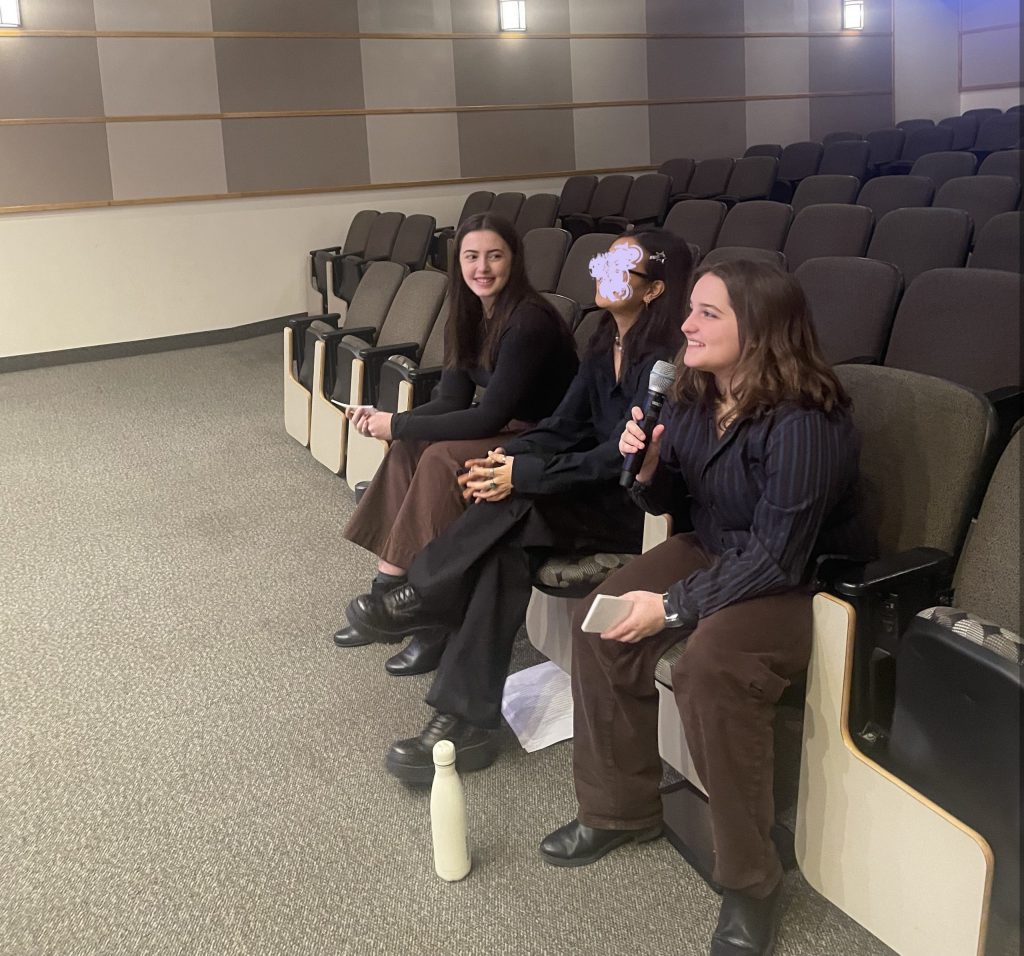
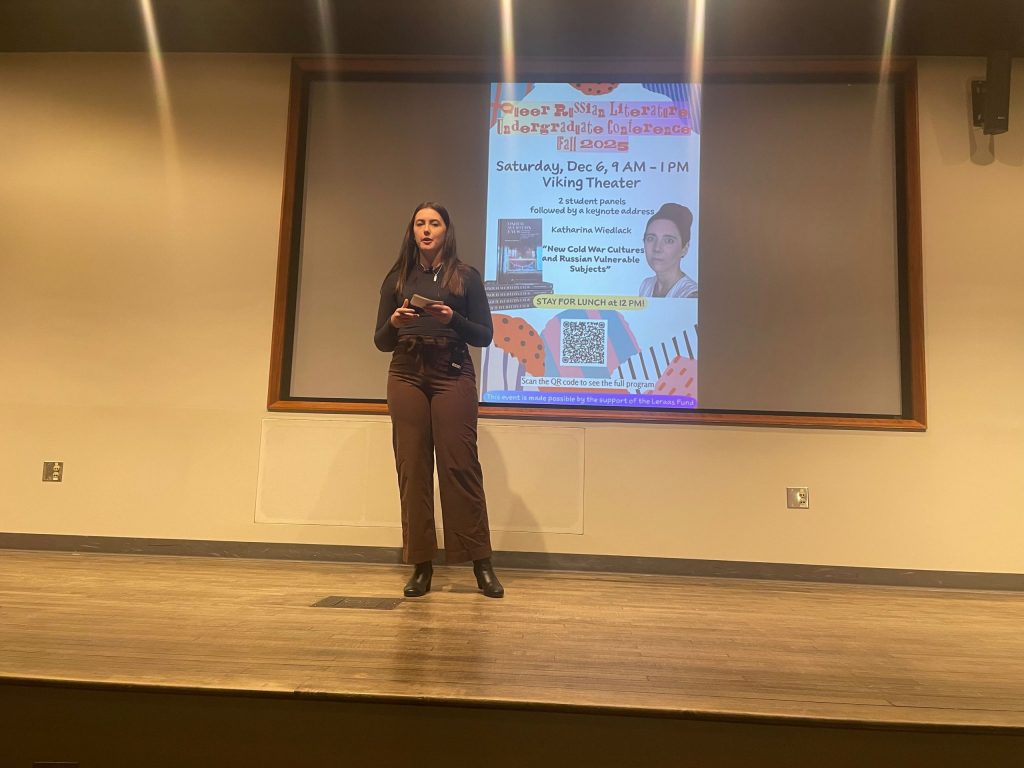
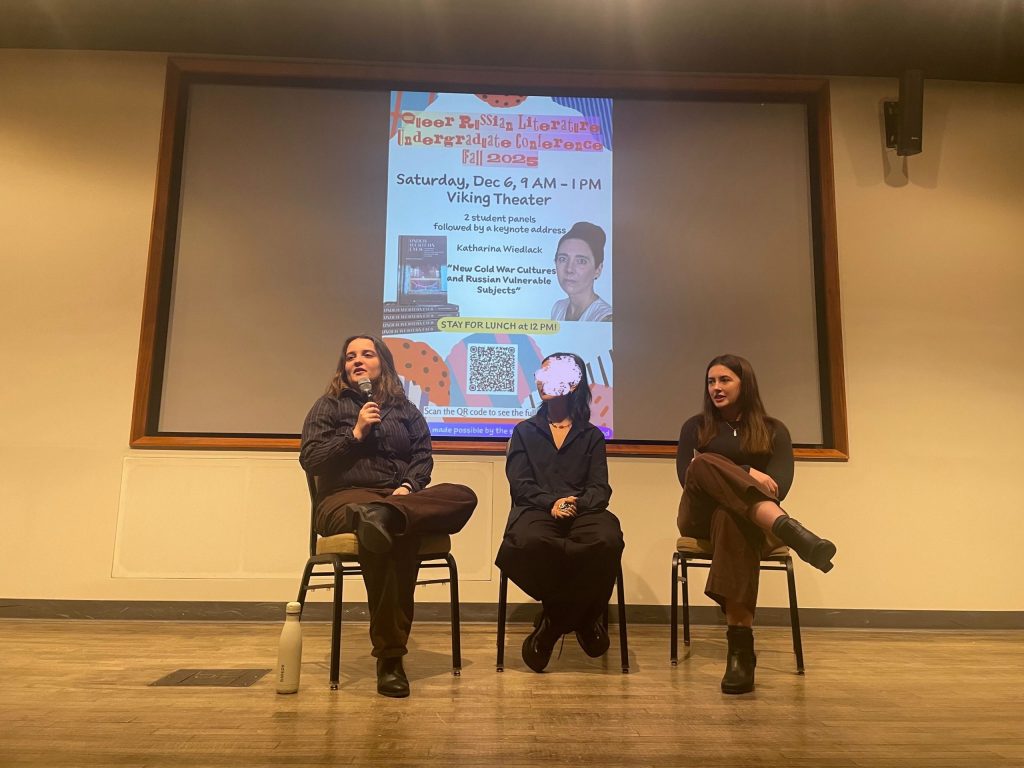
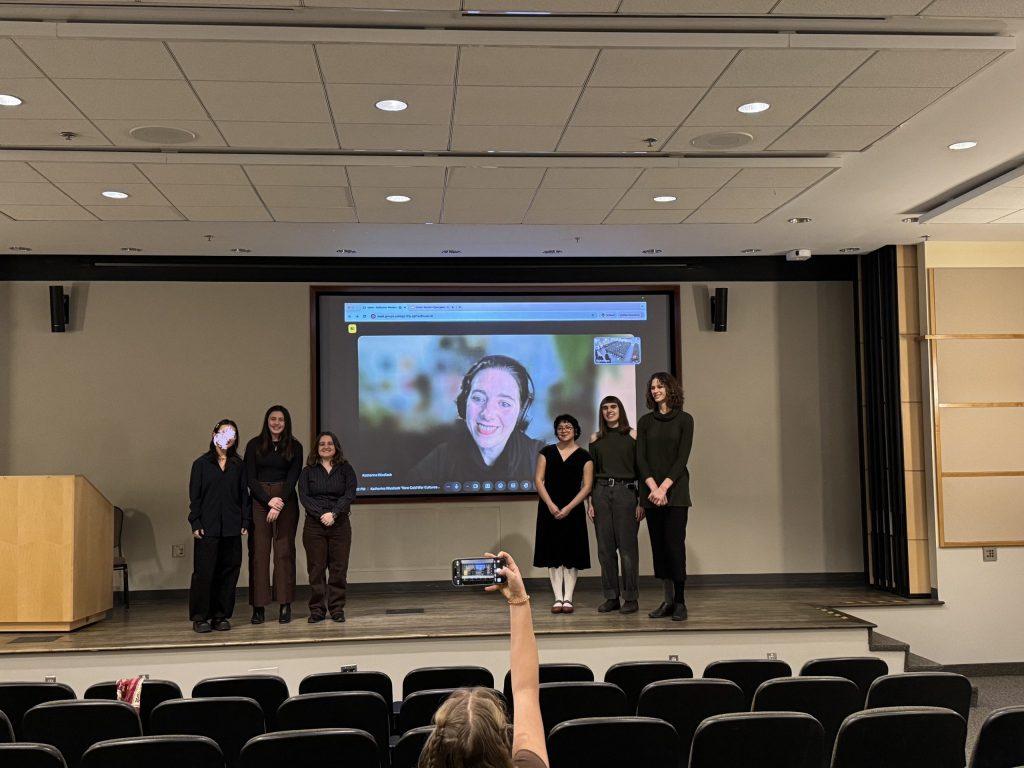
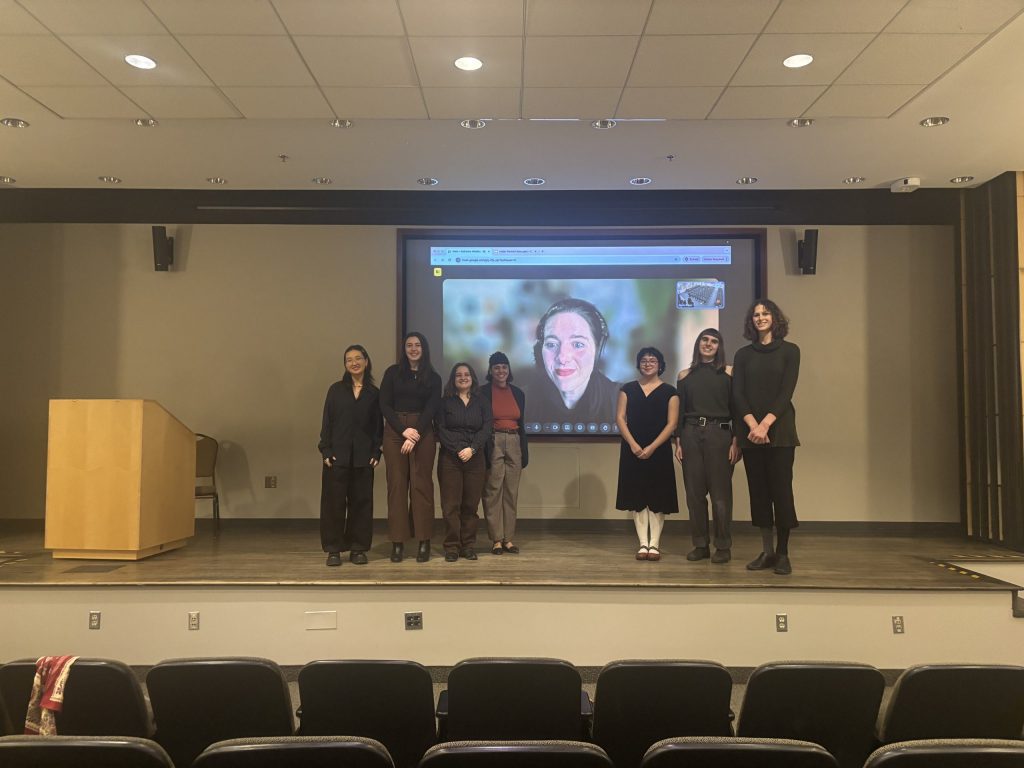
On Saturday, December 6th, the Russian Language and Area Studies department hosted the first Queer Russian Literature Undergraduate Conference at St. Olaf.
The event consisted of two student panels followed by a keynote from Katharina Wiedlack (University of Vienna).
Six amazing students from Prof. Dossi’s Queer Russian Literature(RUSSN 330) delivered presentations on a variety of queer Russophone authors, some of whom you might not know, but many more that you will want to discover! After the panels, Katharina Wiedlack delivered her keynote address, titled “New Cold War Cultures and Russian Vulnerable Subjects.” The presentations and keynote were followed by a small reception catered by Tasteful Delights.
Panel 1
Maggie Walker “Mikhail Kuzmin’s Wings: A Platonic Fable”Parker Chelikowsky “Pederasty and Mikhail Kuzmin’s Wings“Maria Leyva “Having an Idol Doesn’t Always End Well: Sergei Esenin and His Followers”Panel discussion
Panel 2
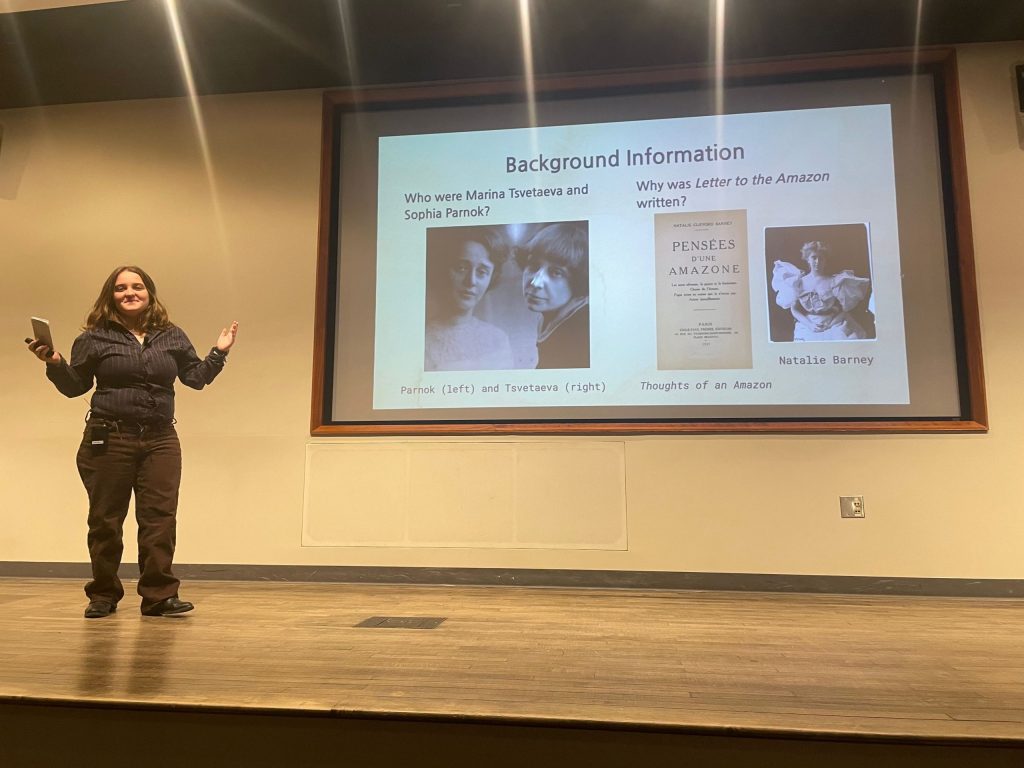
Emily Kleiber “From Fantasy to Reality: The Collapse of Queer Desire in Marina Tsvetaeva’s Letter to the Amazon“Cayla Chun “Queerness is Russian: Aesthetic Revolt from Modernism to the 1990s”Panel discussion
Yaz T. delivered a talk entitled “Цветы и Шпаги: Dichotomy of Gender in Marina Tsvetaeva’s work.” We won’t post a picture of Yaz to protect their anonymity.
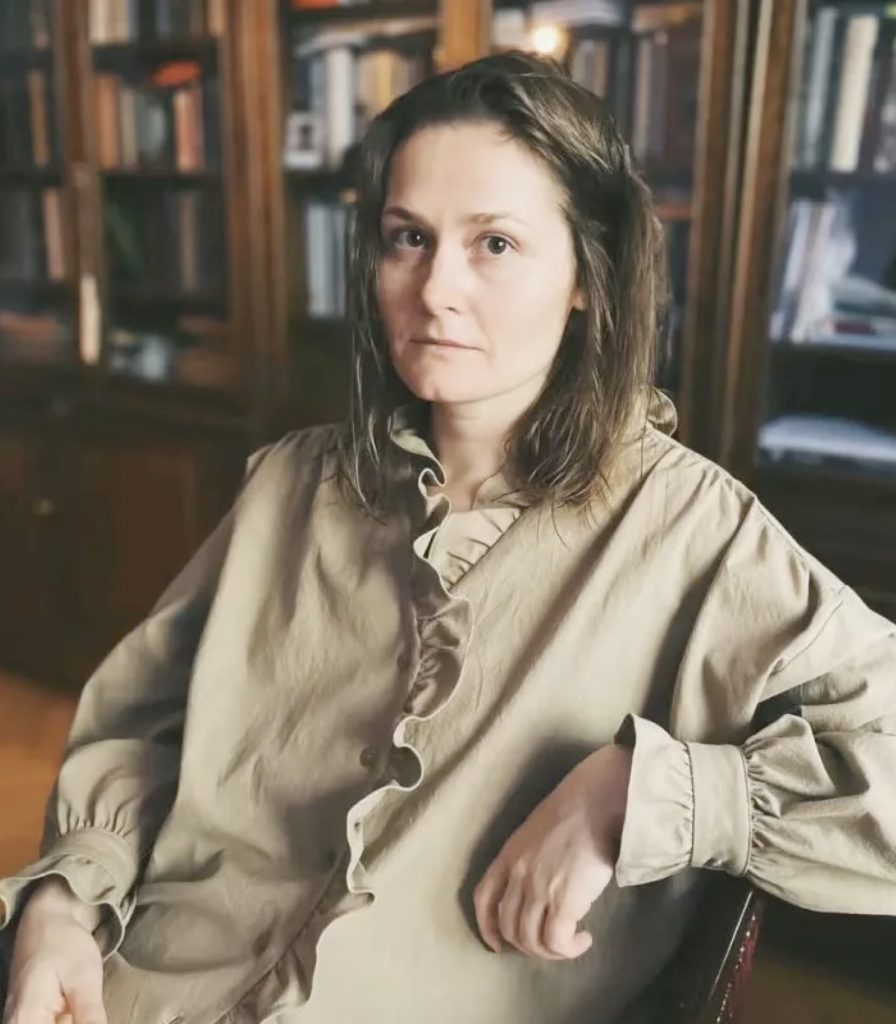
During fall semester 2024, students in third-year Russian (RUSSN 301: Conversation and Composition) translated excerpts from Oksana Vasyakina’s novel, Wound (2021).
Although the focus of our classroom workshops was language and translation, we also discussed some of the major themes in the novel, which follows the journey of a lesbian poet across Russia and through memory as she travels to inter her mother’s ashes in her Siberian hometown. In the process, the narrator meditates on themes of queerness, death, and love. She also gains a new understanding of her relationship with her mother, her sexuality, her identity as an artist, and her country.
Lyubov Mikhailovna said mama’s breathing had been bad, heavy. She found out about it from the priest. This kind of breathing is common among people close to death. The light was good, there was no wind. The light was golden, just like in August.
Lyubov Mikhailovna’s arm rested on the back of the couch, swollen and grayish. Strange, I thought, looking at this arm, as if without the priest’s sanctioning, it’s impossible to understand that a person is dying, even if they are obviously dying.
Lyubov Mikhailovna had a calm face. She believed in God and her cancer stopped. She probably thinks her cancer stopped because she believes in God. On her face is an air of superiority. It’s as if, on her knees, she has the cup of life, which she won from my mother.
Andrey said that tomorrow at ten in the morning Mikhail Sergeevich would call me. Andrey had already given him the gas money so he could take me to collect the ashes. I would have managed myself, but here, helping out was important. Helping out and concern. The light was really good, it was warm. And the noodle soup turned out well. Everything turned out well like I promised. It’s the thought that counts.
The husband of mom’s old neighbor, already leaving the funeral, said that Andrey shouldn’t be sad. He said that he should call him if he wants to go fishing. Andrey said that he would call. But I know that he won’t call, here again, helping out and concern.
Lyubov Mikhailovna told me I should accept her condolences. I did. She gave Mama holy water for a month: three tablespoons with prayer in the morning and three tablespoons with prayer in the evening. She told me that after the visit from the priest, mama perked up and was back on her feet. Lyubov Mikhailovna said Mama laughed and made a soup.
Mama said that the priest put some doodad on her head and asked her to repent while he read the prayer himself. She didn’t dare admit to Lyubov Mikhailovna that Orthodox Christianity doesn’t help much when you’re sick. Especially when you don’t believe in God.
As a child, I was told it is good for it to rain when a person is buried. On the one hand, rain when you’re setting out is a good omen — and on the other hand, it’s nature crying. Nature participates, and it sympathizes. When my father was buried, it was raining lightly. But there is no rain in February. Instead of rain, there is good light. In that light, everything is rosy and whole, like an apple.
Everyone just sat on the sofa where Mama had lain dying. And then everyone left all at once. Andrey and I cleared the table, and washed the dishes. Andrey said that one shouldn’t throw anything away from the funeral table and should only eat with spoons. He said that he would wash everything. He turned on the T.V. in the kitchen and began to wash the dishes. I brought him the empty plates. It was a long way to evening.
Andrey asked if the crematorium works at night. I answered that I didn’t know. I knew that our turn was at 4:30 which meant her body was already burned. Andrey said that it was revolting — burning living people. I said nothing, but just thought that she wasn’t alive, she was dead. I sat down on the sofa and watched T.V., then after a little while laid down and fell asleep with a feeling of bitter relief. That night, I dreamed of darkness.