Biography
As you begin reading about the life and music of Hildegard von Bingen, you are invited to play this recording of Hildegard’s Kyrie to help you begin to immerse yourself in the music of this great theologian, visionary, and composer.
Hildegard’s Musical Oeuvre
there was every type of delight, every type of music, all the voices of those who sing, all the joys of the happy, and the greatness of all gladness
Hildegard, speaking of a heavenly brightness
Hildegard’s musical output spans many genres including antiphons, responsories, sequences, hymns, symphoniae, ordinary chants, and a virtue play. This listing also orders the frequency for which she composed for each genre which clearly reflects “the liturgical structure of the Office and the Eucharist for which she composed.”2 It is clear that Hildegard was composing in service of the services she was to lead at her monastery.
Some have described Hildegard’s music as being highly unique, and very different from the music of the time. When compared with early chant repertoire, this is true, but when Hildegard’s music is compared with that of others in the Late Medieval Period when she was living, an observer finds that her music fits well into the standing genres while maintaining her unique compositional style.3 Hildegard follows the standard practice for text-setting within genres; hymns and sequences tend to be more syllabic than responsories or antiphons. In the cases where melisma is used, Hildegard’s music is particularly ornate with as many as 81 pitches used on a single syllable. While melismas sometimes occur on unimportant words, Hildegard also follows the practice of elaborate ornamenting important words.
Hildegard’s morality play, Ordo Virtutum is another example of innovation within the status quo. Staged musical works existed in the church in the liturgical drama genre. However, Ordo Virtutum is unique in that it was not used as a supplement for the Mass. It existed as its own free-standing work, that would likely have been performed by the nuns at Eibingen for enjoyment and to further the theology that Hildegard was teaching. Hildegard is creative in her use of many characters representing female virtues, as well as her decision to make the Devil the only spoken role.
Unlike most medieval writers, Hildegard rarely acknowledged any source of the Bible. Although she was well-versed in a wide range of literature, her claim of divine inspiration was necessary for her acceptance as a female theologian at the time. Exceptions are noted by Honey Meconi including: text of her hymn for the Holy Spirit, O ignee spiritus, was inspired by the famous Pentecost hymn Veni creator spiritus, while O beatissime Ruperte borrows a phrase of its text from the hymn Pange lingua.
Try It Out!
In the last 30 years there has been a significant rise in the performance and recording of Hildegard’s music in both the academic and commercial music worlds. See below, two recordings of O vis aeternitatis, and consider the performers’ various choices when crafting the recording and how they are similar or different.
Rhythm
The rhythmic interpretation of Hildegard’s music is widely disputed. Some scholars argue in favor of an “equal-value” approach where each note is sung for approximately the same duration. Others support a “mensural” interpretation where notes are given different durations. While various styles of chant rhythm most certainly existed in various times and places, the Late Middle Ages “fostered a practice of approximately equal value for each note.1” In her groundbreaking dissertation, Die Gesänge der Hildegard von Bingen : eine musikologische, theologische und kulturhistorische Untersuchung , Barbara Stühlmeyer writes “Based on the results of this work, a mensuralistic performance practice in the sense of later musical traditions can therefore no longer be described as appropriate to the work.”4 However, many modern recordings incorporate a highly free rhythmic structure.
Notation
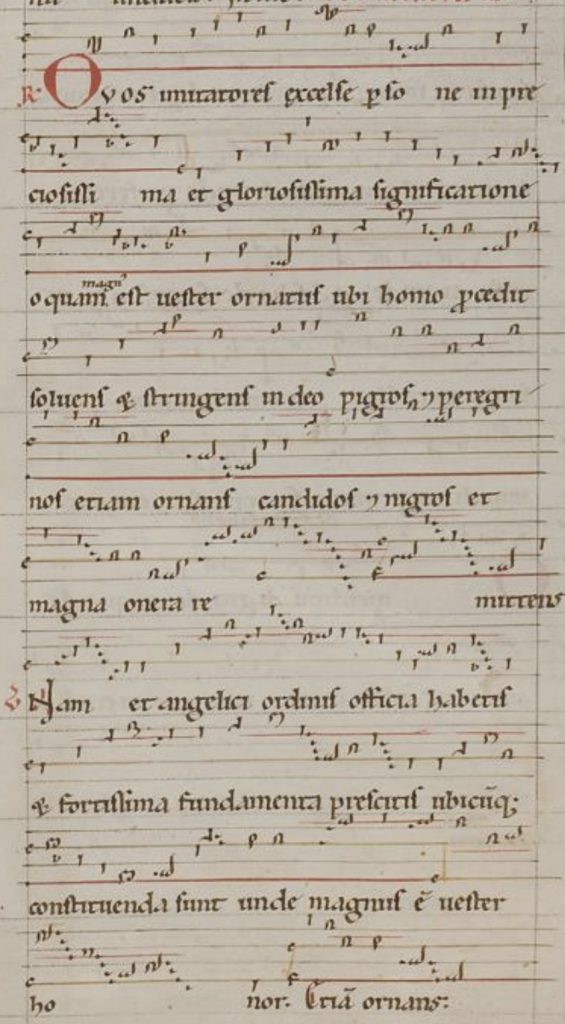
Hildegard’s music is preserved in two primary manuscripts, the Dendermonde Codex and the Riesencodex. These have both, thankfully, been scanned and made available for viewing online by the general public, free of charge.
*you may be required to create a free account in order to view
Neumatic notation is a form of notating chant. A neume is simply a symbol that represents the notes to be sung on one particular syllable. Some neumes include only one note. The beginning of a new neume can also help determine the rhythmic ictus of the piece. Neumes can look slightly different across different styles of notation, but in general, the principles and concepts carry over. Pictures of symbols you might find when looking at the music found in the Riesencodex or the Dendermonde Codex have been included on this page.
Punctum

The punctum is the basic notational unit in neumes. It looks much like a period or dot and it indicates a note to be sung for one pulse.
Clivis (flexus)

A clivis (flexus) is a group of two notes where the higher note comes first.
Porrectus

A porrectus is a group of three notes, with the first note descending and the second note ascending.
Climacus

The climacus is a descending pattern of three or more notes.
Porrectus flexus

A porrectus flexus is a group of four notes, comprised of a porrectus, followed by a note below it.
Scandicus flexus

A scandicus flexus is a group of four notes that begins with ascending notes and ends with the final note descending.
Apostropha / Bistropha
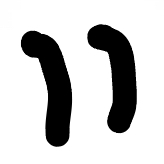
An apostropha always occurs in groups of two (distropha) or three (tristropha) and these can be repeated. these groups may sung with a slight stress of impulse of the voice, but it is recommended to sing them as one sound, the singer may choose to use a slight crescendo or descendo depending on position within the text and melodic line.
Pressus
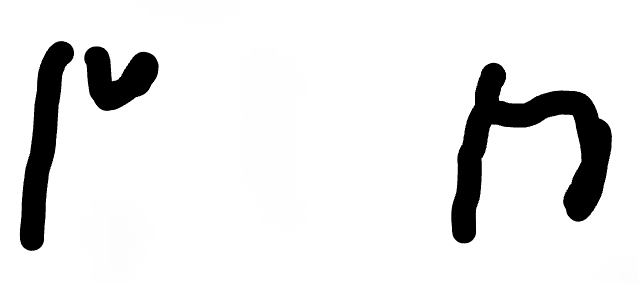
When two notes are placed side by side on the same degree, the result is a single note with a value of two pulses.
Virga
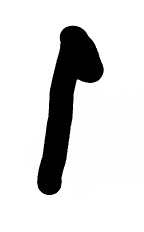
A virga functions in the same way as a punctum. The only difference is that a virga has a rod attached to the notehead and is commonly used to begin a descent in the melody.
Pes / Podatus

The pes (podatus) is written with a curve on the bottom and a straight upward stroke. The lower note should be sung first and the upper note should follow with a lighter vocal quality.
Torculus

A torculus connects a group of three notes that go up and back down to the original pitch. The top note should be gently rounded off.
Scandicus
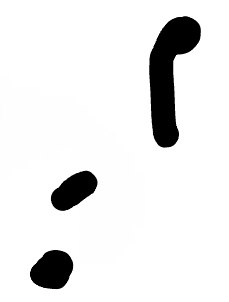
A scandicus is an ascending group of three or more notes.
Pes subbipunctis
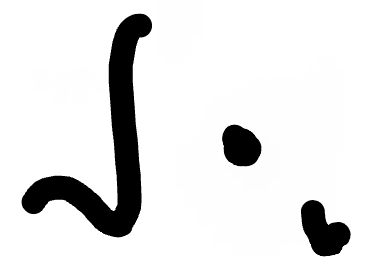
The pes subbipunctis is a compound neume comprised of a podatus, followed by a flexus.
Torculus resupinus

A torculus resupinus is a group of four or more notes that alternate in ascending and descending intervals. The term resupinus refers to when an ascending note is added to the end of a neume.
Bivirga / Trivirga
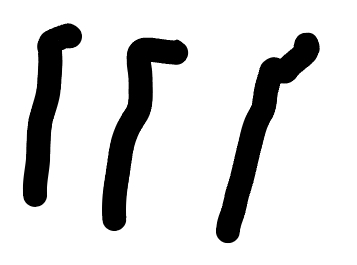
When virga occur in groups of two or three, they are called bivirga or trivirga and they function like bistropha and tristropha.
Quilisma
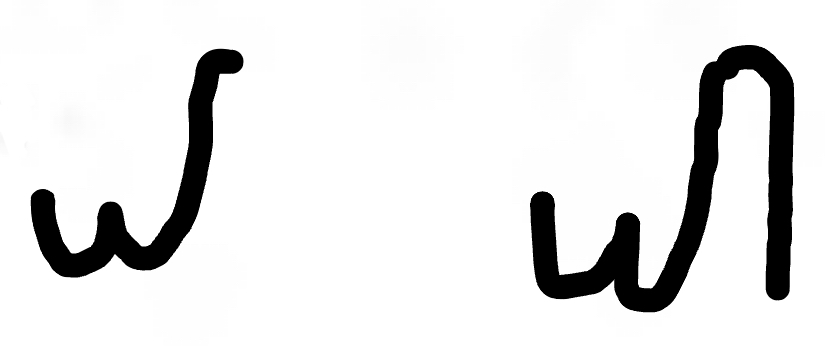
Quilismas are found only in ascending melodies, preceded and followed by one or more notes.
Try It Out!
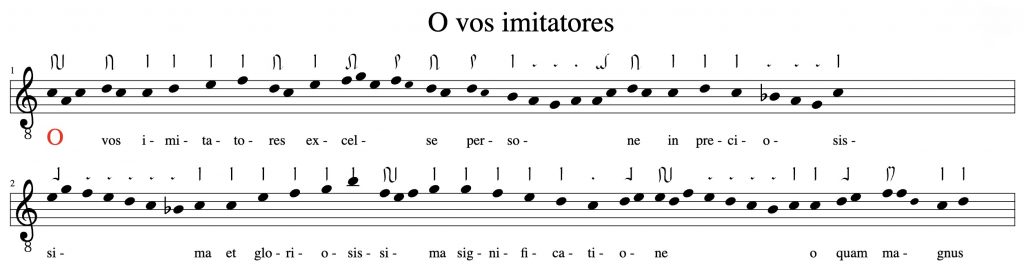
Below, are two transcriptions of O vos imatores. The first image is a modern notation transcription of the piece with the corresponding neumes shown above. The second version is an image taken from the Riesencodex manuscript. As you listen to the piece for the first time, try to follow along with modern notation edition, taking note of the different neumes being used. After that, listen to the piece a second time, and try to follow along using the manuscript edition. Consider how it feels to follow the music with each notation style, observing what different nuances are communicated in each version.
Notes on Performance Practice
In any conversation on Historical Performance Practice, it is important to remember that absolute authenticity is an unattainable goal. Music is an art form that exists in time, and no moment is the same as any other. Especially, in the case of early music, we don’t know exactly what the music sounded like and we don’t know what aspects of the music were particularly important to the composer.5 As modern musicians, we tend to be most interested in “accurate” melody, rhythm, dynamics, and tempo. It’s also important to note, that although we may have treatises left for us that give some instruction to how the music should be performed, we still lack any recordings or sense of what the music actually sounded like.
Resources for Further Reading
Apel, Willi. “The Importance of Notation in Solving Problems of Early Music.” Papers Read by Members of the American Musicological Society at the Annual Meeting, 1938, 51–61.
Bain, Jennifer, ed. Cambridge Companion to Hildegard of Bingen. Cambridge: Cambridge University Press, 2021.
Bain, Jennifer. “Hildegard, Hermannus, and Late Chant Style.” Journal of Music Theory 52, no. 1 (2008): 123–49. https://doi.org/10.1215/00222909-2009-012.
Bain, Jennifer. “Hooked on Ecstasy: Performance ‘Practice’ and the Reception of the Music of Hildegard of Bingen.” The Sounds and Sights of Performance in Early Music : Essays in Honour of Timothy J. Mcgee, edited by Power, Brian E, Maureen Epp, and Timothy J. McGee, 253-273. Burlington, VT: Ashgate Pub., 2009.
Burkholder, J. Peter, and Claude V. Palisca, ed. “Hildegard of Bingen: Ordo virtutum, sacred music drama: Closing chorus, In principio omnes.” In Norton Anthology of Western Music, 7th ed., vol. 1, Ancient to Baroque, 36-38. New York: W.W. Norton & Company Inc, 2014.
Crocker, Richard L. Studies in Medieval Music Theory and the Early Sequence. Brookfield, Vt: Variorum, 1997.
Dowley, Tim. “Christian chant: The core of medieval worship.” In Christian Music: A Global History. Revised and expanded ed, 42-58. London: Society for Promoting Christian Knowledge, 2018.
Everist, Mark, and Thomas Forrest Kelly, eds. The Cambridge History of Medieval Music. Cambridge, United Kingdom ; Cambridge University Press, 2018.
Flanagan, Sabina. Hildegard of Bingen, 1098-1179 : A Visionary Life. 2nd ed. London ; Routledge, 1998. https://doi.org/10.4324/9780203007297.
Fontijn, Claire Anne, and Hildegard. The Vision of Music in Saint Hildegard’s Scivias : Synthesizing Image, Text, Notation and Theory. Hudson, N.Y: Music Word Media, 2013.
Harteloh, Peter. “Hildegard of Bingen: Philosophical Life and Spirituality.” Religions (Basel, Switzerland ) 15, no. 4 (2024): 506-516. https://doi.org/10.3390/rel15040506.
Hildegard of Bingen. Lieder : Faksimile Riesencodex (Hs. 2). Edited by Lorenz Welker, Michael Klaper, and Hessische Landes. Wiesbaden: L. Reichert Verlag, 1998.
Hildegard of Bingen, and Barbara Newman. Symphonia: A Critical Edition of the “Symphonia Armonie Celestium Revelationum” (Symphony of the Harmony of Celestial Revelations). 2nd ed. Ithaca: Cornell University Press, 2018. https://doi.org/10.7591/9781501711879.
Hildegard von Bingen. Riesencodex, 1180-1190. Electronic reproduction of original manuscript. RheinMain University and State Library. https://hlbrm.digitale-sammlungen.hebis.de/download/pdf/449618.pdf.
Hoch, Matthew. “The Music of Hildegard von Bingen: A Categorical Overview of Her Complete Oeuvre.” The Choral Journal 60, no. 10 (2020): 18–35.
Kelly, Thomas Forrest. Capturing Music : The Story of Notation. First edition. New York: W. W. Norton & Company, 2015.
Leech-Wilkinson, Daniel. The Modern Invention of Medieval Music : Scholarship, Ideology, Performance. Cambridge ; Cambridge University Press, 2002.
Leigh-Choate, Tova, Flynn, William T., and Margot E. Fassler. “Hearing the Heavenly Symphony: An Overview of Hildegard’s Musical Oeuvre with Case Studies.” In A Companion to Hildegard of Bingen, edited by Debra Stoudt, George Ferzoco, and Beverly Kienzle, 163-192. Leiden: Brill, 2013.
Meconi, Honey. “After the Party: Hildegard since 1998: Barbara Stühlmeyer, Die Gesänge Der Hildegard von Bingen: Eine Musikologische, Theologische Und Kulturhistorische Untersuchung (Hildesheim: Georg Olms, 2003).” Early Music. Oxford: Oxford Publishing Limited (England), 2005.
Meconi, Honey. Hildegard of Bingen. 1st ed. Vol. 7. Champaign: University of Illinois Press, 2018.
Meconi, Honey. “The Unknown Hildegard: Editing, Performance, and Reception (An Ordo Virtutum in Five Acts).” In Music in Print and Beyond, 105:258–306. United Kingdom: Boydell & Brewer, 2013. https://doi.org/10.1515/9781580468282-014.
Miljević, Bojan. “Musical World of Hildegard of Bingen.” New Sound: International Magazine for Music, no. 42 (January 2013): 167–82. https://search-ebscohost-com.reedleycollege.idm.oclc.org/login.aspx?direct=true&db=a9h&AN=109188105&site=ehost-live.
Panti, Cecilia. “A Woman’s Voice Through the Centuries. Hildegard of Bingen’s Music Today.” In The Past in the Present: A Multidisciplinary Approach, edited by Fabio Mugnaini, Pádraig Ó Héalaí, and Tok Thompson, 15-40. Catania, Italy: Culture, Arts, and Humanities Taskforce of the Coimbra Group, 2006.
Sorce Keller, Marcello. “Why Do We Misunderstand Today the Music of All Times and Places and Why Do We Enjoy Doing So?” in Essays on Music and Culture in Honor of Herbert Kellman, ed. Barbara Haggh Paris: Minerve, 2001, 567-574.
Stühlmeyer, Barbara. Die Gesänge der Hildegard von Bingen : eine musikologische, theologische und kulturhistorische Untersuchung : pbk. G. Olms, 2003.
Notes
- Honey Meconi, Hildegard of Bingen, 1st ed. Vol. 7 (Champaign: University of Illinois Press, 2018), 89.
- Barbara Stühlmeyer. Die Gesänge der Hildegard von Bingen: eine musikologische, theologische und kulturhistorische Untersuchung, Translated by Google, (G. Olms, 2003), 54/64.
- Honey Meconi, Hildegard of Bingen, 1st ed. Vol. 7 (Champaign: University of Illinois Press, 2018), 93.
- Barbara Stühlmeyer. Die Gesänge der Hildegard von Bingen: eine musikologische, theologische und kulturhistorische Untersuchung, Translated by Google, (G. Olms, 2003), 314/324.
- Marcello Sorce Keller, “Why Do We Misunderstand Today the Music of All Times and Places and Why Do We Enjoy Doing So?” in Essays on Music and Culture in Honor of Herbert Kellman, ed. Barbara Haggh (Paris: Minerve, 2001), 573.