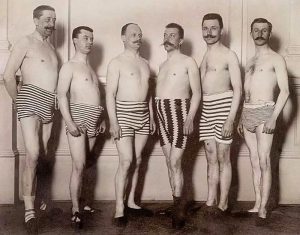
French music in the 1900s was all about rejecting European norms and creating a new wave of nationalism within the country’s borders that had been previously violated by war, specifically the Germans. Composers like Fauré, Chabrier, Bizet, and Massenet decided to reject German stuff like Wagner and Mahler, and invent a new kind of essential “French” sound. And what’s better than German music and Wagner? Lifestyle modernism, a.k.a., men in bathing suits—at least, according to French nationalists after the Franco-Prussian War (Taruskin, Morgan).
It makes a lot of sense that the French wanted to reject German culture and music traditions after the Franco-Prussian War ended with the Siege of Paris, where the capital of the country was occupied for a long time and their culture and musical life died out briefly during such a difficult time (Taruskin, Simone). After being controlled by Germans for so long, it’s understandable they turned away from German music after they were freed. I can absolutely understand why they would adopt such an attitude towards German music and some of the more flamboyant, late-Romantic ones like Wagner and Mahler. And honestly, I remember quite a few different composers from not just France, but Verdi in Italy, who also had issues with him, so I assume Wagner must have been not only a controversial composer at his time, but a person with a controversial personality and opinions.
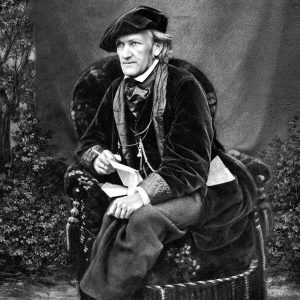
And that whole issue, of course, applies today, considering that we now know he was an anti-semite and his music was rumored to have been played at Nazi concentration camps. So if I’m being honest with you, I don’t blame the French for disliking Wagner. They didn’t even know what would happen later regarding his music, but their opinions were prophetic in that regard. His music is also just frequently a bit too much for me, in my personal opinion, and although I’m a fan of romantic music, I don’t typically reach for Wagner immediately. His music isn’t something I, or most people I know, typically crave, and I think that says a lot about him as a composer and person, both during his life and how we listen to his works today.
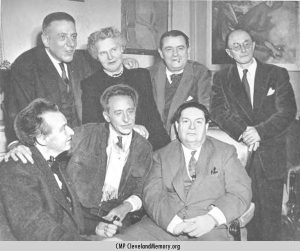
In the time immediately after the war, Fauré and other veteran composers wanted to reawaken French musical culture. They created the Société Nationale de Musique, a nationalist society with composers and other artists, to create this new “French” art (Grout/Palisca/Burkholder). Composers like D’Indy were commissioned by these nationalist societies to write French music and promote other French composers like Berlioz and Faure (Bauer). Les Six, a group of young composers including members like Poulenc and Durey denying German influence were formed to counter the Russian Five. It was a matter of competing with other countries’ unique musical styles and tastes, and it appealed to the public to have their own French version of something so beloved in Russia. These six composers were inspired by Satie and his furniture music, and known for embracing neoclassicism and still being unique and “French”.
Much of the music that was birthed from this French nationalist movement is some of the most unique and beautiful in the world, both at the time of its conception and today. In fact, when I said earlier that when I don’t love Wagner’s music, I’m sure you wondered what it is I do like from this time period? You guessed it, French stuff, specifically Debussy and Poulenc. But what I don’t completely understand yet is the real definition of lifestyle modernism. Men in bathing suits? What does that even really mean, how does one define lifestyle modernism?
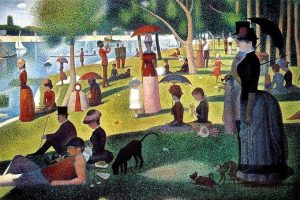
According to Taruskin, the new crop of young French composers looking to redefine the quintessential French sound wanted to “cast off the trappings of impressionist mystery and celebrate the artistically transfigured ‘everyday.’” This meant they were less concerned with embedding emotions, passionate feeling, or detailed stories into their music. Rather, they were fine with comparatively mundane inspirations like scenes from daily life, a particularly picturesque garden, or other non-stereotypical things like ballerinas (Les biches, Poulenc), a circus (Parade, Satie), or… men in bathing suits, apparently. They also created interesting new genre fusions, like Poulenc’s rag mazurka about erotic promiscuity.
Taruskin claims that this is simply a return to the pre-Romantic music styles, like Mozart, but I’m not entirely convinced. The main reason why is mostly a gut feeling, but I am of the opinion that Mozart doesn’t sound anywhere remotely similar to anything we are currently studying, like Debussy. Even Ravel, who claimed to love Mozart’s music and is considered relatively neo-classicist compared to others like Satie, doesn’t sound much like Mozart. So the question remains – what do men in bathing suits have to do with French modernist music? Apparently they’re non-Romantic muses perfect for young French composers looking to reinvent their nation’s music. In my opinion, they succeeded, even if their inspiration is a bit… unconventional.