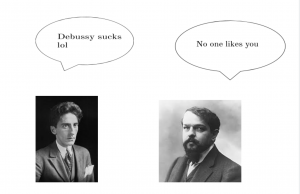
In class on Tuesday, February 18th, Professor Epstein told us that a group of completely homogenous people cannot truly exist; it’s literally impossible. I wrote this down in my notes because I think it allows us to comprehend the differing arguments made by composers and authors we have studied thus far. As of right now, the stances on foreignness and what makes French music distinctively French have been the most incomprehensible for me. For example, Cocteau accuses Debussy of falling victim to the “Russian trap” of music in Le coq et l’arlequin, and he claims that when musics are combined into “Russian-French” or “German French”, they are “necessarily bastard”.1 Contrastingly, we then read the translation of Maurice Ravel’s “Contemporary Music” lecture in which he writes that foreign influence does not actually create a “bastard child”. 2 Instead, Ravel claims that French music is inspired by many various sources and yet will always unfurl in its own individual nature derived from French genius. Going back to the concept of homogeneity, I feel as if Ravel has a more realistic worldview than Cocteau. While Cocteau had an obvious intent to ignite a reaction out of his readers (20th century clickbait?), he still makes bold comparisons between composers Satie and Debussy, and clearly favors Satie over the commonly nicknamed “Father” of French music– a historical documentation of which I have included below:
It could definitely be argued that Cocteau believed Satie respected French nationalism more than Debussy, and that Satie’s music was a representation of a homogenous France and everyday life in Paris, especially seen in the choreography of “Parade” shown below. But then that brings up the question of what nationalism is and how it exists in relation to homogeneity.
This leads me into a more detailed conversation about nationalism and the confusion I feel surrounds its effects on music. Many important events in French history created a sense of unity and pride among the nation such as the French Revolution, the creation of the French national anthem, and the French government’s offer of subventions to orchestras after France’s defeat in the Franco-Prussian war to initiate the idea that good music creates good people, and that would create a sense of nationalism! However, as history progressed, the common view on what nationalism and “Frenchness” was became convoluted.
In Darius Milhaud’s “The Evolution of Modern Music in Paris and Vienna” , he writes about how melody is the most distinct musical idea in making French music French, and even though his music may contain not-necessarily-French elements such as polytonality and chromaticism (I think this is demonstrated well in Milhaud’s symphony No. 2, Op. 49 “Pastorale”3), the melody would always reign supreme in regard to the music’s Frenchness.4 On the other hand, Cocteau would argue that any foreign influence really makes the music not-French. So, the question that still remains in my mind is: who gets to decide what is “French?” Who gets more authority compared to others? While musical ideas are very comprehensible to me as a music student, the cultural elements still remain blurry to me.
1 Jean Cocteau, Le coq et l’arlequin, https://archive.org/details/CockAndHarlequin/page/n15/mode/2up
2 Bohdan Pilarski and Maurice Ravel. Une Conferénce De Maurice Ravel A Houston (1928). https://www.jstor.org/stable/927879 (only accessible with academic privileges)
3 Darius Milhaud. Six Chamber Symphonies: Symphony No. 2, Op. 49 “Pastorale”. Orchestra of Radio Luxembourg. 2014. https://open.spotify.com/track/2FR1NJFQ5StL1EBlcdJ4MC?si=CfvU_3kNSFmqXpysdTr3EQ
4 Darius Milhaud, The Evolution of Modern Music in Paris and Vienna, https://www.jstor.org/stable/25112995 (only accessible with academic privileges)