For the premiere of Mercure, Satie worked with Picasso to create an impressionisme inspired work. Satie’s connection to Montmartre in Paris allowed him to explore and see different types of art and bring them into his ballets. Satie worked closely with the Comte de Beaumont, a French aristocrat known for his parties, extravagant balls, and support of avant-garde art. Beaumont was known for staging ballets for Cocteau and Les Six. (1)
An interesting aspect of the ballet are the costumes and characters. Mercure, who represents the planet Mercury, also argued to represent Jean Cocteau, was modeled after Greek and Roman mythology. Satie and Beaumont’s depictions of each planet gives them a modern characterization of the roman gods and goddesses in a modern way (2). Costumes were modeled after Picasso’s art pieces, in a cubist, avant garde fashion. The characters “the Three Graces,” were dressed in drag, and a few characters were represented by avant-garde sculptures instead of actual ballet dancers (3)
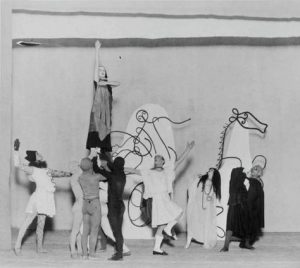
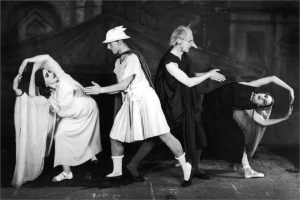
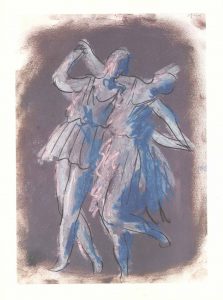
This was a deviation from the Ballet Russes, which primarily focused on the dancers and the music, rather than the art surrounding the piece. Satie wanted this Ballet to focus on art and aesthetic of costume and scenery just as much as it did music. Satie told Debussy:
“I explained the necessity for a French-man to disengage himself from the Wagnerian adventure, which does not correspond to our natural aspirations. And I pointed out to him that I was by no means anti-Wagnerian, but that it was necessary for us to have a music of our own—with no sauerkraut, if possible. Why not make use of the descriptive approaches that Claude Monet, Cézanne, and Toulouse-Lautrec are showing us? Why not transpose this approach into music? Nothing simpler. Are these not expressions? It is necessary that the orchestra does not contort when a character enters the stage. Look at the trees of the scenography. Do they bend? A musical scenery must be created” (4)
Satie’s emphasis on art in this Ballet made it stand out from others, showing the importance of cubism and dadaism in his depictions of these roman mythological characters. Adding an avant-garde art and music style to this story makes the audience think about it in a different way, and shows his and Picasso’s depictions of the characters instead presenting historical norms.
(1) National Gallery of Australia. “Etienne DE BEAUMONT.” BALLETS RUSSES: The Art of Costume -. Accessed April 30, 2020. https://nga.gov.au/exhibition/balletsrusses/default.cfm?MnuID=4&GALID=15179&viewID=3.
(2) Kucan, Christina, Stuart Cheney, Jack Delaney, and Kevin Salfen. “‘Mercure’ (1924): Erik Satie’s Aesthetic Translation of Art into Music”. ProQuest Dissertations Publishing, 2009. http://search.proquest.com/docview/305000686/.
(3) “II. Working for the Ballet – Picasso and Dance – Exhibitions – Visits.” Opéra national de Paris. Accessed April 30, 2020. https://www.operadeparis.fr/en/visits/exhibitions/picasso-and-dance/ii-working-for-the-ballet.
(4) Quoted in Templier: a conversation with Claude Debussy , Erik Satie, 17