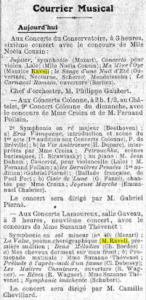
A treasure trove of information exists in historic newspapers regarding the premiere performance of Ravel’s symphonic poem La valse. The findings have been astonishing, as there are a total of 15 different articles between 13 different newspapers spanning the course of two days within the premiere of the piece (December 12 and December 13th, 1920). As many of the newspapers provide the same information in a plethora of ways, it has been interesting to see what insights the various newspapers can display by analyzing the differences between them.
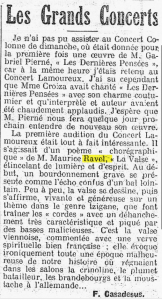
For instance, of all of the positive reviews of La valse, two of the articles stand out as they align La valse with a French nationalist perspective by providing nationalist commentary in addition to a description of the piece. One of these articles, published in La Presse, written by Francis Casadesus praises Ravel’s work for its brilliant spirit and recognizes the gradual degeneration of the piece as it progresses. In his words, Casadesus gathers that the piece has, “a very French spiritual verve; it ironically evokes a whole unhappy era in our history where…the German mustache reigned in the salons.”1 While it may seem that Ravel’s depiction of the waltz desturbes Casadesus, as the waltz appears to demonstrate historic German power over French music, in reality, Casadesus communicates that the gradual unhinging of the piece portrays the waltz in ironic fashion, and as such, the German influence on music should be viewed in a similarly ironic light.
Finally, the newspaper reviews made clear that the two most prestigious concerts to attend on December 12, 1920 were the Concerts Lamoureux (the concert where La valse premiered) and Concerts Colonne. Between all of the newspapers, these concerts were mentioned more frequently than any other concert, even though at least three other musical performances (not to mention theater performances) were taking place on the same day, as can be seen in the December 12th issue of Le Figaro.2
The frequent commentary about Ravel’s La valse in almost every single article attests to both the anticipation of the work, as well as the popularity of the work after its premiere.
Although many of the newspapers portrayed very similar information, the differing manner by which the newspapers did so demonstrates various nuances to the information that attests to both nationalist reception by certain critics of La valse, as well as its overall popularity.