I am much more convinced by Moore’s arguments than Dorf’s regarding themes of homosexuality in music. . Samuel Dorf focuses on Satie’s Socrate, commissioned by the Princess de Polignac, who used her salon as a space for her to embrace her own homosexuality. Christopher Moore focuses on camp in Poulenc’s ballets, such as Les Biches.
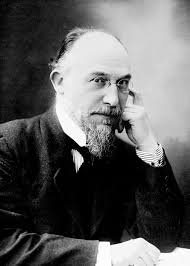
Dorf writes about how Satie and the Princess de Polignac collaborated heavily on the libretto of Socrate (88). While Polignac’s sexuality is an important factor of her identity, it probably didn’t dictate everything she commissioned. An outwardly homosexual statement would have been publicly detrimental to both Satie and Polignac. Dorf also explains how Socrate was different than any other Greek inspired work of Satie’s: “Socrate’s modalities are diatonic: the composer does not use flattened leading tones for effect within a line, but rather they appear as diatonic to the mode in which the line is written. In Socrate, there are no piquant notes, no overt dance rhythms, no “slippery” notes. Rather, we get smooth quasi-plainchant vocal lines, and a much
broader sense of fluidity1” (90). Dorf does not adequately explain WHY this shift in composition style indicates messages of homosexuality however. I don’t think these two elements are strong enough evidence to claim that that Satie and Princesse de Polignac conspired to include sexual messages in their piece.
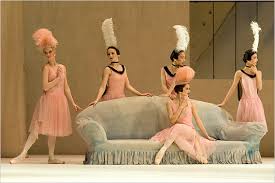
Moore explains how Poulenc was able to use camp in his compositions and ballets to express his sexuality in a time it may have been dangerous to do so. He writes that camp was a vehicle with which to shield expressions of homosexuality from the public view, specifically in Les Biches and Aubade2
(303). Moore references many scholars and primary sources, such as Poulenc’s letters themselves, to support his argument.
Moore’s argument is more factually based and seem more thoroughly researched than Dorf’s. Despite both authors providing evidence for their hypothesis, I think they may be putting these composers into a box they don’t deserve to be in. While it is good to recognize these possible themes and recognize queerness in art, looking for evidence of homosexuality in a gay person’s work leads to the risk of reducing the art to that one aspect of their identity.
1 Samuel Dorf, “‘Étrange, n’est-ce pas?’ The Princesse Edmond de Polignac, Erik Satie’s Socrate, and a Lesbian Aesthetic of Music?” FLS: Queer Sexualities in French and Francophone Literature and Film 34 (2007), 87-99.
2 Christopher Moore, “Camp in Francis Poulenc’s Early Ballets,” Musical Quarterly 95 (Summer-Fall 2012), 299-342.