In Dorf’s article I find the evidence suggesting a change in Eric Satie’s style when composing Socrate a compelling starting point for a queer reading. I find Dorf’s narrative about Socrate being a more isolated case in Satie’s body of work, conceptualized in close collaboration with a “confirmed” lesbian patron, especially compelling. Dorf by doing this assumes the premise that a) Prinsesse de Polignac somehow had a queer agenda or influence with her commission, b) that the Prinsesse had that kind of artistic influence as a patron.
I agree that the tone of the first two letter excerpts is different, the first one bursting with excitement, the other more subdued and matter-of-factly. Dorf suggest that this is representative of how he describes the piece in other letters and writings, moving forward. What I would have Dorf comment on, is the difference in tone Satie might have when addressing the two recipients. When writing, what Dorf describes as Satie’s friend, Valentine Gross (later Hugo) that happens to be a woman and a later collaborator on Socrate, that might call for a tone depending upon the specifics of their acquaintance.

Valentine Gross (later Hugo)
When Satie addresses Henry Prunières, also described as friend by Dorf, a man and musicologist the more sober tone might be socially coded. Considering gender dynamics of the late teens, when writing to a woman, one might be more condescending and/or explicit and even more emotive than when writing to a man. A man whom Satie would have considered his intellectual equal.
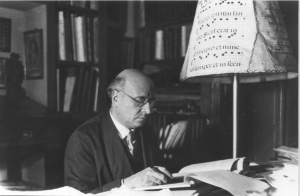
Henry Prunières. (This is how all musicologists work. When we graduate we have to buy a plainsong lampshade and give a solemn promise to wear tweed until our dying day.)
Why am I nit-picking on this? Because I can. But also because a lot of Dorf’s argument rides on the premise that Satie’s approach to Socrate was different from his other works, not only in practice, but in his own opinion. If Dorf had presented evidence suggesting that Satie’s tone shifted when writing Gross, that would be even more compelling, that a shift in tone between two recipients.
WORKS CITED
Dorf, Samuel. (2007). “Étrange n’est-ce pas?”: The Princesse Edmond de Polignac, Erik Satie’s Socrate, and a Lesbian Aesthetic of Music?. French Literature Series. 87-99.