Historically contextualized, queer composers used music as a way to express themselves in a way they could not in the public eye. The ideas that music always contains secret messages and ulterior motives then for entertainment was used as a reason why music sounds a certain way. We often look for a certain aspect of a composer, such as sexuality in the case of Poulenc and Polignac, to define them and make it the reason why they created the type of music that they did. It’s usually a lot of different factors, but it begs the question(s):
Why is it that we always attribute queer composers music to their sexuality before we consider other factors?
Which aspects of a composer’s personal lives and ideas lead them to create certain types of music?
In the case of Poulenc, many of his works were derived from camp style, used as a way to express queerness, or sexuality in a time where it was more taboo to come out of the closet. Moore connects Poulenc’s signature jovial and light-hearted styles directly to camp (1):
“Camp draws its creative and social force by implicitly challenging the very underpinnings of straight discourse through the adoption of an ironic attitude that undermines the perceived “normality” of the sexual binaries that buttress heterocentricity .” (Moore, 302)
The playfulness or flirtatiousness of his music very much suggests irony and “making light” of the current situation. According to Moore:
“It also allows us to refine our under- standing of the composer’s attraction to important modernist trends, such as neoclassicism and surrealism, which as a result of their syntactical and semantic ambiguity were particularly effective vehicles for a composer who sought to hide his “big secret” from public view” (303)
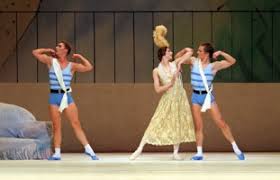
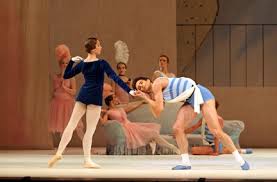
This could definitely explain Cross dressing, flirtatious characters, and ambiguously gendered characters in Ballets like Les Biches. These were all incredibly uncomfortable and taboo topics of the time, so it made sense that Poulenc was careful in what he revealed about his personal life in this ballet. He at one point stated, “Les Biches, has no real plot, for the good reason that if it had it might have caused a scandal.” (2) In Les Biches, an androgynous character called, “La Garconne” is meant to spark interest in the audience and create controversy in idea, because they represent neither a male or female role, which broke a lot of norms in ballet. Poulenc’s creation of “La Garconne” may not have been influenced by camp and queer art and music, but they are an interesting character to say the least, and one of the reasons Les Biches became so captivating.
In Satie’s Socrate, the same can be said. Since the patron, La Princesse de Polignac, identified herself as queer, how much did that play into Satie’s writing. Looking through a lense of gender and sexuality, a lot. The mezzo-soprano voices, the greek language, the scandal between characters, simple music, and subtle sensual elements (3) all can be used as evidence to support the claim that Polignac’s sexuality played an important role in the music of Socrate.
However, if we studied this through a lense of nationalism, political stance, or other factors, we have gotten a different reason as to why these pieces of music sounded the way they did, and from who or what composers were influenced. I think that Dorf and Moore make excellent arguments about the homosexual origins of some of these pieces, but without checking it with other outside factors. Would La Princesse de Polignac applaud the character of “La Garconne, or would it fascinate and confuse her like it did others? The assumption that knowing composers sexuality, ethnicity or religion can explain everything about their music is going down a dangerous path.I would be most interested to see a bunch of musicologists debate this topic. For example, when we studied Poulenc and Satie at the beginning of this course, sexuality was never even mentioned, and I’d wonder if the authors of our previous readings about these composers and La Princesse de Polignac would agree.
(1) Moore, Christopher. “Camp in Francis Poulenc’s Early Ballets.” The Musical Quarterly 95, no. 2/3 (2012): 299-342. Accessed April 22, 2020. www.jstor.org/stable/41811629.
(2) Karthas, Ilyana. When Ballet Became French: Modern Ballet and the Cultural Politics of France, 1909-1939. Montreal: McGill-Queens University Press, 2015.
(3) Dorf, Samuel N. “‘Étrange n’Est-Ce Pas?’: The Princesse Edmond De Polignac, Erik Satie’s Socrate, and a Lesbian Aesthetic of Music?” Queer Sexualities in French and Francophone Literature and Film, January 2007, 87–99. https://doi.org/10.1163/9789401204903_008.