According to Jeffrey Jackson, the French called the 1920s “the crazy years.”1 As jazz music and dance came to France it brought ideas that made many French people uneasy, often because they felt their sophisticated way of life was being threatened. 2 Jazz music was linked to the economic developments in America, a mechanization and efficiency that contrasted the French economy.3But somehow, the French people were still fascinated with facets of jazz and African culture, resulting in Negrophilia in France in the 1920s.
There was certainly an increased interest in these cultures in France during this time. However, this interest caused different cultures to be conflated into a product sold to the French elite. For some French people, the commodification of black culture simply meant that these pieces of art were out of the flea markets and into higher class consumer space.4 Is this truly appreciation? Or were the French trivializing a culture different than their own to satisfy a need for the exotic?
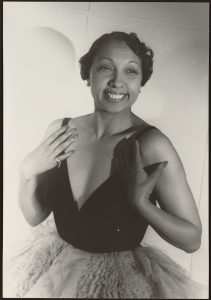
In his examination of La Revue Négre, Matthew Jordan asks, “Can jazz, or any other cultural product, be considered a pure expression of race?” 5 I would argue that cultural product is not limited or restricted to expressing a singular facet of identity. Furthermore, it is inappropriate to use one jazz performer or black dancer to represent all others who engage in that cultural tradition. Many French people saw La Revue Négre as extraordinary solely because of Josephine Baker’s performance, claiming that the music was somewhat unremarkable since they had been hearing similar sounds for years in Paris.6 This insinuates that the French audience simply found Baker’s performance extraordinary because it was new and exotic. This does not show an appreciation for black art and artists, it just shows a temporary and shallow intrigue with the unfamiliar.
This conclusion has tangible implications for the way certain cultures engage with unfamiliar music. For example, consider the way that music departments in American colleges and universities incorporate music outside of the western canon into curriculum. Are all colleges and universities encouraging lasting engagement with music from cultures that we have othered throughout history? Is it better to deeply engage with only one non-western culture throughout a students time at college or to narrowly engage with many? If we don’t consider these types of questions then we are risking the shallow intrigue characteristic of Negrophilia in France in the 1920s.
1 Jeffrey Jackson, Making Jazz French: Music and Modern Life in Interwar Paris (Durham: Duke University Press, 2003), 72.
2 Matthew Jordan, Le Jazz: Jazz and French Cultural Identity (Urbana-Champagne: University of Illinois Press, 2010), 105.