When I was six years old I took ballet. For the final recital, myself and ten other small, suburban white girls dressed in tiny black tutu’s danced to “What a Wonderful World” by Louis Armstrong. It’s a good memory that has stayed with me for my entire life. Six-year-old me did not see Louis Armstrong as “other”. She didn’t even know what the man behind the music looked like, she just knew that she loved the music even though the music was black and it was jazz and none of the little girls in that class had experienced any sort of racism or oppression. I wonder now that I’m older and supposedly wiser if it was wrong to enjoy it. To answer this question, I look to 1920s Paris.
Much like my six-year-old self, French people were elated when hearing jazz for the first time. It was new, it was exciting, and sounded nothing like anyone had ever heard before. The problems came when fun and exciting music turned into exoticizing. Josephine Baker, a black woman born in St. Louis, Missouri, contributed with the exoticization of black people in La Revue Nègre. “It is certain that the show was designed to play on [the idea that authentic jazz was a direct offshoot of la music negré], as well as to reify the exotic and primitivist stereotypes associated with la negré [..] La Revue Nègre succeeded in conforming to age-old fantasies about exotic negré swirling in the French cultural imagination [1].” Critics called the show “‘authentic’ and ‘raw’,” and as the “epitome of avant-garde [1]”. Audiences “screamed with disdain and delight” as they watched a topless Josephine Baker move in an “acrobatic epilepsy of tortuous gestures and hallucinatory spirals [1].” André Levinson was absorbed in the “beauty of black dance, its marvellous flexibility and rhythmic fantasy, were the product of an innate gift, not a conscious art- a gift that has more or less atrophied in the cultivated human being [2].” Yikes. African Americans were apparently not cultivated enough, and this allowed them to have incredible dancing skills.
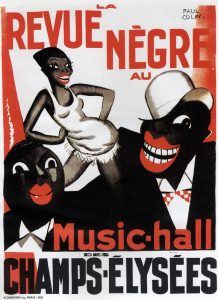
All cultivations aside, the show was a smashing hit. But not for everyone, especially a man named René Bizet. Bizet was outraged that a nearly-naked Baker was performing in his sacred performance hall, which “should be a place for performances as civilized and sophisticated as their audiences [1].” Yikes again. “Bizet believed the popularity of the show was symptomatic of a decrease in refined taste within French culture [1].” Honestly, it’s hard to win in this situation. On one hand- if you’re a French person fully supporting and loving the show, you are uncivilized, unsophisticated, and in support of the “heathen” ideas the show promotes. On the other hand- if you’re like René Bizet with your nose stuck up in the air laughing at those who think that La Revue Nègre is “high art” doesn’t that make you just as bad? I don’t think either side had a respect for black culture, and that’s why I think 1920s Parisians really did not love, respect, or celebrate African American artists. I believe at first, parisians were a lot like me in ballet at six years old, discovering something new for the first time and filled with excitement. La Revue Nègre proves that the French took this innocent wonder and gave it a good old-fashioned colonist spin, and African Americans became nothing more than a loveable sideshow.
Sources
[1] Jordan, Matthew F. Le Jazz: Jazz and French Cultural Identity. University of Illinois Press, 2010.
[2] Acocella, Joan and Lynn Garafola. André Levinson on Dance: writings from Paris in the twenties. Wesleyan University Press, 1991.