When Josephine Baker and La Revue Nègre arrived in Paris in the fall of 1925, the public was captivated by her and the other performers’ visceral dancing. It put the soul into black jazz for the white Parisian audiences. Jazz was an enormously controversial music in France at the time. There was both an obsession and repulsion by it. Matthew Jordan in Le Jazz: Jazz and French Cultural Identity described this as “discursive dissonance.1” Composers like Ravel, Milhaud, Gershwin, Stravinsky, and others were implementing elements of jazz into their music, and some compositions were even explicitly cited as jazz.
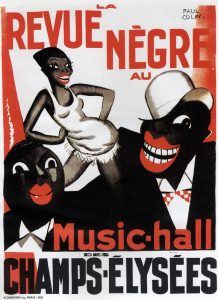
However, many critics of the time were concerned about American influence in France. After World War I, there was an influx of African American immigrants who were stationed in France during the war. In France there was no legal segregation, so it was a somewhat better place to live. Additionally, the French economy was in peril, which allowed American tourists to take advantage of the weakened currency. This dissonance, the love of jazz and the “exotic” and the French nationalist love of tradition and self, was at the heart of French negrophilia.
Was the 1920s French obsession with blackness true love of black culture? No.
An authentic love would require a mutual relationship between the French people and black performers, in which the white audiences learned and listened and collaborated with artists of color. However, they were not interested in this. They weren’t even “in love” with black culture. They were infatuated by a racist idea of blackness as an “exotic” and “primitive” other. André Levinson says that black dancing is “an innate gift, not a conscious art” and that it is nothing more than their “irrepressible animality.2” Furthermore, many critics like Bizet, Brach, and Levinson viewed the liking of jazz and black performance as a vice, even going so far as to say that it was eroding French culture.
Essentially it comes down to this: the French did not want to learn about African American culture and instead only perpetuated false ideas that othered and degraded blackness.
These problematic obsessions have not entirely disappeared. Modern musical culture is filled with issues of representation and exoticizing. While there are more platforms for artists of non-white identities, there is still rampant appropriation and othering. Take for example how artists like Beyoncé, Cardi B, and Lizzo are perceived by society. Or how rap and hip hop is consumed by upper class white people. There are lots of examples in the present of obsessions with “the other.” Perhaps we need to examine how we think of popular artists and see if we are no different than the 1920s black obsessed French public.
Footnotes
1Matthew Jordan, Le Jazz: Jazz and French Cultural Identity (Urbana-Champagne: University of Illinois Press, 2010), 102-111.
2André Levinson, “The Negro Dance: Under European Eyes,” in André Levinson on Dance: Writings from Paris in the Twenties, ed. Joan Acocella and Lynn Garafola (Hanover: Wesleyan University Press, 1991), 69-75.