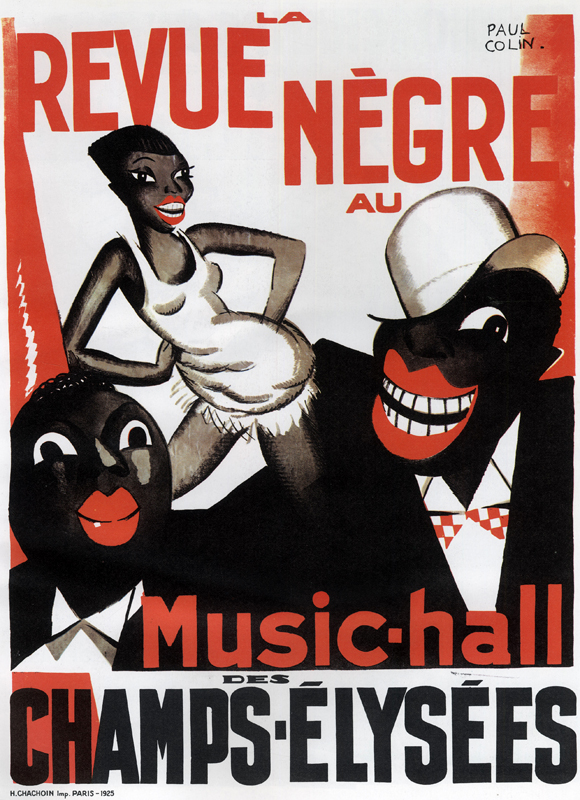
Reception towards the influx of black cultural products in 1920s France consisted of equal parts attraction and enjoyment but also revulsion and fear. Reading through French author’s impressions of La Revue Nègre, which they describe as “soft, splenetic, brutal, lustful, or sad,” “something animal,” and “frenetic and devilish,” it is clear that what 1920s Parisians felt towards black culture was not genuine love or respect.1Critics did not approach the music or dancing as art on an equivalent level with the “refined” creations of France, but instead viewed it from above and from a distance as something primitive and other.
However, the dynamics that allowed negrophilia to flourish in 1920s Paris were not as simple as merely the reactions of critics. To some extent, the acts in La Revue Nègre were carefully curated and designed to elicit such an effect and cater to French romanticizations and conflations of blackness.2 Similar to Spanish artists of the time, African American artists in Paris profited by auto-exoticizing themselves. Like Stravinsky’s Le Sacre du Printemps or Milhaud’s La création du monde, La Revue Nègre showed that any publicity was good publicity, and a “succès de scandale” was a success nonetheless.
So who wins and who loses? The French public gets their distorted ideas of blackness reinforced; at The Revue Nègre, they are allowed to feel just the right amount of discomfort. But even if the French did not truly love and respect African American artists as equals, their attitudes were the much lesser of two evils in comparison to those in the Jim Crow South. Josephine Baker undoubtedly lived a more creatively fulfilling and successful life in France than she could have in America, at the price of being objectified and dehumanized, but also admired and allowed to pursue her passion of dance. That artists like Josephine Baker could use the exploitation and commodification of blackness in France to build a better life does not in any way condone this exploitation, or cancel it out. It is a reminder that they were thinking, feeling human beings, not passive victims.
It is easy to look back condescendingly on attitudes of 1920s Parisians, or point to them as clearly “wrong.” Today, our discomfort with negrophilia speaks to how much public discourse on how we interact with and even define the “other” have changed. With such a wide variety of music available through Youtube, Spotify, and other streaming sources, we can arguably no longer react to or even imagine a musical “other” in the same way as Parisians did 100 years ago.
Sources
1Jordan, Matthew F. Le Jazz: Jazz and French Cultural Identity. Urbana, IL: University of Illinois Press, 2010.
2Ibid.