The concept of Negrophilia becomes quite convoluted when attempting to dissect it and separate it into its true parts. The question of if Parisian’s really did love African and African American artists at the time cannot truly be answered by a modern scholar, as I’m sure there were Parisians who really did appreciate the music for what is was and the people for what they were, but I don’t believe these were the people truly appropriating and fetishizing black people and their musical creations. I believe the ones “loving” black culture were truly motivated by more malevolent reasons, whether they were aware of it or not.
After WWI, there was an “overwhelming desire to dance to ‘negré rhythms”, writes Matthew F. Jordan in his work “Le Jazz and French Cultural Identity.1 However, this desire was often judged harshly by “culture critics who valued traditional French music that inspired intellectual restraint”.2 This proves that there was a fascination with black rhythms, musical gestures, and trends, but at the same time, they were often labeled as distinctly “not French” because of their apparent primitivism. Granted, Jordan brings up the point that many people experienced loss during WWI– not just Americans. He argues that there is indeed a “basis” for French people identifying with the “suffering of black Americans” because they, too, had lost loved ones in the war and were looking to use the blues to get over their “blues”.3 However, this only sparked more disagreement over what was to become of French culture. Was Jazz music truly destroying France’s moral foundations as traditionalists argued? Or was jazz a way to react against a repressive social order as the modernists thought? Either way, the music of black people was being either demonized or weaponized by those who essentially did not cultivate it, and that is where the issue lies.
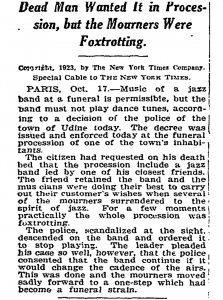
An interesting example of how Jazz was controlled comes from the 1923 New York Times article summarizing how jazz music was strictly moderated by police at a funeral (zoom in to read more clearly or follow the link below):
On a similar note, there is another fascinating article from 1928 that outlines French critic Fortunat Strowki’s opinions on jazz, the black American, and how jazz relates to Frenchness which you can see below:
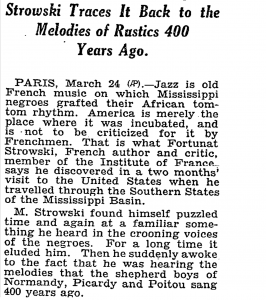
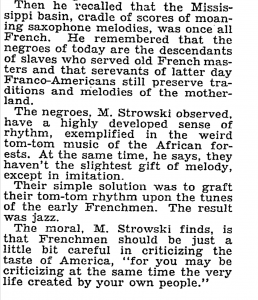
While these two sources don’t encapsulate all of the opinions surrounding jazz music, which was arguably the most influential and “black” music that the Parisians liked to imitate or adopt, they are good examples of how jazz was written about at the time. Fetishization happening at the same time as demonization is perhaps illustrated better in the second article, where the highly developed rhythmic talents of the black person are praised, and yet it said they have no gift of melody. This language opens the door to the wider trend of Parisians only adopting certain elements of black culture and music– the ones that they found beautiful, sensual, and fun. They did not want the ugly, mistreated, and disenfranchised part of black culture.
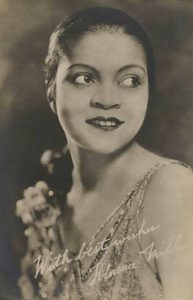
Taking a look at André Levinson’s work on the Negro dance gives great examples of the complicated and often contradictory language that was used to describe black music and dance in France. Even though he originally hails from Russia, he moved to France in the early 20th century and became an essentially French journalist. In his work, he writes that “negro ragtime” is “bewildering” and yet performed with “unimaginable dexterity” (72). He compliments “marvelous flexibility” and “rhythmic dexterity” and yet goes on to say that “we should not, however, jump to the conclusion that because of this extraordinary rhythmic gift alone the Negro dancer should be taken seriously as an artists” (72-73). It becomes rather astounding that he can include this sort of language while also praising black performers such as Josephine Baker and Florence Mills for their elegance and extravagance. These women, to him, contain a “carnal magnificence” and yet he claims their forefathers are “savages” (74-75).

Undoubtedly, jazz caused controversy not only in France, but all over Europe.6 While jazz was not considered exclusively black, it was most commonly associated with black musicians and culture. Parisians who felt repressed by strict social orders enforced by traditionalist culture critics could very well indeed have loved the freedom of expression, unique rhythms, musical trends, and stylistic choices of black musicians, I do not truly believe that they loved black people themselves. Rather, they more commonly picked the qualities they wanted to imitate but were ultimately more racist in their demeanor than progressive and accepting. Not only did the demonize black people, but they fetishized what they wanted and discarded what they did not in order to create a new sense of French nationalism for some and a source of fright and disagreement for others.
When it comes to modern day music that we classify as “other”, the same phenomenon often occurs. For example, a largely white group of students can listen to, let’s say, Afro-German music while easily being unaware of Afro German identity in the history of nazi Germany. However, we could still take elements from that music and imitate them in our own musics, even though the music black Afro-Germans make could be a commentary or result of a history of oppression. While I don’t think that makes us ignorant– as it is often not obvious to delve deeper into music since we are currently living in a culture of rushed consumerism– it shows how the taking of music has persisted throughout history, despite this being a pretty niche example.
Sources:
1 “Jordan – Le Jazz and French Cultural Identity.pdf.” Google Drive. Google. Accessed March 9, 2020. https://drive.google.com/file/d/0BxQzWOgr8AurZVlpckFCZmVZZ28/view.
2 Ibid., 45
3 Ibid., 53-54
4 “FRENCH POLICE STOP JAZZ BAND AT BURIAL: DEAD MAN WANTED IT IN PROCES- SION, BUT THE MOURNERS WERE FOXTROTTING.” New York Times (1923-Current File), Oct 18, 1923. https://search.proquest.com/docview/103154936?accountid=351
5 “SAYS JAZZ ORIGINATED IN OLD FRENCH MUSIC.” New York Times (1923-Current File). New York, N.Y.: New York Times Company, March 25, 1928. http://search.proquest.com/docview/104631528/
6 Bernard Gendron writes about how countries such as Italy and Germany reacted to jazz music as well. “Gendron – Between Montmartre and the Mudd Club.pdf.” Google Drive. Google. Accessed March 9, 2020. https://drive.google.com/file/d/0BxQzWOgr8AurSWlIdjhWeGtOaDA/view.