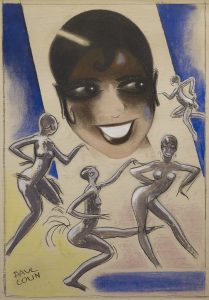
Negrophilia is one of the more complicated, and difficult topics we’ve talked about so far in class. One of the difficulties is that many, if not most Parisians really did believe that they were experiencing genuine representations of African American and African music and culture, and that their consumption of these materials was based in love, and fondness. Of course, looking back, it is clear that most Parisians’ affections for blackness was probably more grounded in the thrill of partaking in perceived transgressions, and fetishisation than genuine love or respect.
La Revue Nègre was one of many shows in Paris that fueled and was fueled by negrophilia. Critics described the show in manners clearly designed to thrill French audiences, but filled with deeply entrenched racism. One critic described the show as containing “all the négre soul with all its animal convulsions, its childish joys, and its sadness from past servitude”. Genuine love does not call its subject “animal” or “childish”. What was really at play was not love, but fetishisisation of a perceived other. Much of this was based in primitivism, which allowed French culture to measure itself against a stereotypical version of another and find itself superior. We know that France at this time was obsessed with nationalism and national identity, and imagining another culture as “less developed” likely allowed many anxious Parisians to feel more secure in a changing world. What was loved was more the idea of blackness, and French perceived superiority than any real affection for, or interaction with either African or African American cultures.
The fact that all black culture was conflated during this time period is perhaps the most compelling evidence for the underlying sentiments of negrophilia. True love depends on knowledge of the subject. Most of the writers we have studied felt that they were fundamentally different from other European cultures, and likely would have been horrified had another country become obsessed with whiteness and presented a show in which white Americans were presented as essentially interchangeable with some notion of a culturally homogenous Europe. We would not claim that as genuine love, and we should not claim that French fetishisastion of blackness was love either.