Georges Auric was a French composer born in 1899 and was part of Les Six, or the group six French artists that came out of Cocteau’s ideas of French music. While his compositions included ballets, solo and ensemble piano, voice, and orchestra, he was widely known as a film composer and music critic. In his writings and compositions, Auric wanted to promote Les Six, populism, and the art of film music that was widely seen as amateur and unserious.
Audio: “Where is your Heart?” from Le Moulin Rouge by Georges Auric
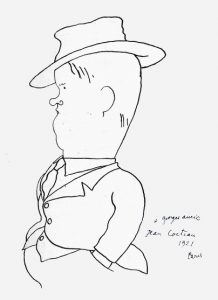
My first source is called Les Six : the French Composers and Their Mentors, Jean Cocteau and Erik Satie by Robert Shapiro (1). Shapiro is a well-respected scholar that specialized in twentieth century French music. He has done a lot of research, especially on primary sources like the correspondences of Georges Auric. Since he studied mainly French music, he could have biases in favor of it, and particularly the Les Six composers, not always recognizing the musical styles and opinions of other French composers, foreign composers, and critics. What I like about this source is that is has information on each member of Les Six, but it includes their interactions and relationships. In Cocteau’s Le Coq et L’Harlequin, he begins with a letter dedicating the piece to Georges Auric, warning and praising him about the importance of incorporating nationalism in his music:
“I offer [these notes] to you because a musician of your age proclaims the richness and grace of a generation which no longer grimaces, or wears a mask, or hides, or shirks, and is not afraid to admire or stand up for what it admires. It hates paradox and eclecticism. It despises their smile and faded elegance. It also shuns the colossal. That is what I call escaping from Germany” (2)
Interactions between Cocteau and Satie with Auric are important in understanding Auric’s influence as a composer and nationalist during the time of Les Six. Shapiro’s book would be a good source for anyone studying a member of Les Six because it includes information on each composer and how they reacted to Cocteau and Satie, which says a lot about their influence at the time. He mainly argues that each composer in Les Six was influential and their own way and made a large enough impact to shape the history of French music in the 20th century. Shapiro claims that the group was created and thrived out of the response to German invasion and were important to both the French nationalist movement and contemporary surrealist art forms including Pablo Picasso.
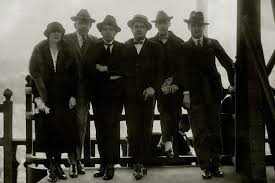
The second encompassing source I found relating to Auric was a journal article titled Reaching a Plus Grande Publique: Georges Auric as a Populist by Colin Roust (3). Roust is a professor of musicology at University of Kansas who specializes in French music, and specifically researched Georges Auric. He wrote a full biography on Auric as well as his graduate thesis and this article in The Musical Quarterly. Roust claims that Auric has “fallen through the cracks of history” and he wants to show his influence on Parisian Opera, film, and classical music in the early 20th century. Roust organizes this article mostly chronologically, but also by separating Auric’s political action with his music. He also goes in depth which many of the film’s Auric had scored in order to show his interest in public affairs. Again, since Roust studied in France, he may definitely have bias in favor of Auric and the composers connected to post WWI France, not taking into account many other voices. Roust’s depiction of Auric’s work with the communist party makes a lot of sense with some of his target audiences and the purposes of his compositions. The populist movement and youth music movement (Fédération Musicale Populaire) was shown in a lot of his music because he was trying to get away from the “elite” music and write for the common people, which is why he was so intrigued by film music. I also enjoy how Roust inserts excerpts of sheet music within the text to help explain his main points.
(1): Shapiro, Robert. Les Six : the French Composers and Their Mentors, Jean Cocteau and Erik Satie London ;: Peter Owen, 2011.
(2): Cocteau, Jean. Cock and Harlequin. Notes Concerning Music… London: Egoist Press, 1921. (p. 3)
(3): Roust, Colin. “Reaching a ‘Plus Grand Public’: Georges Auric as Populist.” The Musical Quarterly 95, no. 2/3 (July 1, 2012): 343–367.