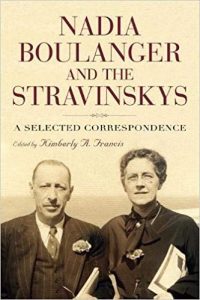
In my research on Nadia Boulanger I have been turning to Kimberly Francis time and time again for information on Boulanger and her relationship with the Stravinsky family. Francis is one of the most prominent scholars in this area of research, along with Caroline Potter. The most useful source for me so far has been Francis’ Nadia Boulanger and the Stravinskys: A Selected Correspondence. This book provides the text of many letters between Nadia Boulanger and various members of the Stravinsky family (mainly Igor and his wife, Catherine) along with commentary and context provided by Francis. Since Boulanger’s letters are scattered between many libraries across the world, and are not often available to remote readers, this resource is incredibly useful as a sort of library of the sources I need. I also find this source to be very useful because the evidence for all of the arguments Francis makes are available to the reader immediately because the letter being referenced is always printed directly next to the space where the argument is being made. It’s helpful to be able to look at the evidence an author is drawing on without having to either take their word for it, or go searching for the source they used.
The letter I am writing is dated in December 1929, just four months after Boulanger and the Stravinskys began developing their friendship in earnest. Being able to read their letters from this time period has helped me understand how they wrote to each other, and how quickly the friendship grew close. Soulima Stravinsky began taking lessons with Nadia Boulanger in late September 1929, and by May 1930 the family was consulting Boulanger for advice about Soulima’s potential marriage to an American woman. Talk about a fast moving friendship. Their letters also reveal a good deal about their personal lives, and the things they cared most about as individuals, which also allows me to understand what sorts of things they might have written in a letter to a friend. The one difficulty is that Nadia Boulanger almost never wrote letters longer than a page unless they were score edits, so I’m having to imagine what she might sound like if she were writing on more than one topic in a letter.
Luckily for me, many of Boulanger’s students were both impacted enough by their lessons to write about them, and well known enough that many of their writings were given to libraries or published. This allowed me to get background knowledge from many different composers who studied with her in order to get a feel for what through-lines people mention. Among those is that everyone seems to agree that she was intensely focused on individuality and seeing musicians as people first, which leads me to my main claim that Boulanger’s emphasis on the whole person is what allowed her to be such a great teacher. What complicates this slightly is that Boulanger also believed that musicians should write with their national characteristics in mind, which is best brought out in Annegret Fauser’s article on Aaron Copland’s experience as an American in Paris, which delves into the ways that Boulanger encouraged him to write music that reflected his US American national identity. This article complicates my argument somewhat, because it is not just that Boulanger treated her students as individuals, but also that she wanted them to be representative of their nations, and nations are necessarily communal rather than individual. But, based on this, I believe nationalist tendencies may have pushed Boulanger’s friendship with the Stravinsky’s, and might explain some of her particular investment in Soulima Stravinsky, who shared some of her life experience as the child of a Russian immigrant in Paris. I am also including references to this shared identity, and the ways it bolstered Boulanger’s relationship with the Stravinskys within my broader argument that the relationships formed with students were what ultimately made Boulanger such a great teacher. Trying to understand a historical figure well enough to imagine occupying their headspace is an interesting exercise in both empathy and research, and I already feel that I know both figures in my letter much better now than I did two weeks ago.