An Introduction
Introduction:
This website is designed to be a user-friendly resource that is as succinct and clear as possible. It is by no means comprehensive. When dealing with musical style from the past, it is difficult to be exact as we cannot hear how the music was performed by the musicians of the time; instead, we must rely on the treatises and testimonies of those musicians, as well as their lives, to be our guide when studying such a nebulous thing as performance practice, and as a result, much is left to the performer to practice good taste. With this necessary caveat out of the way, let’s examine some important background information.
Historical Background:
As with any musical tradition, a little bit of history surrounding some of the major composers is essential.
Jean-Baptiste Lully (1632-1687) [4]
Let us begin with a brief history of Jean-Baptiste Lully, who is in many ways the founder of many of the stylistic traits that are so peculiar to the French style. Lully was not actually French; rather, he was born in Tuscany to peasant parents, and learned music with the Franciscan friars in the area. While it is not known how it occurred, he was chosen to be an Italian tutor to Louis XIV’s cousin, Anne-Marie Louise d’Orleans. As she lived in the Palais de Tuileries, he had access to many elite French musicians of the time, who probably completed his musical studies. Here he was also introduced to ballet and dancing, and through his palace connections he managed to enter the service of Louis XIV himself, who greatly appreciated his dancing and music. Lully then composed many operas, ballets, and other incidental music for the royal court. Through his success, he became a naturalized French citizen, married the daughter of a French composer with the contract signed by none other than Louis XIV himself, and wrote music that rose to international fame, drawing a commission from the Grand Duke of Tuscany for some popular dance music. The King was obsessed with Lully’s music, and gave him extensive control over the royal music making, so he was able to control the accuracy of the instrumental playing, demonstrate the steps of ballets, show how a performer should make an entrance and move on stage, and display the attitudes they should adopt. Thus his music was very particular in its style, and quite unique, and it is quite likely that this musical authoritarianism that he worked with led to his style becoming much of what we now think of as French Baroque performance practice.
Marc-Antoine Charpentier (1643-1704) [6]
Son of a Parisian Master Scribe, Charpentier was one of Lully’s leading contemporaries, though like many who attempted to establish a musical presence around the royal court, he was pushed out by the monopolistic control that Lully had on the music making in the Chapel du Roi. Early in his life, he went to Rome to study, where he learned a lot about the current Italian music, bringing several motets and oratorios back to Paris. He then went to work in the Hôtel de Guise, where he was employed by the Guise family as their private composer, and served them until 1688.
Nicolas de Grigny (1672-1703) [7]
Of those composers who wrote specifically for the organ, Nicolas de Grigny is especially important. Born in Reims to a family of organists, he became an organist quickly as well, and left the city to become the organist at the Abbey Church of St. Denis in Paris in 1693. He returned to Reims in 1696 where he soon took up the organist post at the cathedral of Reims, where he worked until his early death in 1703. He was known for contributing some of the most complex music to the French Baroque organ repertory, involving far more pedal facility than many of his contemporaries.
François Couperin (le grand) (1668-1733) [5]
A member of a long line of excellent organists, François Couperin “the great” was just the latest Couperin to hold office at St. Gervais. He was probably taught by his father, but when he died, the young Couperin was engaged as his successor, with Lalande, another prominent French Organist at the time, functioning as his regent. Eventually, though, he took over the post. In 1689, he was married, and then in the subsequent year he obtained royal privilege to sell his music to the masses. Couperin’s work is extremely extensive and far reaching, consisting of much chamber music, organ music, harpsichord music, and vocal music, and was extremely influenced by the work of Italian composers such as Arcangelo Corelli.
Style in the Period
There is an inherent difficulty in attempting to describe what “good taste” meant to the composers of French Baroque music, as we cannot actually go back and hear what their music sounded like when played by contemporary musicians of the day. Thus, what we know is the result of a collection of treatises spanning from the time of Lully to Couperin.
Notes Inégales
One of the more unique stylistic traits that we have an extensive record of is called notes inégales, a practice of playing certain subdivisions of the primary meter unequally, even if the notes are written as equal. In general, when there is a pair of notes with equal written durations, the first note is subtly lengthened and the second shortened so that there is a slight agogic stress on the beat. The first mentioning of this practice comes from Loys Bourgeois in 1550, but it was not discussed in French writings for another century (there was some discussion of this practice in Spain and a little in Italy, but not much.) This suggests that Inequality had been a staple of French music for a long time before the arrival of Lully and the establishment of his style. [3]
Inequality has little though in terms of generally applicable, hard-and-fast rules. For the music of Grigny, Lully, Gigault, and the Couperins, there were different approaches to all of them. As it is, some guidelines to get started are as follows:
- The quarter-beat rule: [3]
- In simple meters, notes less than or equal to a quarter-beat are unequal.
- In compound meters, notes half the size of the smallest triple group are unequal.
- For example, in cut time, eighth notes would be unequal, in common time, sixteenths, and quarters in 3/2.
- This is by no means universal. Often, quavers, or eighth notes, were deemed to be unequal anyways. Etienne Loulié, a theorist who also resided with the Guise family, said that quavers should be unequal occasionally in any time signature, and lots of the pieces of Gigault in a collection of 180 works show unequal quavers written out in meters such as common time that do not follow this rule. As he may have been one of Lully’s teachers, this is quite an important exception, and may have some bearing on the performance of Lully’s music. However, in the eighteenth century, there were fewer exceptions to this rule.
- Inequality more generally is applicable to a vocal style; as a result, angular melodies are more equal. [1][3]
- This is another guideline that is very composer specific. Couperin is adamant about this, however, Gigault dotted disjunct lines freely.
- Inequality in disjunct passage work stems from early baroque viol repertoire, while the equal approach is from Italian influence.
- Inequality results in a couple of interesting phenomena when note values are mixed: [3]
- First, 8-16-16 is played dotted 8-32-32 or 8-dotted 16-32.
- In 6/4, ternary groups have a dotted first note that then shortens the second note without changing the duration of the third, creating a “gigue” rhythm, but occasionally equal ternary groups are called for.
- In general, any values less than the greatest unequal note value are also unequal, but if these values occurred simultaneously, then there is much disagreement, and as such good taste is the final arbiter in all of this when making performance decisions.
- Most cases they are not unequal.
- Piquer vs. Lourer [2]
- There were two main forms of inequality, termed Piquer and Lourer, that were applicable in different types of pieces.
- Piquer is more extreme, often with a ratio of 3:1 for the unequal note values, while Lourer is more relaxed almost to a ratio of 5:4. This is more of a vibe distinction, though, as performers will often bend the ratio of the inequality as an expressive device.
- In Piquer style, written out dotted rhythms are often over-dotted (we would describe it as roughly double-dotted rhythms with today’s notational practices). There is also often a significant detachment of the first note from the second.
- In Lourer, written out dotted rhythms are played normally.
- The gentler Lourer is more suitable for pieces with a lyrical character, such as Grigny’s Tierce en Taille. Below is an excerpt from this piece where Lourer works quite nicely:

- As we can see, in between the long runs, Latry’s inequality is a little more extreme then at the end of measure 28.
- The more fiery Piquer works better for energetic works, such as Lully’s Marche pour la cérémonie des Turcs.

- If this type of inequality was applied to the Grigny, it would feel jerky, and out of character. This is why gauging the degree and severity of the inequality is extremely important.
Now let us examine some cases where inequality does not apply.
Inequality does not apply when: [3]
- There are figures with leaps or passages of mixed note values (with the previously indicated exception).
- Where the values of notes are mixed, inequality does not occur for the most part, unless it was the 8-16-16 pattern.
- If more than three notes are joined by a slur, then they are meant to be played equal.
- If a melody outlines a broken chord, or if there are accompanimental figures that outline broken chords, then those notes are equal.
- If there are syncopations, then they are meant to be played with equal note values.
- Notes with a staccato dot written over them.
- Repeated notes are generally equal unless otherwise indicated.
- Where croches égales, or equal notes, is marked explicitly.
- Recitative accompaniments are not usually dotted, though the vocalist may indeed sing unequally.
- Inequality is not present in passages or figures that are Italian in nature (compound melody, chordal outlines, etc.) but when disjunct melodies are not obviously Italian, there is again disagreement.
A natural question now is whether or not inequality was ever reversed, that is, if pairs of notes are ever played short long with the same rules as above. This kind of inequality is sometimes called Lombardic inequality or Lombardic Rhythm, and Couperin indicated its use with a dot over the second note in a group. There are various other signs, but this rhythm is extremely rare, and rather functions as an embellishment, and can be found in pretty much any polyphonic situation. [3]
Now, for a few closing remarks about the existence of when inequality is indicated or not. Inequality was for the most part not notated, but sometimes was, especially for pieces sent outside France as the performance practice would need to be more clearly defined in another culture. Therefore, there is no hard-and-fast rule about whether inequality is always written equal. According to Bacilly, gentle inequality was left un-notated for fear of encouraging excessively jerky unevenness, thus implied inégale should be more like tied triplets than dotted rhythms. Again, the degree of inequality is very much a case-by-case issue depending on the piece and composer. As another insight from the Gigault pieces, equality may be used in a section prescribed for inequality simply for contrast reasons. Thus, in this way, one could look at inequality as just another frequent embellishment of the texture.
Table of Ornaments
Now that we have examined a little of how one might play the bones of the French Baroque music, let us add some flesh in the form of ornaments. Below is a table of the most frequent embellishments in French Baroque music. Each contains information about execution and use cases.
The Tremblement
One of the most essential ornaments in the French Baroque style, the tremblement, or trill, is pretty much what we expect to our modern ears, a relatively free and quick alternation of a primary note with another note a tone or semitone above it. They are quite difficult to execute well, and as such, playing trills expressively requires good technique and much practice. [2]
Technique
One’s fingers “must be evenly controlled, with relaxed nerves, and all muscles in the arm not directly involved should be unengaged.” [9] On heavy actions, the trill can be assisted by a subtle shaking of the hand to produce the additional force necessary to execute such a facile detail. Trills should be executed with a high wrist to reduce strain on tendons. [9].
When it comes to how to finger the trills in French Keyboard music, there are two approaches. First, there is the approach primarily brought about by François Couperin le Grand in his treatise L’Art de Toucher le Clavecin, where the use of primarily the strongest fingers for trills is advised. Interestingly, Couperin recommends playing trills with different fingers for each hand. 2-3-4 for the right and 1-2-3 for the left, implying that he believed that different fingers were stronger in each hand. [1] But Couperin also mentions an old school of fingering where all fingers were expected to be able to play trills clearly and accurately. Due to his relatively late existence within the timeline of French Baroque music, this old school of fingering is probably better applied to older composers of the style, such as Louis Marchand and Nicholas de Grigny. However, many of the keyboards of this time in France were extremely light with their action, as harpsichords are quite delicate and the suspended tracker actions of the organs allowed for similar lightness in the touch, which made it easier to execute facile trills with the weaker fingers. [2] On modern actions, though, this is often more difficult due to their weight, so Couperin’s suggestions offer what will be more satisfactory on the instruments of today.
In French trills, the loudest note should be the first note, which is always the note above the written pitch, and as such creates an emphasis on the dissonant neighbor tone and a relaxing on the written pitch. This first-note priority can be exaggerated further if it is preceded by a grace note, which implies an extreme agogic accent on the upper neighbor. [1]
- French trills always start on the note above the written pitch. If there is a termination (tour de gosier), which consists of a resolution to the chordal pitch followed by it should be played with the same speed as the other notes of the trill. [2]
- The trill with termination (tremblement ouvert) can be played more expressively if the alternations of the trill are played with an accelerando, with an agogic accent on the first note above the written pitch. This time delay is a matter of taste and artistic excellence. [2]
- If the trill is preceded by a grace note, then this indicates an extreme agogic accent on the first upper neighbor. [2]
- The tremblement simple, or simple trill, is without a termination and is of varying length, depending on tempo and the length of the note. [2]
- A tremblement lié is a trill where the preceding upper neighbor is tied over from a previous note, and these usually occur on a weak beat. They can be performed two ways: First, suitable for slower tempi, the trill can begin after the beat, essentially transforming the first note of the trill into a suspension. This also works well for long notes. For briefer use cases, beginning the trill on the beat with the written note supplies the same ornament. [1]
- The stopping point of a trill is the point d’arrêt, which should occur before the melodic line continues. [8]
- Fifths and especially thirds are good for trills. [9]
The Port de Voix
The port de voix is the other ornament that is rendered indispensable by the authors of the time [9]. More commonly known by their Italian name, appoggiaturas, these simple ornaments consist of a written smaller note preceding a main note. Of course, this is overly simplified, as this ornament has a myriad of different possible executions depending on the composer.
The Moderate Appoggiatura
For musicians in the early baroque, appoggiaturas were of moderate length, taking roughly a third of the length of dotted notes and a quarter of the length of undotted ones. [2] These can either ascend or descend, and are struck with the harmony; this distinguishes the port de voix from the coulement, which is struck before the beat. [1]
The Long Appoggiatura
Towards the end of the seventeenth century, the long appoggiatura, where it takes half the length of undotted notes and two thirds the length of dotted ones, becomes the norm. With long appoggiaturas, it is desirable to make them as long as the context will permit as they sustain dissonance with the harmony and create emotional tension. Then the shorter resolution note adds a sense of release which should factor into performance. Of the three styles of appoggiatura, the long appoggiatura is the only one which can begin on the upbeat, but this is only the case in duple meter. It is also often paired with other types of ornaments in cadential passages. On instruments where such a technique is possible, a subtle crescendo should be effected on the appoggiatura with the goal of creating a mild sforzando on the appoggiatura. [2]
The Short Appoggiatura
Towards the middle of the eighteenth century, the short appoggiatura came onto the scene. These take an non-measurable amount of time away from their subsequent note and are more decorative than functionally important like the long appoggiatura. These are often used to fill in melodic gaps of a third. There is also the port de voix double, or disjunct double appoggiatura, which involves repeating a preceding note then leaping to a neighbor tone to the resolution note then resolving it. These two ornamental notes should be played quite quickly, and on the beat (with the harmony). [2]
The Coulement
Similar to the port de voix is the coulement. Also called the coulement d’une tierce (unrolling of a third), it is an ornament that occurs within the interval of a falling third and is only from strong to weak beats. It is played before the beat, and is slurred to the following note. [2] It should be played gracefully and unaccented (it should literally unroll).
The Coulé
The coulé is a tasteful alternative to a trill, composed of a grace note played on the beat from above, and is rather short. Unlike a coulement d’une tierce, this can be played from a weak beat to a strong one. If there are multiple coulées in a row, then it is up to the performer’s discretion whether to play the grace notes before or on the beat. The harmony can be a helpful guide. [2]
The Tierce Coulée
The tierce coulée is an on the beat ornament that divides a third. For example, if there is a C-E third in the right hand, then a tierce coulée would be performed C-D-E or E-D-C depending on the direction of the ornament sign, which consists of an angled line between the notes. [8]
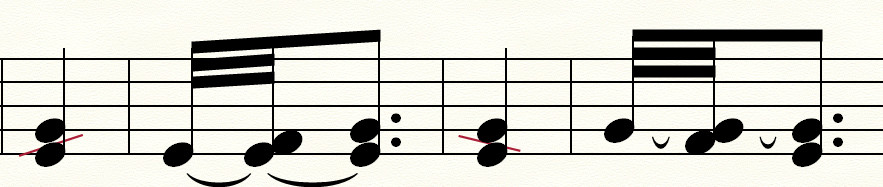
If the line is at an upwards angle, then begin on the lower note, if it is at a downwards angle, then begin on the upper note. It is always played on the beat.
The Pincé
The pincé, or mordent, is a brief alternation between the primary tone and its lower neighbor. All notes of the scale are well-suited to the use of this ornament. The time value of the note that the mordent (pincé) is placed on is generally what determines the number of alterations in the ornament. This rule also applies to trills and appoggiaturas. [2] For the organ and harpsichord, the mordent takes the place of the martèlement (tremolo) on bowed instruments.
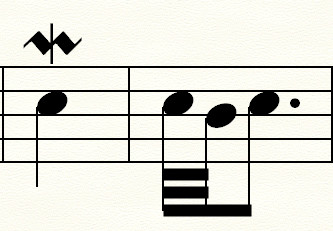
The pincé is often combined with the port de voix to create the port de voix simple which is an appoggiatura followed by a mordent. The term port de voix coulée is just an appoggiatura. In any case, both must be struck with the harmony (on the beat). With these ornaments, the note preceding the grace note should be shortened slightly with the intent of allowing space for the grace note and the mordent to follow. [2]
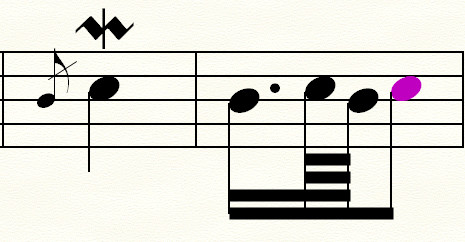
Keep in mind the inégalité of the subdivisions (the pink note should not get half the value of the beat), as this will allow for a freer, more relaxed execution of this rapid combination of ornaments.
The Pincé étouffé
This may be one of the ornaments we are less familiar with today, especially as it is exclusively practical to the keyboard. Also termed the acciaccatura or smothered mordent, this embellishment consists of striking the main note with a neighboring pitch simultaneously, and then quickly releasing the accessory (pink) note. This is only used in detached passages where its abruptness is not out of character. [2]
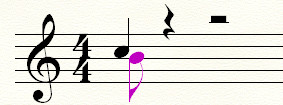
There is a second, and perhaps more well-known definition of a pincé étouffé, which is a note that does not belong to the chord played briefly amongst an arpeggiated chord. For specificity, this version is termed the passing acciaccatura, and the first version is the simultaneous acciaccatura. [2]
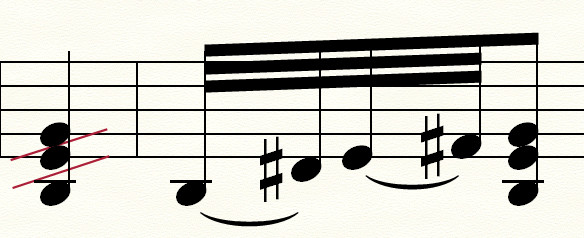
This is very similar to the tierce coulée, especially when it splits a third, and are often used to decorate large, arpeggiated chords in harpsichord music. [2]
Coulades and Tirades
A coulade is the simplest ornament to define. It is any ornament written out by a composer rather than indicated with a sign. [8] This usually allows for greater control by the composer of the ornamental shape, or if there are any modifications to the ornament that they want that are not indicatable by a symbol. A type of ornament that is often written as a coulade is a tirade, (pronounced tiirahd), which simply consists of a rapid scalar passage. [8] Let’s look at a musical example. In the Grigny mentioned previously, we can see an example of this in the same passage:

All of these rapid runs are tirades written out as coulades, which add a dramatic quality to this sequence.
Bibliography:
[1] Couperin, François. 1974. “L’art de toucher le clavecin : = the art of playing the harpsichord.” New York: Alfred.
[2] Donington, Robert. 1974. The Interpretation of Early Music. New version. New York: St. Martin’s Press.
[3] Fuller, David. “Notes inégales.” Grove Music Online. 2001; Accessed 5 Dec. 2024. https://www.oxfordmusiconline.com/grovemusic/view/10.1093/gmo/9781561592630.001.0001/omo-9781561592630-e-0000020126.
[4] Gorce, Jérôme de La. “Lully, Jean-Baptiste (i).” Grove Music Online. 2001; Accessed 18 Nov. 2024. https://www.oxfordmusiconline.com/grovemusic/view/10.1093/gmo/9781561592630.001.0001/omo-9781561592630-e-6002278219.
[5] Higginbottom, E. (2001). Couperin [le grand], François (ii). Grove Music Online. Retrieved 12 Dec. 2024, from https://www.oxfordmusiconline.com/grovemusic/view/10.1093/gmo/9781561592630.001.0001/omo-9781561592630-e-6002278203.
[6] Hitchcock, H. (2001). Charpentier, Marc-Antoine. Grove Music Online. Retrieved 11 Dec. 2024, from https://www.oxfordmusiconline.com/grovemusic/view/10.1093/gmo/9781561592630.001.0001/omo-9781561592630-e-0000005471.
[7] Howell, A., & Sabatier, F. (2001). Grigny, Nicolas de. Grove Music Online. Retrieved 12 Dec. 2024, from https://www.oxfordmusiconline.com/grovemusic/view/10.1093/gmo/9781561592630.001.0001/omo-9781561592630-e-0000011778.
[8] Kreitner, Kenneth, Louis Jambou, Desmond Hunter, Stewart A. Carter, Peter Walls, Kah-Ming Ng, David Schulenberg, and Clive Brown. “Ornaments.” Grove Music Online. 2001; Accessed 25 Oct. 2024. https://www.oxfordmusiconline.com/grovemusic/view/10.1093/gmo/9781561592630.001.0001/omo-9781561592630-e-0000049928.
[9] Laukvik, Jon. 1996. Historical Performance Practice in Organ Playing. Stuttgart: Carus.