Date: 1153
The Scivias
A little over 10 years ago I received a calling to share my visions. The Scivias is my documentation of such visions and declaration that these visions are true from God. It took 10 years to write with the help of Volmar, my former teacher and now secretary, and my favorite nun, Richardis von Stade.
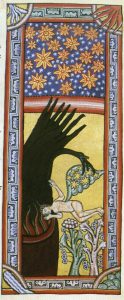
I’ve had quite a few visions about Adam and Eve, but one that I go into deeply in the second vision of my first book which looks at the two in regards to the creation and the fall. First Lucifer fell and soon after so did Adam because of Eve’s temptations. Eve, innocent for she was made from the innocent Adam’s ribs, was easily seduced, as all women are. Women are more susceptible as men are stronger, yet fall weak for those that they love; Adam would do whatever she said to him. 1 This vision shows us how woman can very quickly overthrow man.
I chose to remain a virgin when I was a teenager, but this vision further solidified my beliefs on the matter. Virginity is a most noble act and will earn you glory in the celestial kingdom. Virginity equates the carnal body with glory for it remains unpolluted. 2
The Ordo Virtutum
I composed my Ordo Virtutum, a morality play, soon after finishing The Scivias. My visions actually inspired me to write The Ordo Virtutum, as a shortened version of my play is included at the end of The Scivias. When writing the play I decided not to present any biblical event, saint’s life, or miracle, instead I illustrated the allegorical struggle between the virtues and the Devil.
The play begins by introducing the Virtues, all personified as women, to the Patriarchs and Prophets. The imprisoned souls then beg the Virtues for divine insight, but one soul is tempted by the Devil. As the Virtues define themselves, the Devil opposes those views of the virtues. The soul that was tempted by the Devil eventually returns weakened and stained by her experience and she repents. The Virtues, led by Humility, the Queen of the Virtues, capture and bind the devil as they praise God the Father.3 The play ends by invoking Christ to ask God to accept his suffering as the cure for the ills of a wounded world.4 I chose to have the female Virtues restore the fallen soul rather than the male Prophets and Patriarchs to empower my sisters.5
All major characters of the play, except for the devil, are portrayed by women. And I chose to only give the Devil hoarse croaks of false praise as he shouts his oaths and temptations rather than grant him any music, for music is the imitation of divine harmony and the Devil cannot have it. For the virtues, I chose to give Virtue Castitas the longest speech in praise of virginity. The triumph over the Devil with the trampling of the serpent in Genesis equals the virgin birth of Christ. As the virtues defeat the Devil in the play, virginity prevails as it always will.6
On the topic of virginity, I’ve received backlash on letting my nuns don white veils adorned with gold crowns, but I respond simply by stating the radiant-white robe represents the paradise humans had and lost in the Garden of Eden. Through chastity, my nuns show the innocence of Eden and when they are in heaven standing at the Last Judgment their white veils show their primordial state of blessedness and are of the original feminae forma.7 My Ordo Virtutum celebrates the triumph of the human soul that gets tempted by evil through salvation not from man, but from the virginal soul in the female body.8
Start at 54:13 to hear the Devil’s hoarse croaks of false praise
Symphonia
I decided to compose music after receiving my call to share my visions in 1141. The collection of my liturgical songs can be found in a cycle called the Symphonia armoniae celestium revelationum with music set to my own text. I follow the monophonic chant style that I hear in the church, but I decided to expand the range of my singers beyond what I’ve heard my whole life.9 Much of my music pays homage to the Virgin Mary. I included 16 Marian pieces in my symphonia, but one of my personal favorites is the responsory “O quam preciosa”, which is usually performed after one of the short lessons of the hour.10
O quam preciosa virginia huius que clausam portam habet,
Et cuius viscera sancta divinitas calore suo infudit,
Ita quod flos in ea crevit.
Et Filius Dei per secreta ipsius
Quasi aurora exivit.
Unde dulce germen, quod Filius ipsius est,
per clausuram ventris eius paradisum aperuit.
Et Filius Dei per secreta ipsius
Quasi aurora exivit.
O how precious is the virginity of this virgin who has a closed gate,
And whose womb holy divinity suffused with its warmth,
So that a flower grew in her.
And the Son of God came forth like the dawn through her secret.
Hence the tender shoot,
Which is her Son,
opened paradise through the cloister of her womb.
And the Son of God came forth like the dawn through her secret.11
This responsory celebrates the miracle of Jesus Christ with a focus on the anatomy of Mary. This bodily focus on Mary serves as a metaphor for my monastery. My sisters fill the cloister of the Virgin’s womb with their songs of praise. I mention the secret of Mary’s Virgin body throughout the responsory, a secret that only myself, Christ, and my fellow virgin sisters know.12
Another one of my works from Symphonia, “O vos angeli”, looks at the suffering of the soul. This antiphon illustrates one of my more peculiar visions on the order of the angels.
O vos angeli
qui coustoditis populos,
quorum forma fulget
in facie vestra,
et o vos archangeli
qui suscipitis
animas iustorum,
et vos virtutes,
protestates,
principatus, dominationes
et troni,
qui, estis computati
in quintum secretum numerum,
et o vos cherubin
et seraphin,
sigillum secretorum Dei:
Sit laus vobis,
qui loculum antiqui cordis
in fonte asspicitis.
Videtis enim
interiorem vim Patris,
que de corde illius spirat
quasi facies.
Sit laus vobis,
qui loculum antiqui cordis
in fonte asspicits.
Oh you angels
who guard the peoples,
whose form gleams in your face,
and O you archangels,
who recieve the souls of the just,
and you virutes,
powers,
princedoms, dominations,
and thrones,
who are counted in the secret number five,
and O you cherubim
and seraphim,
seal of the secrets of God:
Praise be to you,
who behold in the fountain
the little place of the ancient heart.
For you see
the inner strength of the Father,
which breathes from is heart,
like a face.
Praise be to you,
who behold in the fountain
the little place of the ancient heart.13
I’ve divided the angels into a few groups- the angles and the archangels who represent body and soul, the cherubim and seraphim who signify the knowledge of love and God, and the five orders corresponding to the five senses and five wounds of Christ.14 As I mentioned earlier, my compositions differ from Gregorian chant I usually hear in the church because I extend the range more than my contemporaries. I decided to give “O vos angeli” a wider range than any other composition in my Symphonia. I used melismas throughout “O vos angeli” to explore the range of the voice as well as show the ascent of the soul.15 This text talks not only about the powers of the angels, but also much to my dismay, the human inability to reach God. Through the composition of my antiphon, the listener will have no choice but to understand our bodily inferiority.16
1 Hildegard of Bingen, Scivias (New Jersey: Paulist Press, 1990), 77.
3 Audrey Ekdahl Davidson, “Music and Performance: Hildegard of Bingen’s Ordo Virtutum,” in The Ordo Virtutum of Hildegard Bingen: Critical Studies, ed. Audrey Ekdahl Davidson (Michigan: Medieval Institute Publications, 1992), 1-29
4″Hildegard of Bingen (1098-1179): Ordo virtutum: Closing chorus, In principio omnes,” in Norton Anthology of Western Music, Volume 1: Ancient to Baroque, Seventh Edition, ed. J. Peter Burkholder and Claude V. Palisca (New York: W. W. Norton & Company, 2014), 36-38.
7 Pamela Sheingorn, “The Virtues of Hildegard’s Ordo Virtutum; or, It Was a Woman’s World,” in The Ordo Virtutum of Hildegard Bingen: Critical Studies, ed. Audrey Ekdahl Davidson (Michigan: Medieval Institute Publications, 1992), 43-62.
9 Holsinger, Bruce W. “The Flesh of the Voice: Embodiment and the Homoerotics of Devotion in the Music of Hildegard of Bingen (1098-1179).” Signs 19, no. 1 (1993): 92–125. http://www.jstor.org/stable/3174746.
10 Holsinger, Bruce W. Music, Body, And Desire in Medieval Culture: Hildegard of Bingen to Chaucer. California: Stanford University Press, 2001.
11 Saint Hildegard of Bingen. Symphonia: A Critical Edition of the “Symphonia Armonie Celestium Revelationum” (Symphony of the Harmony of Celestial Revelations). 2nd ed. Cornell University Press, 1998. http://www.jstor.org/stable/10.7591/j.ctv75d3k2.