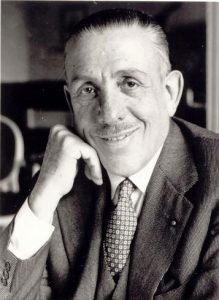
As a performer in the arts, I had heard of Poulenc before but nothing quite as intimate as Moore describes with Poulenc’s relationship with his own music. One composition that Moore talked about was the piece Aubade.
From an oblivious perspective, this is just a woman named Diane who is rebellious and abandons the virgin community to experience fiery love. But I have to say that I don’t think Moore went too far as to talk about these pieces being about Poulenc’s sexuality, in fact, it is justified and convincing.
One of Poulenc’s pieces that are analyzed in Moore’s article is Aubade. In Moore’s article he says that “Wilfred Mellers believed that Aubade had ‘autobiographical undertones,'” and more recently Richard Burton suggested that the work is “‘clearly expressive of some deep conflict within the figure of Diana”‘ 1 It is quite clear that Poulenc is talking about himself and his new relationship with Richard Chanlaire which was new and exciting after getting rejected by Raymonde Linossier. He is breaking his “virginity” or heteronormative ways and being transcended into love with a man, labeling him as gay or breaking his purity. It was not accepted, thus he put his emotions and thoughts into characters and music.
Poulenc’s scenario could be seen as an allegorical commentary on his struggles with his homosexuality near the end of the 1920s.2 As mentioned above, he most likely felt with this figure of Diana and centered on the theme of sexuality. I believe that music was a safe spot to express one’s feelings even more than writing. Music is received differently by different people and this was the most productive way to express sex in music.
1“Camp in Francis Poulenc’s Early Ballets.” The Musical Quarterly 95, no. 2/3 (2012): 321, http://www.jstor.org/stable/41811629.
2 Ibid. 321