Surprisingly, the French debates over national musical identity are not that unfamiliar. In a world that often feels politically and culturally insecure today, it seems that America is seeking to redefine itself and its culture just as composers and musicians sought to establish a musical identity that was uniquely French.
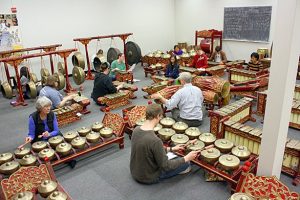
Efforts made to define national identity served as a central influence to many French composers of the early twentieth century. Musical characteristics that individuals identified as “uniquely French” were infrequently the sole product of French ideas and innovation. They often took inspiration from other existing music in an attempt to escape the domination of German and Russian-centric musical structures and harmonies.[1] Satie’s Parade (1917) represents the “otherness” of American identity in the Ragtime du paquebot by referencing Irving Berlin’s That Mysterious Rag (1911). Many of Claude Debussy’s works were inspired by the Javanese Gamelan that he first heard at the 1889 World’s Fair. Maurice Ravel was drawn to Ancient Greek topics in his compositions, while Darius Milhaud took inspiration from a variety of global musical ideas.[2] Yet, one common thread runs between all of these composers; they each worked to define French identity through music. In their definitions, the concise exclusion and inclusion of certain musical influences alludes to strong, nationalistic tendencies. To author Ernest Gellner, defining nation and nationalism mandates a separation of what a nation is, but also what it is not.[3] Overall, this inclusion and exclusion is an aspect of the relationship between music and identity that I am most comfortable with. I can frequently see attempts at defining culture in my own life and, more broadly, in the United States. Often, we see our government and its constituents in conflict and conversation over what ideals America should represent and what should be excluded in our perpetual discourse over defining Americanness through art.
One of the least comprehensible aspects of debates over French musical identity, for me, lies in conflicts rooted in cultural criticism towards others’ musical compositions and stylistic choices. I often think of the experience of writing music as an inward conversation between existing compositions and individual consciousness. Darius Milhaud most eloquently describes this thinking in his work, The Evolution of Modern Music in Paris and Vienna. He says that, “What gives life to a work, what makes it true, will never be its characteristics, polytonal or atonal, but rather, its essential melody. Thence springs its real power, because it comes straight from the heart of the musician.”[4]
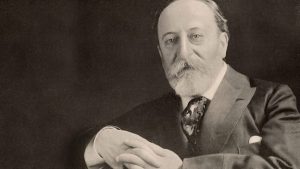
The conflict that arose between many prominent art figures is almost inconceivable to me. Jean Cocteau’s Cock and Harlequin highlights the evident disdain that he held for German and Russian composers as well as Debussy’s works.[5] The Société Nationale de Musique developed with a desire to found a national art form.[6] Its most well-known members and leadership included Gabriel Fauré, César Franck, and Camille Saint-Saëns.[7] Yet, the next, younger generation formed the Société Musicale Indépendante because they believed that the Société Nationale became too conservative.[8] These conflicts are rooted in the different conceptions of French identity composers had through music. Further, it is evident to me that composing music expanded beyond the self and had a broader, political purpose. I have never really considered this idea a possible motivation for musical composition.
Ultimately, I think that the debates about French music and identity are extremely complex. While I feel like I have a strong grasp of many of the cultural and musical factors at play in the search for French musical identity, many still remain foreign. The start of the semester has been fascinating, and I am excited to continue to explore and enhance my understanding of all that I have yet to fully comprehend.
[1] Cocteau, Jean. Cock and Harlequin. Notes Concerning Music. London: Egoist Press, 1921., Milhaud, Darius. “The Evolution of Modern Music in Paris and Vienna.” The North American Review, April 1923, 544., Ravel, Maurice. “Une Conférence de Maurice Ravel.” Revue De Musicologie. (December 1964): 208–21.
[2] Milhaud, “The Evolution of Modern Music in Paris and Vienna”, 544., Ravel, “Une Conférence de Maurice Ravel.”, 2018-21.
[3] Gellner, Ernest. Nations and Nationalism. Malden, MA: Blackwell Publishing, 2013.
[4] Milhaud, “The Evolution of Modern Music in Paris and Vienna”, 544
[5] Cocteau, Cock and Harlequin. Notes Concerning Music.
[6] Bauer, Marion. “Nationalism in France: ‘La Societe Nationale De Music,” Cesar Franck and His Followers.” In Twentieth Century Music: How It Developed. How to Listen to It. 74-84. New York, NY: G.P. Putnam’s Sons.
[7] Ibid.
[8] Ibid.