We all know the couple, the one we constantly watch with curious eyes as their relationship continues, even if it shouldn’t: the couple who is always on and off again. Whether in movies or in real life, toxic relationships are an unfortunate reality of human love. Often characterized by imaginary expectations, manipulation, conquest, inconsistency, fleeting infatuation, a lack of mutual respect, or unrequited feelings, these relationships can be harmful to both parties involved. Although they may contain love, it is typically not the kind that can be healthy, sustainable, respectful or beneficial.

Parisian audiences of the 1920s certainly enjoyed jazz and may have considered their feelings toward it to be love, but the relationship between African culture and Parisian audience resembles what modern readers might call a toxic relationship.
The French may have loved African culture, but they loved it because of what they imagined it to be, not what it truly was. Much of their appreciation for jazz came from an understanding of black culture as primitive and “other,” something to be used and refined, not to be purely appreciated as its own profound art . Reviews and news articles reporting on the performances of Josephine Baker demonstrate these sentiments (Jordan, 106). The French fascination with jazz also lumped together African and African-American cultures, considering them to be more similar than different, and simplifying cultural identity for their own ease of use (Gendron, 106). The mass simplification and reduction of African and African American culture created an imaginary idea of “nègre” art, which eventually led to its manipulation and commodification by infatuated Parisian audiences (Gendron, 107).
France’s negrophilia, or the mass fetishization of African and African American art and culture, allowed the country to invigorate its own musical traditions. Milhaud’s La Création du Monde is a strong example of the ways in which French composers incorporated or manipulated Jazz or blues influences to create a new and popular kind of French music (Watkins, 117). Although some composers recognized the contributions of black artists, others did not.
Many lacked a respect for black culture that would force them to acknowledge its artistic brilliance in a genuine way. Andre Levinson wrote, “With the mulattos and the quadroons of the Revue Nègre, who took Paris by storm in 1925, this sense of rhythm was more of a physiological–I am tempted to say glandular–phenomenon, allied to their excessive hysteria and their unbelievably high animal spirits” (73). Even when praising, the French reduced African culture and artistic success to a kind of primitive racism and zoomorphism.
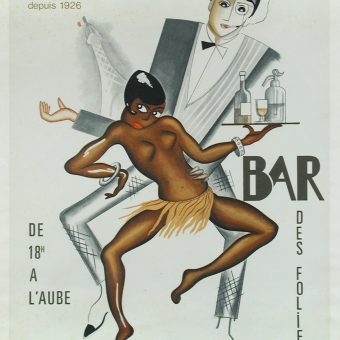
Due to this reduction the French were free to “use” black artistic and musical elements without consent or payment. France may have seen itself as the dominant power in this relationship, perhaps the masculine or colonizer, and black culture the feminine or the colonized. In which case, France was free to use the materials of the colonies because “superior” French art was lifting the primitive “other” into high society.
Like many other unhealthy relationships, the French infatuation with African culture was rather fleeting, and was eventually condemned by many critics who recognized the threat of American influence (Jordan, 109-110). Despite the nature of the relationship between French audiences and black musical traditions, negrophilia did play a large role in increasing the popularity and success of some black artists and musical traditions.
In the past few decades, hip-hop and rap music have slowly become more mainstream, and this year, the Superbowl half-time performance was completely dedicated to these genres. However, only a few short years ago, many parents instructed their children not to listen to hip-hop and rap. These days, most pop songs feature some rap or hip-hop elements, and new rappers and hip-hop artists commonly receive awards, media attention, and fame. Parisians may not have assessed their relationship with African American culture in the way Americans can now. Today, American society is intensely critical about how we engage with the material of other races, cultures, and religious practices, but we still make many mistakes. Therefore, we can and should continue seeking to learn and understand the ways to develop healthy relationships with other cultures and their materials.