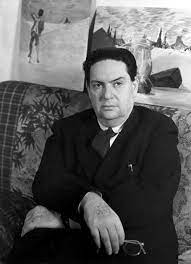
One source that has been especially useful to me is the magazine article “The Evolution of Modern Music in Paris and in Vienna” that Milhaud himself wrote. Naturally, because this is a primary source of the figure I chose, there is a directness available to me that would not otherwise be there. I know that what is written on the page is the opinion of Milhaud. His compositions of course contribute to his impact on French music, but just as importantly, so does his discourse. Whether we like it or not, discussion has the ability to directly impact how people think and write about the same – or similar – subjects. This applies to modern day, as well as the past. By advocating for composers such as Debussy and Satie, Milhaud is knowingly bringing their names and their styles forward in hopes of convincing others of his opinion. Describing French music – specifically that of Satie – as, “… renewed because of its plainness and purity, the spirit of French music, free from all foreign weight” (Milhaud 448) is showing us what Milhaud deems this to be valuable knowledge. This is how he makes his case, and this is how Milhaud contributed to French music through discourse.
With this knowledge, let’s listen to an example of what Milhaud argues is quality French music. In Satie’s “Socrate” the characteristics that Milhaud deems uniquely French are prominent.
The tenor melodic line is very much highlighted, and there are few musical embellishments from the orchestra. This so-called plainness, as we’ve established above, is one quality that Milhaud contributed to the discussion of French music. It’s no wonder he described it as, “… having a sureness and authority which only perfect works possess” (Milhaud 449). Of course, the opinion of Milhaud is not absolute. There are many interpretations of music from the time, each one as valid as the next. But just taking a close look at Milhaud, we can see that this “sobriety” and “plainness” is crucial to his idea of what French music should be.
Milhaud, Darius. “The Evolution of Modern Music in Paris and in
Vienna.” The North American Review, Apr. 1923, pp. 544–553.