Many of our class sources that have discussed national and cultural identities in music have served as extremely applicable to my understanding of Ida Rubinstein’s contributions to “French” music during her career. The most recent and idea-striking reading I have encountered so far is James Parakilas’ “How Spain Got a Soul,” in which he asserts that Maurice Ravel (1875-1937) engaged in a different type of Spanish exoticism than his contemporaries, due to his personal cultural connections to Spain. Ravel’s cultural upbringing, including childhood memories of his Hispanic mother’s guajira (songs which freely alternate between 3/4 and 6/8 time) lullabies, gave him an insider’s knowledge of Spanish culture which other composers did not necessarily have. For example, his Chansons Madecasses features solo mezzo voice for three long songs, which could very well be a direct allusion to his own mother’s voice. The most specific reference can be heard in the first of three movements of Chansons Madecasses, as it uses guajira-like 3/4 time rhythms between 1:22-2:04. This Spanish identity allowed him to contribute a more culturally-authentic (although still self-exoticizing) Spanish style of music to the French repertoire than any other “musicians for whom Spain was simply exotic” (Parakila 184). And because Ravel was also immersed in French culture (as he was born and raised in France), I have come to label his identity as a (general) cultural “dual-citizenship” between France and Spain.
Parakila’s observations automatically struck me as a direct parallel to the identity of my research subject, Ida Rubinstein (1883-1960), who was born to Jewish Ukrainian parents and lived in the Ukraine, Russia, and France during her lifetime (Garafola 1999). Like Ravel, Rubinstein engaged in self-exoticization while starring as leading roles in Russian and French ballets. Lynn Garafola also notes in her article that Rubinstein’s “dark, exotic looks” gave her leverage and distinction when performing for Paris audiences (Garafola 1999). Rubinstein’s background training in Russian theater at the Moscow Theatre School, her physical appearance, and her later experience in French ballet performance during the early 1900s, all worked in tandem to raise her to exotic fame and shocking influence in French musical setting of ballet. As you can observe below, she used her distinct features (which would have looked exotic to native French citizens) to draw public attention.
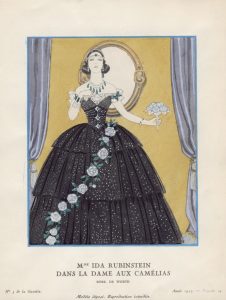
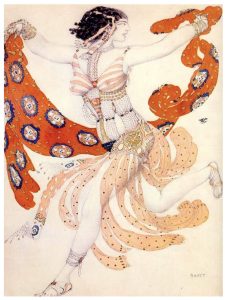
Using Parakilas’ concept of Ravel’s cultural duality, I conclude that Ida Rubinstein used Ravel’s technique of self-exoticization through performing in exotic roles in French ballets, which granted her influential power to display the exotic “temptation of the East” in the realm of early 1900s French music (Garafola 1999).
Works Cited:
Casares, D., 2022. Guitarreria Alvarez & Bernal – Daniel Casares “Guajira”. [online] Youtube.com. Available at: <https://www.youtube.com/watch?v=EEyxrBtzRGw> [Accessed 3 March 2022].
Garafola, Lynn. “Ida Rubinstein.” Shalvi/Hyman Encyclopedia of Jewish Women. 31 December 1999. Jewish Women’s Archive. (Accessed 24 February, 2022) <https://jwa.org/encyclopedia/article/rubinstein-ida>.
James Parakilas, “How Spain Got a Soul,” in The Exotic in Western Music, ed. Jonathan Bellman (Boston: Northeastern University Press, 1998), 184-188.