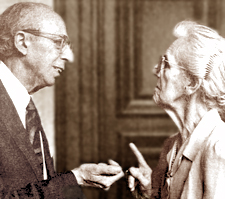
Copland has always been one of my favorite composers, his piano sonata has been a favorite piece of mine for years. So before a lot of my research that I’ll discuss below, I had very high opinions of him and his composing, and in turn, his relationship with Nadia Boulanger. But my sources are conflicting; I’ve found it disturbing to learn that Copland tried to deny Nadia’s influence on his music and give more credit to men that he worked with, like French writer André Gide or his American friend Harold Clurman, and Les Six, whom he encountered only once in person (Fauser).
In the article by Fauser we read in class, we talked about how the French taught Copland that American-ness is low-culture compared to French (like negrophilia), and that jazz is a great modern genre from the French fascination with jazz (example: Milhaud). The French also focused on stereotypes of Americans like simplicity and industrial-ness. Copland embraces these French-created American stereotypes and helps develop more positive ones, like the American plains pastoral imagery and folk song integration. American music was mocked as sloppy, heavily rhythmic (polyrhythmic), like mechanical factory sounds. These were negative associations that French composers and music critics in general made about American music, and these points of view, in turn, affected the way Copland composed American music with the aid of Nadia Boulanger. He was told to devote himself to writing about what Americans are good at, not music (Fauser).
The accounts of Copland’s opinion on Boulanger differ depending on the source I choose. At one moment he’ll say things like “Nadia Boulanger knew everything there was to know about music” (McCallum), and compliment her further, and some sources will spin their relationship to be friendly and peaceful, with Copland giving due credit and respect to her. Then in the very same source, he’ll admit he’s timid to tell his family he’s studying with a French woman (Callum) or in another source, claim that women have “innate mental blocks” that prevent them from composing large scale works (Ross). I also remember discussing that Copland made some forceful claims about how even though Boulanger was his first and possibly most influential teacher, he still believed she was lesser than him simply because she was a woman. (I cannot find the source that comes from or remember what day we discussed that, so please let me know if you remember!)
I find it disturbing that a person can both appreciate their teacher, and then slander them and other women simply because of their gender. But I suppose this is a trend in history, and I shouldn’t be surprised. It’s certainly tainted my original view of Copland, though, and I’m not sure if I can look at his music the same way again.
Works Cited:
Fauser, Annegret. “Aaron Copland, Nadia Boulanger, and the Making of an ‘American’ Composer.” The Musical Quarterly, vol. 89, no. 4, Oxford University Press, 2006, pp. 524–54, https://doi.org/10.1093/musqtl/gdm005.
McCallum, Wendy M. Pedagogical Style and Influence of Nadia Boulanger on Music for Wind Symphony, an Analysis of Three Works by Her Students: Copland, Bassett, and Grantham. ProQuest Dissertations Publishing, 2004, pgs. 30-35.
Ross, Alex. “Even the Score. Female composers edge forward.” The New Yorker, 2022. [Accessed 25 April 2022] Available at: https://www.newyorker.com/magazine/2013/04/29/even-the-score