The question of whether Parisians truly loved, respected, and celebrated African American artists requires delving into the specific definitions of these three verbs as well as “Parisians” and “African American artists.” First, it is difficult and probably inaccurate to define, nevertheless assign a fully-mutual sentiment to, every member of a large group of people. For the sake of this argument, I will narrow “Parisians” down to mainly Parisian critics and performance directors of the time, assuming that some of the lay Paris population’s beliefs might have been influenced by the literature or performances they produced. I will narrow “African American artists” down to what Parisian critics themselves perceived and defined as “black art,” rather than the full, true cultural art that the French often stereotyped and misunderstood. From the get-go I will assert that Parisian critics did not truly engage with authentic black art. As Gendron quite accurately summarizes, the French “redesigned [productions] to fit French expectations” of black stereotypes, so that “the Africaneity of the Creation [du mond] was Africa-Americanized by the tonalities of jazz, [and] the African American entertainments of the Revue [nègre] were Africanized by the interventions of the French imaginary.”1 If the French had no knowledge of what black art truly consisted of, there is no way they could have attempted to love, respect, or celebrate its true entity.
The Parisian interpretation of black artists and their art centers on primitivism, a racist term that has been used both by modern scholars of French critics’ writings and by the French critics themselves. Primitive qualities that the French identified in black art include, for example, “bewildering syncopation and rubato,”2 “emotionalism” and “nostalgia…for a world that had been lost” to civilization,3 and “pastoral” timbres of Harlem ensembles and rhythms of ragtime and blues.”4 French critics perceived these musical elements as innate racial characteristics of black performers.
To analyze whether 1920s Parisian critics truly loved African-American artists, I am purposefully excluding the sinless and selfless agape definition of love, since it is often difficult to come by in human actions. If we define “to love” as to feel admiration for, enjoyment of, and perhaps sexual attraction toward something, many Parisian critics fit the bill. Some commentators praised the ” ‘rhythmic surety’ of the dancers” and the “communal harmony normally lacking in the French music hall.”5 Specifically in response to black artist Josephine Baker’s increasingly famous performances, writer Pierre de Regnier complements her embodiment of “the ‘primitive’ spirit” as ” ‘pure modern art! It is magnificent!’ “6 Other critics pointedly focus on Baker’s explicit display of sexuality. Levinson highlights the “carnal magnificence” emphasized in her “poses, back arched, haunches protruding, arms entwined and uplifted in a phallic symbol.”7 Similarly, Jaques Patin wrote for Le Fiargo about how “She bends, undulates, bounces, stoops…shaken by a kind of rhythmic convulsion” in her performances.8 Such comments as these present a genuine admiration for black artistry, though some of which lean more heavily towards flat-out infatuation.
Despite any earnest praise they may have given, many French critics and show producers pushed this infatuation far enough to disrespect the bodies and, as a result, the humanity of black artists. From Baker’s dances, as seen in her rigorous banana dance in the video clip below, it is clear that her choreographers’ goal was to make her appear as ridiculous as possible by means of bent-over, angular poses and cross-eyed faces:
(1925) Josephine Baker Dancing the Original Charleston. Youtube, 2014. https://www.youtube.com/watch?v=jEH6eDpjgRw.
In her dance Plantation, which can be viewed in entirety in the clip below starting at timestamp 2:13, Baker’s moves transition from seemingly mimicking a mechanical windup toy, to displaying the bouncy self-entertainment and grumpy, trudging tantrums of a child, to almost schizophrenically interacting with invisible things onstage. Each of these references would have belittled her authority as an adult professional performer, not to mention as a human, in the eyes of a 1920s Parisian audience:
Plantation: Avec Joséphine Baker Et The Thomson Jazz Orchestra. La Revue Des Revues. Youtube, 2009. https://www.youtube.com/watch?v=cOdPGZkQaFE.
The costumes assigned to Josephine Baker were just as ridiculous and explicit as her dances, if not more so. For the banana dance, she was made to wear a costume that consisted of a nearly-absent bikini top, gigantic jewelry, golden sandals, and a golden banana skirt — quite literally made of phallic-like bananas, as photographed below:
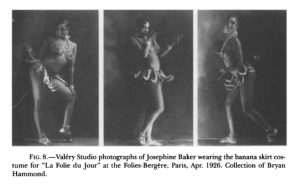
After this analysis, I make my case that many French critics and producers had a genuine love for and/or infatuation with black artists and their cultural art. However, when fueled by racist ideology, certain critics and producers’ sentiments dehumanized and objectified African artists, one of whom specifically being Josephine Baker. The French celebrated black artistry in a back-handed way, praising their skills while simultaneously confining them to animalistic primitivism.
When taking this observation into account today, my mind goes to a song I learned at a language immersion camp. The program intentionally incorporated songs in languages that were different even from the language of our camp — in the French Village, one free time option was to learn a choreographed dance to a few foreign songs. One of my favorites was Tunak Tunak Tun by Indian artist Daler Mehndi:
https://www.youtube.com/watch?v=vTIIMJ9tUc8
Tunak Tunak Tun – Daler Mehndi|Official Video|Sanjeev Anand|Shahab Allahabadi|Yogesh. Youtube, 2014. https://www.youtube.com/watch?v=vTIIMJ9tUc8.
Born in India, he writes and performs songs in the Bhangra and Indi-pop genres, including the hit song Tunak Tunak Tun which “was the biggest ever for a South Asian pop singer.”9 Bhangra began as traditional dance music for harvest festivals, but Punjabi artists in the United Kingdom later incorporated Western pop styles to the genre.10 Mehndi explained that the most important element in modern Bhangra music is ” ‘The foundation of the rhythm,” noting that “The moment it’s played you can’t help but sway involuntarily…it inundates your very soul instantly, leaving you exhilarated and happy.”11 Interestingly enough, his description of the importance and effect of rhythm echoes what French critics noted about African music. Levison in particular asserted that rhythm is the most fundamental element in black music, so much so that “The savage or folk dancer is essentially an instrument of percussion.”12 Oddly paralleling Mahndi’s statement, Levinson centered his essay on the idea that “The primitive, human instinct is violently affected by such rhythmic insistence. The monotony…has the effect of a narcotic…[and creates] a sense of exhilaration.”13 Unfortunately, Levinson’s opinion, amongst those of other French critics, was twisted by the racist conception that blacks embodied this primitive instinct because of their African heritage, notable by the color of their skin. In order to avoid perpetuating this racist sentiment today, whether admiring Bhangra music or that of another culture, it is vital that we as consumers respect all foreign artists first as dignified human beings. We must recognize also that “different,” whether in rhythm, tuning, or style, does not equate to “primitive,” as there are many ways of expressing the beauties of music. After these values, the world’s musical diversity is open to us to be thoroughly loved, respected, and celebrated.
1 Bernard Gendron, Negrophilia, 115-16.
2 André Levinson, The Negro Dance, 72.
3 Jeffrey Jackson, Making Jazz French, 87, 89.
4 Glenn Watkins, Pyramids at the Louvre, 117.
5 Matthew Jordan, Le Jazz, 108.
6 Ibid., 109.
7 Levinson, Negro Dance, 74.
8 Jordan, Le Jazz, 106.
9 Billboard, “Bhangra Beat,” 100.
10 Ibid.
11 Ibid.
12 Levinson, Negro Dance, 71.
13 Ibid., 72.
Works Cited
André Levinson, “The Negro Dance: Under European Eyes,” in André Levinson on Dance: Writings from Paris in the Twenties, ed. Joan Acocella and Lynn Garafola (Hanover: Wesleyan University Press, 1991), 69-75.
Bernard Gendron, “Negrophilia,” in Between Montmartre and the Mudd Club: Popular Music and the Avant-Garde (Chicago: University of Chicago Press, 2002), 103-116.
“Bhangra Beat Transforms IndiPop Scene.” Billboard, September 25, 1999. Pages 1, 100-102. https://books.google.com/books?id=cAgEAAAAMBAJ&pg=PA101#v=onepage&q&f=false.
Glenn Watkins, Pyramids at the Louvre: Music, Culture, and Collage from Stravinsky to the Postmodernists (Cambridge: Harvard University Press, 1994), 112-18.
Jeffrey Jackson, Making Jazz French: Music and Modern Life in Interwar Paris (Durham: Duke University Press, 2003), 71-103.
Matthew Jordan, Le Jazz: Jazz and French Cultural Identity (Urbana-Champagne: University of Illinois Press, 2010), 102-111.