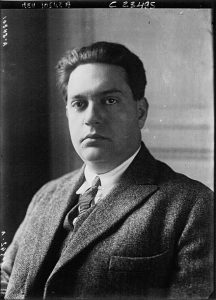
One Parisian who certainly thought he had a true love for jazz music was Darius Milhaud. He made a point to visit places like Harlem and New Orleans in America to observe jazz musicians for himself, where he decided that jazz was indeed its own art form (Gendron). Unfortunately, most French modernist composers, aside from Cocteau and Milhaud, got their first glimpse of jazz from white interpreters in Paris (Watkins). I think Milhaud put in a lot more effort to understand jazz than most of the other white French modernists, like Satie, Poulenc, and Les Six. But unfortunately, his “love” for jazz, and his attempt to trailblaze a new kind of popular modernism, was still severely flawed.
Millaud’s La Creation du monde, was the first attempt by French composers in Paris to incorporate jazz into classical composition. The sound was a new kind of modernism using popular music, not just folk tunes, and it had never been done before. La Creation features a blues scale throughout the piece, which shows an appreciation for and proper use of jazz tonality (Gendron). A lot of his orchestration choices are also fairly authentic to what he heard in jazz music performed at the time, like his use of saxophones and percussion. But his commentary reveals not only the twisted meanings behind his orchestration choices, but the blatant racism and misunderstanding of jazz. He says that the percussion is “crude and barbaric… the percussion background provides the necessary barbaric atmosphere, and the the jazz inflections of the tune suggest a stylized negro speech” (Watkins).
Milhaud clearly lacked the cultural background information that would save him, or at least discourage him, from stereotyping and fetishizing Black people and their music. He also took part in blurring the origin stories and cultures of different nations within the massive continent of Africa, erasing their differences and making them a monolith in Parisian culture, and then finally “othering” them as primitive (Watkins). So although Milhaud put in the most effort to understanding Black music, it seems to have all been in vain since he never was able to realize the differences between African-American jazz, African music, and different nations within Africa, all having their own cultures and music.
Our judgments upon composers like Milhaud are easy to make when we can look at all the events that occurred before, during, and after his lifetime. It’s so simple to look at his writings on jazz and condemn him for his misunderstanding, and then forget that we are also consuming this music today, and our understanding of it may also be flawed. We must look into our own appreciation and “love” of marginalized music to make sure we aren’t doing the same thing Milhaud did. The recent resurgence of Inuit throat-singing on TikTok could fall into this category. It’s hard to know if everyone newly enjoying throat-singing who isn’t Inuit is properly educated on the topic and the meaning, or if they are just stereotyping it and primitivizing the sounds they’re hearing.

Sources: