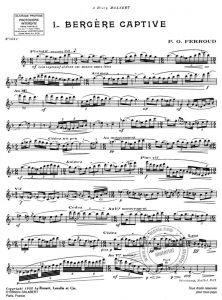
At the beginning of the semester, the extent of my knowledge of 1920s French music could be found in “that one time we talked about Erik Satie in Introduction to Musicology”, my affinity for playing early 20th century unaccompanied flute music, and the program note I wrote about Francis Poulenc’s Laudamus Te for St. Olaf’s Christmas Fest.
As I reflect on all of my research for the class, one theme that has triumphed over all of the others is nationalism. More specifically, the deeply rooted quest for French national identity. It seems that you cannot approach gender, sexuality, race, or class without at least a whisper of nationalism or a mention of France’s musical or cultural identity.
Staunchly opinionated composers and members of French society strove to establish and exemplify their own definitions of French music in their compositions. Jean Cocteau, Erik Satie, and members of Les Six sought the creation and formation of a new French music. Cocteau’s Le Coq et L’arlequin gives us some inside information into their perspectives. The conflict I explored while researching the Société Nationale de Musique told me that the identity of musical France was contested. Certain characterizations of French music were socially motivated: after all, the Société Musicale Independante formed because of a conflict in social values. Maurice Ravel took his own approach to exoticism, distinctive from Josephine Baker’s. Each of the examples I have laid out tell me one thing. Paris was not without its own internal conflict and there was no clear cut definition of what “French music” really should’ve been.

French music of the 1920s broke age-old, traditional boundaries. In defying the social norms, French composers created their own new boundaries. They turned away from the “Wagneriennes”, away from sounds heard in recent French past, and towards different sounds, unfamiliar to the average French ear.
For the first day of class, before we had met, we were asked to watch the opening title sequence from Woody Allen’s Midnight in Paris. We were then asked to come to class with six words or less to describe how we perceived musical life in Paris from our (or at least my own) limited understanding based on a couple of readings and this video. I wrote that it seemed like 1920s musical Paris was “politically informed” and that there was a “strive for change.” On some level, I think I got it (at least part of it) right. Social, race, gender, and class politics all seem to have informed musical life in Paris. And, if I haven’t made it clear yet with these six blog posts, there was truly a desire to move away from what was expected of a classical music composer. I leave this class understanding 1920s musical Paris to be an intricate web of relationships, personal motivations, and conflicting social values that amassed into a large network of performances, new styles, and compositional choices that are unique to the time. I also come away from this class understanding that, myself, as a critical thinker, reader and listener can only situate the events of the past within my present understanding of the what we are evaluating. There are certain things I will never understand, but there are also new claims and arguments that I can bring to the table from an evaluative look into the past. While Gallica and Retronews offer us a “primary source peek” into the time, we surely cannot boil down 1920s Paris life into a few words or experiences. Certainly, we need more than six!