Paris’s reputation of being a cultural epicenter still is embedded in today’s modern worldview. Filmmakers, fashion designers, artists, students, and even the average tourist dreams of heading to the city that’s known for its embracing of the avant-garde, the romantic, and the new. When looking back on 1920’s Paris and its music scene in particular, the themes that stick out to me the most are those of class and gender/sexuality. I saw these two lenses overlapping quite often, especially when studying the ideas of patronage and the ballet companies that dominated the Parisian entertainment scene in the early 20th century.
Gender and sexuality seem to play a large part in modern music, especially the music that emerges in theater and pop culture. The music industry has certainly not always been accepting of female/LGBTQ+ creators, but recognizing and analyzing the composers and patrons of 1920’s Paris who didn’t fit into the “straight man” mold proves how music and art became a sort of freeing medium for the commonly disenfranchised. This is not to say that all women should become composers or that all gay men are naturally fantastic musicians. Rather, I think it highlights how those who were discriminated against found ways to infiltrate the popular entertainment scene through navigating the complicated class system of Paris. For example, the Princess de Polignac, who was gay herself, used her own wealth and political connections to create a space for other LGBTQ+ folk to congregate without much anxiety.1 Therefore, other women and queer creators could meet one another and not only create strong connections of friendship, but ones that created opportunities as well. Additionally, many of the composers we studied were queer themselves. If we take Cocteau and Poulenc for example, while they may have had anxieties about their own sexualities, they were able to obtain success in a cutthroat industry despite the obstacles that queer people faced (and face) every day.
In regard to class, the music-hall culture of Paris and the ballet companies showed the importance of patronage and wealth acquisition in order to obtain a sense of power in the entertainment industry and help to implement new artistic trends. I believe that each of our three papers helped to highlight this lens in one way or another. For example, in our first papers, we were to choose figures who made important contributions to Paris’s musical life in the 1920s. Each of these figures, despite their origins, managed to navigate the classist world of Paris in order to make their contributions. Coco Chanel was an influential designer and therefore a successful patron, Ida Rubinstien created a famous and monetarily successful ballet company, artists such as Georges Braque and Picasso inspired and contributed to art movements, and so on. Not only were we able to focus on different influential figures, but we were given the opportunity to delve deeper into the music-hall and theater scene of Paris and how these halls relate to class, wealth, and contributed to the success or failure of new artistic ideas. In addition to studying institutions and figures, the opportunity to pose as a critic in 1920’s Paris forces us to adopt a lens from which to view a piece of music. To adopt the mindset of someone who lived 100 years ago takes intense research and the ability to argue a point you may not agree with yourself. For example, as a critic I adopt an extraordinarily nationalist view of the world, even though I don’t think that way in my everyday life. As critics we can enforce the elitism of music in Paris, or decided to denounce it.
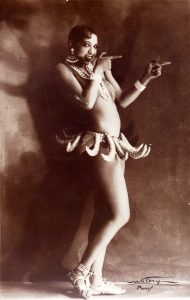
Another theme that I definitely think is worth quickly mentioning is that of race because I think it relates back to class and gender/sexuality. The obvious fetishization of black people in Paris is impossible to avoid. While composers such as Milhaud relied on exoticism, in a sense, they were able to take musical trends that originated from black people and adapt them into their white music.2 Therefore, the ones truly receiving the fame and credit are the white, often male composers with money and a platform. If a black creator wanted to be successful, then, they had to force their way in to a racist society. Josephine Baker obviously acts as the best example of this phenomenon. As a woman, she was at a disadvantage. As a black woman, she was even more destined for failure in a racist society. In order to combat this and rise to the top of the class system, she had to embrace her sexuality (appearing nude oftentimes on stage) and the stereotypes surrounding black people at the time.
Overall, every single reading and listening has offered a unique look into the music of Paris and the cultural politics of Paris in the 1920’s. The listening allow us to comprehend notation, theory, and instrumentation at a deeper level, and the scholarship helps us understand why the music sounds the way it does. However, when looking at the trends of this course specifically through the lens of class and gender/sexuality (and also race), I think it’s revealed that truly anyone can create music, but the society in which its introduced will always affect its reception.
I think the the famous and fantastic 2007 film Ratatouille, manages to show the elitist attitude that will often condemn artists. Because of this attitude, it’s even more important for us to look back in history and re-evaluate the culture in which art was introduced and what artists had to do in order to obtain success. Much like how Anton Ego first reduces Remy to nothing but a rat, when he’s re-introduced to a dish that was commonly labeled a “peasant” dish, he reevaluates his elitist stance on cooking and learns to enjoy the art of the everyday.

1 Kahan, Sylvia. “Music’s Modern Music: Winaretta Singer, Princesse de Polignac.” Rochester: University of Rochester Press, 2003. https://drive.google.com/file/d/0BxQzWOgr8AurZnFvNXZ2dzRQX0E/view
2 Author Bernard Gendron writes extensively on the concept of “Negrophilia” and Milhaud’s exoticism. Gendron, Bernard.“Negrophilia,” in Between Montmartre and the Mudd Club: Popular Music and the Avant-Garde. Chicago: University of Chicago Press, 2002.