I find the articles made by Dorf in his article on Princess de Polignac and Moore’s article on Poulenc’s early ballets to both be compelling in how both artists represented their sexuality. In both situations, the composers were mindful of the artistic choices they were making and what they chose to include in their respective works.
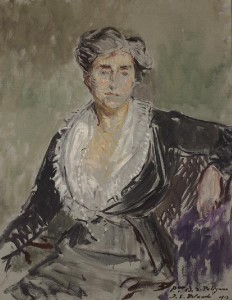
Winnaretta Singer
Credit: http://www.culture.gouv.fr/
I find it really fascinating that in the creation of Socrate, patron Princess de Polignac and composer Erik Satie (the former a confirmed lesbian, and latter suspected) choose to explicitly not include nor glamorize any of the texts reference of sex. Socrate is praised for it’s simplicity and striped down harmonies, it is quite unsexualized. This seems to match how Dorf describes Polignac’s presentation of herself to the world (Dorf 94)1.
“Her lesbian relationships and interests constituted a fundamental pillar of her identity; nonetheless, decorum and restraint were foremost, the prized virtues of the stoic Polignac.”
Dorf argues that it was considered Sapphonic at that time for women to be reading ancient Greek. In some circles, the focus was the poems of Sapphos, however, Princess de Polignac was said to read Greek for more philosophical reasons, which in itself is represented in the text setting. It seems the Princess de Polignac commission of the piece and the representation of her sexuality in this music is very subtle.
Although also being subtle, Poulenc’s representation in his early ballet’s is a little more daring. Moore2 describes a woman in Blue in Les Biches who is portrayed in men’s clothes, and therefore takes on an androgynous role. Moore precedes this with a description of Poulenc’s precedence to cross dress at costume parties.
Both authors make good arguments for the representation of Polignac’s and Poulenc’s sexuality in their respective works for tying aesthetics in their work to practices in their daily lives. It is difficult to tie the two together though. Although both make very distinct choices for the representation, many choices are made from experience, and although experience is formed by all parts of their lives, how can you definitively tie artistic choices to expressions of sexuality. I think it is particularly helpful to think about, especially when it was so taboo in French society at the time. How can art represent the whole of a person, even when they can’t express it outwardly?