The Arguments
The term “Sapphonics” can be defined as a theory of relationality for women in classical music (specifically opera,) but according to Wood it can also be used to describe an individual voice whose qualities represent “lesbian difference and desire,” and consequently affect lesbian/female listeners in particular ways (1). Both Dorf and Moore make arguments as to how Satie and Poulenc composed music with an awareness of this idea.
Both writers make some good arguments. Dorf argues that Socrate, composed by Erik Satie, is white, pure, antique, gentle, free, clear, classical, simple, modern, cubist, precise, and new. All of the descriptors correspond with the “feminine”. Dorf points out that in the piece “we get smooth quasi-plainchant vocal lines, and a much broader sense of fluidity. The infinite quality of the early works finds voice in Socrate as the women’s voices gently draw the listeners into an ancient and distant world […] (2).” Dorf goes on to suggest that the Princess du Polignac had a huge influence on the piece, and that she even sat down and helped Satie write it over dinners at her home.
Moore argues that Poulenc’s sexuality made him more in-tune with the ideas of Sapphonics. Poulenc used “camp aesthetics” to create work that corresponded with an “alibi” to hide what the work was truly about. Moore goes on to basically say that Poulenc was in tune with Sapphonics because he had to hide his sexuality and his gay desires. However, in Poulenc’s Les Biches, the female dancers wore pink (like peach tree flowers!), skin tight vests and shorts, and seduced the men they danced with (3).
Why I Question the Arguments
Firstly, I am highly skeptical of Dorf’s suggestions that Princess du Polignac actually helped Satie compose the piece. Yes, he does say that they called it “their” piece, but I have a hard time believing Satie, a famous and well-respected composer, would let a woman tell him what to do. My theory is that Satie called it “their” piece to appease the woman who was funding the whole operation. You have to keep the customer happy. Furthermore, Poulenc sexualized women a whole lot in Les Biches, as the dancers wore skimpy outfits and flaunted their bodies to men. This doesn’t seem to be very pro-female in my opinion. Poulenc portrayed taboo themes that sexualized and damaged the image of women way more than the image of men.
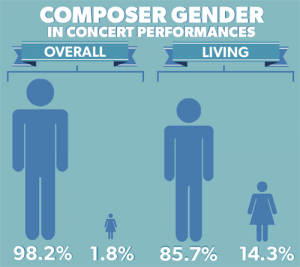
I think Dorf and Moore’s failure to point out that Satie and Poulenc had male privilege was their biggest misstep. Sapphonics is about the theory of rationality for women, not men, and because of their masculinity, I don’t think Satie and Poulenc could have ever really understood what the female experience truly was. As we have seen with Germaine Tailleferre, women, especially female composers, had to deal with a lot more shit (pardon my French) than men. Tailleferre was viewed by her gender first, long before she was ever viewed by the content of her compositions or the genius of her mind. She also had to deal with sexualization, as well as critics who questioned the legitimacy of her work because she was first and foremost female. Satie and Poulenc might have wanted to give off a more “woke” feminine vibe, but the fact that they were endorsing the ideas of women being gentle, simple, and hyper-sexual just explains how un-woke and unaware they really were. Poulenc was able to be flamboyant (he loved costume parties and being naked at them), yet critics and audiences still respected his work, unlike the homosexual Princess de Polignac, who had to show “restraint and decorum” in order to survive in Paris. It was an unfair and unjust system, and in my opinion (and as shown by the image below) this gender stereotyping still widely occurs in the field of music composition today.
Sources
- Wood, Elizabeth. “Sapphonics.” In Queering the Pitch: The New Gay and Lesbian Musicology, ed. Philip Brett, Elizabeth Wood and Gary C. Thomas, (New York: Routledge, 1994), 28.
- Dorf, Samuel. “Étrange n’est-ce pas?”: The Princesse Edmond de Polignac, Erik Satie’s Socrate, and a Lesbian Aesthetic of Music? Northwestern University, 2007.
- Moore, Christopher. “Camp in Francis Poulenc’s Early Ballets.” The Musical Quarterly, vol. 95, no. 2/3, 2012, pp. 299–342.