Like these two bros, Poulenc’s and Satie’s music aligned, at least outwardly, with heteronormative expectations.
By giving the music of Erik Satie and Francis Poulenc queer readings, Samuel Dorf and Christopher Moore use a largely unexplored lense to unearth greater insights to the works and perhaps the composer behind them. However, only Moore seals the deal by providing specific musical details that show the presence of camp in Poulenc’s works, and linking them to an expression of Poulenc’s homosexuality. Ultimately, the fact that Moore succeeds where Dorf does not may reveal a difference in how Poulenc and Satie thought about the relationship of their art to their sexuality.
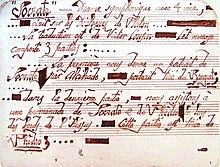
Samuel Dorf argues that in collaborating on Socrate, Erik Satie and his patron, the Princesse de Polignac, created a work that while not overtly sexual, could be heard with a lesbian aesthetic. Dorf emphasizes the Princesse de Polignac’s influence in creating the work. She originally wanted the text to be spoken by herself and her closest friends, hence the female voices, and worked closely with Satie on the libretto.1 However, Dorf doesn’t specify whether Satie, the actual composer of Socrate, was aware of or tried to contribute to a lesbian aesthetic. Perhaps Dorf would say Satie’s intent matters less than what Polignac and those in her circle heard. Regardless, Dorf’s account lacks specific musical evidence from Socrate, outside of its instrumentation, to fully support his queer reading.
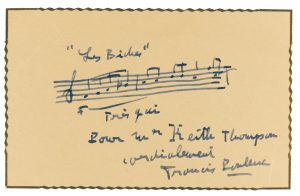
In contrast, musical excerpts and details abound in Moore’s article on camp in Francis Poulenc’s Les Biches and Aubade. Moore shows how the sweet, cloying theme of the Adagietto in Les Biches is “undone by music that betrays the artificiality of the character’s feminine stance.”2 Moore links the musical turbulence in Aubade with the turbulence in Poulenc’s own life of a rejected marriage proposal and a psychologically taxing affair. He argues that throughout Aubade, Diane’s unrest is characterized by chromatic passages, although she occasionally tries to adapt to the conventional tonality characteristic of her companions.3 By weaving details about Poulenc’s personal life with uncanny musical comparisons, Moore persuades that the two are linked.
However, Dorf’s difficulties perhaps point to an essential difference between how Satie and Poulenc expressed their sexuality through art. Moore suggests that for Poulenc, his queer identity was tied to his music making; it was “the expressive impulse that animated his musical works.”4 Camp was a way for him to honor this impulse while keeping his sexuality secret from the public sphere. In contrast, Dorf’s writing suggests that Satie seemed to want his sexuality completely separate from the public sphere, but also from his music, meaning Dorf perhaps had a more difficult task to begin with. While Moore makes a more convincing argument, both scholars provide insight into how composers were influenced by ideas about sexuality in 1920s Parisian culture.
References
1 Samuel Dorf, “‘Étrange, n’est-ce pas?’ The Princesse Edmond de Polignac, Erik Satie’s Socrate, and a Lesbian Aesthetic of Music?” FLS: Queer Sexualities in French and Francophone Literature and Film 34 (2007), 91.